Today · Jul 31, 2026
Churchill Downs Wants to Dump Nine Casinos. The Per-Key Math on Terre Haute Is Brutal.

Churchill Downs Wants to Dump Nine Casinos. The Per-Key Math on Terre Haute Is Brutal.

Churchill Downs just put nine regional casinos on the block, including a $290 million property that opened 26 months ago. The implied valuation gap between what they built and what they'll likely sell for tells you everything about where regional gaming capital is flowing next.

Churchill Downs is exploring the sale of nine regional gaming properties. The stock is down 25% over the past year. Trailing twelve-month EBITDA just hit a record $477 million for Q2 alone. Those three facts don't usually coexist in the same sentence unless someone is repositioning the entire capital structure.

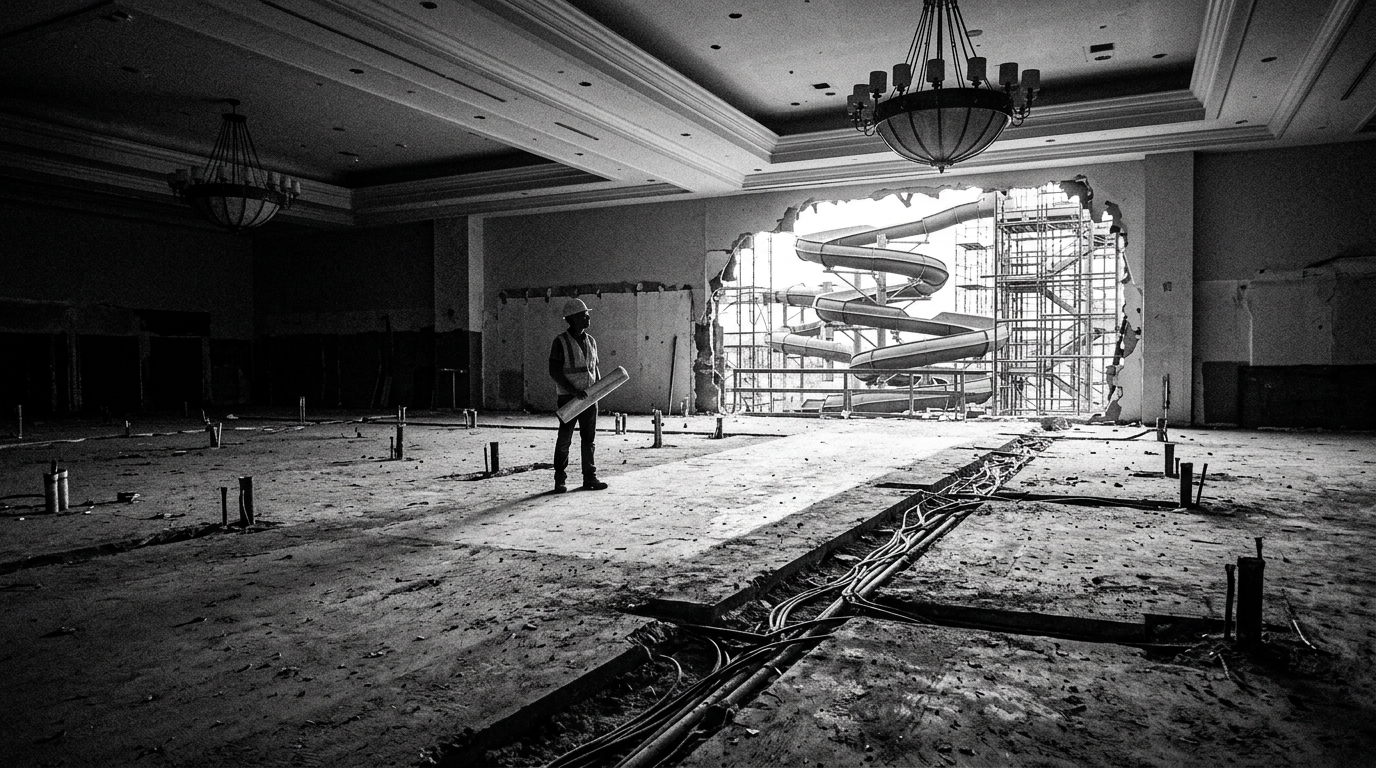
Let's decompose the one that matters most. Terre Haute Casino Resort cost $290 million to build. It opened in April 2024. It has 122 hotel keys. That's $2.38 million per key on the hotel component alone, except the hotel is the smaller piece of a mixed-use asset with 1,000 slots, 36 table games, five restaurants, six bars, and a sportsbook. The relevant metric isn't per-key... it's enterprise value relative to stabilized EBITDA, and we don't have a stabilized year yet because the property is barely two years old. Any buyer pricing this asset is buying a projection, not a track record. I've audited enough disposition models to know that a 26-month-old asset with no stabilized NOI baseline gets a risk premium that the seller doesn't want to talk about.

The strategic logic is clean on paper. CDI is signaling it wants to be a racing, wagering technology, and historical horse racing machine company. The United Tote reacquisition (announced the same day, restoring 100% ownership of its pari-mutuel wagering tech) and the capital projects at the flagship racetrack tell you where management sees margin and growth. Nine regional casinos in seven states, each with its own regulatory environment, labor market, and competitive dynamics, are the opposite of that thesis. They're capital-intensive, lower-margin, and they dilute the growth narrative that gets you a premium multiple. Stifel's $139 price target versus the current $83 tells you the analyst community already sees the sum-of-the-parts gap. The question is whether divestiture proceeds close it or confirm that the parts were never worth what the bull case assumed.

The buyer pool is the variable nobody's quantifying. Regional casino assets in secondary markets aren't trophy properties. Calder in Florida, Oxford in Maine, two Mississippi riverboat-era properties... these are steady-state cash generators at best. The buyer willing to pay a premium for Terre Haute is paying for Indiana gaming position, not for the hotel. The buyer interested in del Lago in upstate New York is buying into one of the most competitive and oversaturated gaming markets in the country. Each of these nine assets has a different risk profile, a different regulatory timeline for transfer, and a different competitive moat (or lack of one). Bundling them as a portfolio sale would require a buyer with appetite for geographic dispersion. Selling individually extends the timeline. Neither option is fast.

Here's what I'm watching. CDI reported record revenue and EBITDA while the stock sat 30% below its December peak. That disconnect usually means the market has already priced in the strategic pivot and is waiting for execution. If these nine properties sell at a combined multiple below 7x EBITDA, the divestiture confirms what the stock price is saying... these assets were dragging the blended multiple down. If they sell above 8x, CDI left money on the table by signaling the sale during a period of stock weakness. The earnings call today will matter more than the 8-K. Listen for how management frames stabilized EBITDA at the newer properties, particularly Terre Haute. That number, or the conspicuous absence of it, tells you everything about whether this is a position of strength or a concession.

Operator's Take

Here's what to do if you're running one of these nine properties or reporting to someone who is. First, understand you're now in a transition window where deferred decisions become someone else's problem... which means they become nobody's priority. Capital requests will stall. Brand investments will freeze. If you need something approved for Q4, get it in front of whoever's signing checks this week, not next month. Second, if you're an operator or management company watching from outside and thinking about bidding, run your pro forma against actual regional gaming comps in those specific markets, not against CDI's blended portfolio numbers. A 122-key casino hotel in Terre Haute, Indiana is not a Louisville asset. Price it like what it is. And third... if you're a GM at one of these properties, your best move right now is the same as it always is during a disposition: make the trailing 12 look as clean as possible. New owners inherit your P&L before they inherit your team. Make sure both are worth keeping.

— Mike Storm, Founder & Editor
Read full analysis → ← Show less
Source: Google News: Casino Resorts
Sands Burned $787M Buying Back Stock While Earnings Dropped 28%. That's a Choice.

Sands Burned $787M Buying Back Stock While Earnings Dropped 28%. That's a Choice.

Las Vegas Sands just posted a quarter where net income fell 28% and they missed EPS estimates by a mile, then turned around and bought back nearly $800 million of their own stock. If you're an operator watching a casino company prioritize Wall Street over property-level reinvestment, you've seen this movie before.

I worked with a resort operator years ago who used to say the most dangerous sentence in hospitality is "the underlying trends are strong." He said it sarcastically, every single time, because that's the sentence management teams use when the numbers on the page don't match the story they want to tell. Q2 was soft? Underlying trends are strong. Missed your targets by 30%? Underlying trends are strong. Your house is on fire? The underlying foundation is strong.

Las Vegas Sands just delivered one of the most "underlying trends are strong" quarters I've seen in a while. Net income dropped to $373 million from $519 million a year ago. That's a 28% decline. Diluted EPS came in at $0.53 against a consensus of $0.76... not a near-miss, a whiff. Consolidated adjusted property EBITDA fell 16% to $1.12 billion. And management's response was essentially: ignore the scoreboard, watch the game film. VIP rolling hold was unusually low in Macau ($87 million negative impact). The World Cup pulled high-value travelers away. If you adjust for those things, the quarter was actually fine. Maybe. But here's the thing about adjustments... every operator in this industry has learned that the quarter you actually lived through is the one that counts. Your debt service doesn't adjust for bad luck.

What gets me is the capital allocation. In the same quarter they missed earnings by that margin, Sands repurchased $787 million of its own stock. Over the last 11 quarters, they've bought back more than $6 billion worth... 16.3% of outstanding shares. And the board just authorized another $6 billion. Meanwhile, they're carrying $16 billion in weighted average debt, they're in the middle of a multi-year renovation of 2,900 rooms at The Venetian Macao (targeting Chinese New Year 2028), and they've got an $8 billion expansion underway at Marina Bay Sands that won't open until early 2031. The renovation and expansion are the right moves for long-term asset value. But when you're spending nearly $800 million in a single quarter buying your own stock while your operating performance is declining and you're carrying that kind of debt load and CapEx commitment... that's a choice about who you're running the company for. And the answer isn't the person changing sheets on the 14th floor.

The Macau segment tells an interesting story if you dig past the EBITDA line. Rolling volume was up 73% year-over-year. Non-rolling drop up 15%. Slot handle up 30%. Mass gross gaming revenue grew 8% against a market that only grew 4%. Those are real operating gains. The property teams in Macau are generating more activity, attracting more customers, and outperforming the market... and the reported EBITDA dropped 24% because the hold percentage on VIP play came in low. That's the brutal reality of the gaming business. Your team can do everything right and the math of a few high-rollers having a good night wipes it off the page. But it also means the people running those properties deserve better than having their quarter dismissed as a "miss" while the parent company redirects $787 million to shareholders who never checked in a guest.

Singapore remains the crown jewel. Marina Bay Sands generated $689 million in adjusted property EBITDA on its own... one property. Mass gaming revenues up 5%. But even there, the number was down 10% year-over-year. The $8 billion expansion (about $3 billion spent so far) is a five-year bet that Singapore's position as Asia's premium destination keeps strengthening. I think that bet is probably right. But "probably right" on an $8 billion commitment with $16 billion in existing debt and a stock buyback program running at this pace... that's a confidence level I'd want to see matched by operating performance, not excused by hold variance and the World Cup.

Operator's Take

Here's what this means if you're running an integrated resort or any large-scale property where ownership is publicly traded. When the parent company is spending $787 million a quarter buying back stock while missing earnings estimates, the pressure to improve operating margins is about to roll downhill to your P&L. That means labor scrutiny, CapEx deferrals on anything not guest-facing, and vendor renegotiations... all landing on your desk. If you're managing through a renovation cycle like the Venetian Macao teams are right now (2,900 rooms, years of disruption), document every dollar of displacement cost and every guest impact meticulously. When the next earnings call needs a better story, your renovation timeline is the first thing that gets compressed. Protect your timeline by making the data impossible to argue with. And if your property is delivering volume growth (occupancy, covers, gaming handle) while the reported numbers look soft because of factors outside your control... make sure your ownership group sees YOUR scorecard, not just the consolidated one.

Read full analysis → ← Show less
Source: Google News: Las Vegas Sands
Monarch Casino's 37% EBITDA Margin on $142.6M Revenue. Two Properties. Zero Debt.

Monarch Casino's 37% EBITDA Margin on $142.6M Revenue. Two Properties. Zero Debt.

Monarch Casino just posted a 20% net income jump and a 23.6% EPS beat on two regional gaming properties with no outstanding debt. For every REIT asset manager benchmarking portfolio efficiency, this is the comp that should keep you up tonight.

$142.6 million in net revenue, $53 million in adjusted EBITDA, $138.3 million in cash, zero borrowings. Two properties. That's Monarch Casino's Q2 2026. Let's decompose this.

The per-property math is what matters here. Monarch runs two assets (one in Reno, one in Black Hawk, Colorado) and generated $26.5 million in adjusted EBITDA per property in a single quarter. The 37.2% EBITDA margin tells you this isn't a revenue story dressed up to hide cost problems. Net income grew 20.4% year-over-year while revenue grew 4.2%. That's a 5:1 ratio of profit growth to revenue growth. The flow-through isn't just good. It's exceptional. And it happened while the company was actively investing in property enhancements and expanding convention capacity at its Reno asset.

The balance sheet is the quieter story and arguably the more important one. $138.3 million in cash with nothing drawn on the credit facility means Monarch is running two casino-resort properties with zero net debt. In an industry where operators routinely carry 4-5x leverage, that's not conservative. That's a strategic position. It means every dollar of EBITDA belongs to equity holders, not lenders. It means capital allocation is a choice, not an obligation. Stifel raised its price target to $128, noting no material impact from macro uncertainty. Of course there's no material impact. When you have no debt service and $138 million in cash, macro uncertainty is someone else's problem.

The F&B and hotel revenue growth deserves a closer look. Management attributed it to increased available rooms at the Reno property and expanded group business. That's organic growth from existing capacity, not acquisition-driven top line. I've analyzed dozens of gaming portfolios where revenue growth required new supply or new markets. Monarch grew revenue by making its existing footprint work harder. The convention and group business strategy is particularly telling because it drives mid-week occupancy (the perennial weakness in leisure-heavy casino markets) without diluting weekend rate integrity.

One footnote the earnings release doesn't emphasize: the $74.6 million construction litigation judgment with a general contractor over the Black Hawk expansion. That's sitting on the books. It's a meaningful number against a $138 million cash position. The company is presumably appealing, and the legal process will take time, but any investor modeling Monarch's cash position forward needs to haircut for that contingency. The balance sheet looks pristine. It's slightly less pristine than the headline suggests.

Two properties. 37% margins. Zero debt. Growing market share in both locations. This is what concentrated operational focus looks like when the operator actually owns the outcome. The question for every multi-property portfolio manager is simple: are any of your assets running at this efficiency? If not, the gap between your margin and Monarch's margin is the cost of complexity you haven't quantified.

Operator's Take

Here's what Monarch is doing that most operators aren't: they're growing profit five times faster than revenue. That's not magic. That's flow-through discipline on a clean balance sheet. If you're running a casino-resort or a full-service property with F&B and group business, pull your Q2 numbers right now. Calculate your EBITDA margin. If you're below 30%, figure out where the gap lives... is it labor, is it F&B cost of goods, is it deferred maintenance creating operational drag? Then look at your debt service as a percentage of EBITDA. Monarch's is zero. Yours probably isn't. But knowing that number is the difference between running a business and being run by one. This is what I call the Flow-Through Truth Test... Monarch's 4.2% revenue growth turning into 20.4% net income growth tells you exactly how much of each incremental dollar is reaching the bottom line. Run that same test on your property. The answer will either make your day or ruin your week. Either way, you need it.

— Mike Storm, Founder & Editor
Read full analysis → ← Show less
Source: Google News: Casino Resorts
Terrible's Reopened Primm Valley in 17 Days. That Speed Tells You Everything About the Bet.

Terrible's Reopened Primm Valley in 17 Days. That Speed Tells You Everything About the Bet.

A gas station company just took over a casino resort that was bleeding $10-15 million a year and had it open in under three weeks. The question isn't whether they can run a hotel... it's whether they even need to.

Available Analysis

I once watched a new management company take over a 280-room resort property after the previous operator walked away. They spent four months on "transition planning." Hired consultants. Built timelines. Had meetings about the meetings. By the time they actually opened the doors, half the staff that stayed through the transition had already found other jobs.

Terrible's just took over Primm Valley Casino Resort and reopened it in 17 days.

Let that operational reality sink in for a minute. They got regulatory approval on June 25th, took control of the casino properties on July 5th, and had guests checking in by July 22nd. Two hundred fifty rooms. Over 400 gaming machines. A sportsbook. Food and beverage. Seventeen days from keys-in-hand to doors-open. That's not a hotel company timeline. That's a convenience store operator who understands that every day a property sits dark is a day you're paying fixed costs against zero revenue. And here's the thing... they're not wrong.

The backstory matters. Affinity Gaming (the previous operator) called these properties "obsolete" and said the ground lease economics made the whole thing unviable. They reported $10-15 million in annual cash drain. That's a staggering number for a property that's essentially a highway stop between LA and Vegas. But here's what nobody's asking... how much of that cash drain was operational inefficiency versus structural economics? Because the Herbst family (they own Terrible's) ran these exact same properties from 2007 to 2010 after buying them from MGM for $400 million. They know the building. They know the market. They know where the bodies are buried in the P&L. And they came back anyway, this time on a management agreement with the Primm family landowners instead of carrying $400 million in acquisition debt. That's a very different risk profile. No resort fees. Honoring old loyalty tiers. Three hundred jobs preserved. This isn't a bet on the hotel business. This is a bet on the corridor... on gas, on convenience retail, on capturing the traveler who needs to stop anyway and might pull a slot handle while they're at it.

The real tension here is between what Primm used to be and what Terrible's is actually building. Twenty years ago, before California tribal gaming exploded, Primm was a legitimate destination... rollercoasters, outlet malls, headliner entertainment. That world is gone. The Southern California gambler who used to drive to Primm now drives 20 minutes to a tribal casino with a newer building and better restaurants. Terrible's isn't trying to resurrect 1998. They're building a travel center with a casino attached, and the hotel rooms are there to serve the corridor traffic, not to compete with the Strip. That's a fundamentally different business model than what Affinity was trying (and failing) to run. Whether it works depends entirely on whether you can operate a 250-room casino resort at a cost structure that matches highway-stop economics instead of destination-resort economics. The Herbst family's background in gas stations and convenience retail actually makes them better positioned for that model than a traditional gaming operator would be.

What I'm watching is the phased approach. They opened with 250 of what I'd guess is a much larger room inventory. Limited F&B. No mention of the other two properties (Whiskey Pete's and Buffalo Bill's) reopening anytime soon. That's discipline. Don't open what you can't staff, don't staff what you can't fill, don't spend what you can't recover. I've seen too many operators try to reopen everything at once after a transition and drown in labor costs against half-occupied buildings. Terrible's is opening one property, seeing what the demand actually looks like, and presumably scaling from there. That's an owner's mentality, not a management company's mentality. And on a management agreement with no acquisition debt? The breakeven on this is probably shockingly low.

Operator's Take

If you're running a property in a secondary or tertiary market that competes against a structural disadvantage (newer supply, a shifted demand pattern, a market that moved on), pay attention to what Terrible's is doing here. They're not trying to be what this property used to be. They're rebuilding the operating model around what the corridor actually supports today. That's the lesson. I've seen too many operators pour renovation money into a property trying to recapture 2006 when the market has permanently shifted. Before you spend a dollar on repositioning, answer this honestly... are you building for the guest who's coming, or the guest you wish was still coming? If your owner is sitting on a property that a previous operator called "unviable," get them the real numbers on what a stripped-down, right-sized operation actually costs to run. The building isn't always the problem. Sometimes it's the cost structure everyone assumed had to come with it.

Read full analysis → ← Show less
Source: Google News: Casino Resorts
700 Jackpots a Day. That's Not Luck. That's a Marketing Budget.

700 Jackpots a Day. That's Not Luck. That's a Marketing Budget.

Thunder Valley Casino Resort is averaging a jackpot every two minutes and publicizing every six-figure win like it's breaking news. The interesting part isn't who's winning... it's what that payout frequency tells you about how modern casino resorts are buying attention in a market where every regional competitor is fighting for the same drive-in customer.

I worked with a casino resort GM once who told me something I never forgot. He said, "Every jackpot over $50,000 is a billboard I didn't have to buy." He wasn't being cynical. He was being honest about how the business works. The house edge pays for the property. The jackpots pay for the marketing.

Thunder Valley Casino Resort outside Sacramento is running about 700 jackpots a day right now. One every two minutes across their 3,000-plus slot and video machines. They've been pushing out press releases on every significant hit like clockwork... $409,000 on back-to-back Buffalo Link spins in June, $261,000 on Pai Gow the same month, $679,000 on a Dragon Link machine back in April from a $25 bet. The cadence isn't accidental. This is a property that has invested over $100 million in a concert venue, $56 million in a gaming floor expansion, just opened a private VIP lounge inside their entertainment space, and is now using jackpot announcements as free earned media to drive traffic to all of it. It's a 408-key integrated resort owned by the United Auburn Indian Community, and they're playing the attention game as well as anyone in regional gaming right now.

Here's what most hotel-side people miss about casino resort operations. The rooms aren't the product. The rooms are the container that keeps the customer on property long enough for the real revenue engine (the floor) to do its work. That $120,000 Pai Gow jackpot from July 10th costs Thunder Valley real money, sure. But it generates a news cycle that reaches every potential drive-in customer within 150 miles of Lincoln, California... which is Sacramento, which is a metro of 2.4 million people. You cannot buy that kind of hyper-local awareness for what a single jackpot costs. The math on earned media impressions versus payout is absurdly favorable for the house.

The broader play here is what the tribal and regional casino industry has figured out that a lot of traditional hotel operators still haven't. Amenity investment (the concert venue, the VIP lounge, the spa, the dining) creates reasons to visit that aren't purely gaming. But the gaming floor bankrolls all of it. And the jackpot publicity machine is the connective tissue... it keeps the property in the news feed constantly without buying a single ad impression. Thunder Valley is on pace to exceed last year's total jackpot payouts, which means they're either running hotter progressive pools, adjusting their floor mix, or both. Either way, someone in that building made a deliberate decision about how much of their hold to cycle back through high-visibility payouts. That's not luck. That's strategy.

What I find interesting is the timing. Regional casinos are seeing growth right now partly because consumers facing economic uncertainty are choosing closer-to-home entertainment. The tribal gaming segment is projected to grow at nearly 9.5% annually through 2031. Thunder Valley is positioning itself to capture that wave not just with facility investment but with a publicity strategy that makes the property feel alive, generous, and worth the drive. If you're running a hotel or resort within their competitive radius and you're wondering why your weekend occupancy isn't what it used to be... this is part of the answer. They're not just competing for the gaming customer. They're competing for the entertainment dollar, the date night dollar, the "let's do something this weekend" dollar. And they're winning that conversation one press release at a time.

Operator's Take

If you're running a hotel or resort property anywhere in the Sacramento metro or Northern California leisure corridor, understand what you're competing against. Thunder Valley isn't just a casino... it's a 408-key integrated resort with a 5,000-seat concert venue, a new VIP entertainment lounge, and a marketing machine that generates free media coverage every time someone hits a six-figure jackpot. That's multiple times a month. You're not going to out-spend them. What you can do is define exactly what experience you offer that they don't... and make sure your marketing actually says it. Look at your weekend package strategy and your entertainment programming. If your answer to "why should someone spend Saturday night with us instead of driving to a casino resort?" is "we have a nice pool," you need a better answer. Get specific about your value proposition against integrated resort competitors. Have that conversation with your revenue team this week, not next quarter.

Read full analysis → ← Show less
Source: Google News: Casino Resorts
Wynn's Revenue Is Up. Their Margins Are Shrinking. That's the Story Nobody Wants to Tell.

Wynn's Revenue Is Up. Their Margins Are Shrinking. That's the Story Nobody Wants to Tell.

Wynn Resorts posted $1.86 billion in Q1 revenue, up nearly 10% year-over-year, and Wall Street responded by hammering the stock to a 52-week low. When your top line grows and your bottom line can't keep pace, the problem isn't the market... it's what you're spending to stay in it.

Available Analysis

I sat in a budget meeting once with a casino GM who was absolutely beaming about his revenue numbers. Best quarter in three years. Food and beverage was up. Gaming was up. Hotel rooms were up. His regional VP leaned back in his chair and said, "So why is your flow-through worse than last year?" The room went quiet. Because the GM had been buying that revenue... promotional spend, comps, staffing up for events that looked great on the top line and bled margin on the way down. Revenue is vanity. Margin is sanity. That GM learned it that day. Wynn's shareholders are learning it right now.

Look at the numbers. Wynn posted $1.86 billion in Q1 2026 revenue, up $156 million from the prior year. Net income improved to $120.5 million from $72.7 million. Sounds like a win, right? Except the stock just hit a 52-week low of $93.38 and is down 21% year-to-date. Zacks downgraded them to strong sell. Goldman and JPMorgan are trimming price targets. The market is telling you something the press release isn't... Wynn's adjusted property EBITDAR only moved from $532.9 million to $562.4 million on that $156 million revenue gain. That's roughly 19 cents of every new revenue dollar making it to EBITDAR. For a luxury operator, that flow-through number should make you wince.

The Macau story is where this gets really instructive for anyone running a hotel in a competitive market. Macau's overall gross gaming revenue is up 10.9% through five months of 2026. Sounds healthy. But GGR per visitor is down 2%, and hotel rates are signaling weak summer demand. What does that tell you? More people are coming, spending less per visit, and operators are fighting harder for each dollar. Wynn Palace saw revenues jump $123 million to $659 million... but Wynn Macau was flat at $330 million, and Encore Boston Harbor actually declined. When your flagship grows and your other properties stall or shrink, you're concentrating risk, not building a portfolio. And the promotional spending required to maintain share in Macau is compressing everyone's margins. Sands and Galaxy are getting more aggressive. The premium customer base isn't growing as fast as the supply chasing it.

Here's what I find most telling. Wynn is spending its way into future markets... $3.9 billion on Al Marjan Island in the UAE, $2.2 billion committed to non-gaming amenities in Macau over the next decade... while carrying $10.63 billion in total debt. That's not inherently wrong. First-mover advantage in a new regulated gaming market like the UAE could be enormous. But it's a massive bet that requires your existing cash flows to stay healthy while you're building the next thing. And those existing cash flows are getting squeezed by competition in Macau, a slight softening in Las Vegas (visitation was down 2% in April even as gaming revenue spiked 6.5% on baccarat... meaning fewer people spending more, which is not a sustainable trend), and a declining Boston property. The revenue is growing. The cost of earning that revenue is growing faster. That's the movie.

This isn't unique to Wynn. This is the pattern I've watched play out at every level of hospitality when a market matures and competition intensifies. The top line looks fine. Sometimes it looks great. But underneath, you're running harder to stay in place. More promotional spend. More capital investment to maintain positioning. More aggressive pricing from competitors who are willing to sacrifice margin for share. And the ownership... whether it's a public company's shareholders or the guy who signed the personal guarantee on a 200-key select-service... eventually asks the question that GM heard in that budget meeting: where's the money going?

Operator's Take

If you're running a hotel property (any tier, any market) where your revenue is growing but your GOP margins are flat or declining, stop celebrating the top line and start auditing the cost of achieving it. This is what I call the Flow-Through Truth Test. Pull your last four quarters. Calculate how much of every incremental revenue dollar actually reached operating profit. If it's under 40 cents for a full-service property or under 50 cents for select-service, you have a cost-of-revenue problem that will eat you alive in any softening. Look specifically at promotional spend, OTA commissions, and any loyalty-program-driven rate discounting... those are the three places revenue "growth" most often hides margin destruction. Bring your owner the flow-through analysis before they see the revenue number and assume everything's fine. The operator who presents good news and bad news together is the one who keeps the management contract when things get tight.

Read full analysis → ← Show less
Source: Google News: Wynn Resorts
Caesars Just Spent $270K Per Key Rebranding a Casino Hotel. The Tech Under the Hood Matters More Than the Lobby.

Caesars Just Spent $270K Per Key Rebranding a Casino Hotel. The Tech Under the Hood Matters More Than the Lobby.

Caesars Republic Lake Tahoe's $200M transformation is being pitched as a luxury lifestyle destination play, but the real question is whether the technology infrastructure behind 742 renovated rooms can actually deliver what the celebrity chef restaurants and design-forward lobby are promising.

So Caesars just finished a $200 million gut-renovation of the old Harveys Lake Tahoe... 742 rooms, new celebrity chef restaurants, redesigned casino floor, the whole deal. And look, the renderings are beautiful. The brand partnerships are impressive. Gordon Ramsay, Lisa Vanderpump, Clique Hospitality. That's a lot of star power pointed at a single property on the Nevada-California border.

But here's what actually interests me about this project, and it's not the lobby or the pool deck. It's the operational technology problem hiding behind all that $270K-per-key polish. You're taking a building that was originally Harveys... a property with decades of legacy infrastructure, legacy PMS configurations, legacy integrations... and you're asking it to function as a "design-forward luxury destination" that connects via indoor corridor to an adjacent Harrah's property with its own systems, its own loyalty stack, its own everything. That's roughly 1,250 combined rooms across two properties that need to talk to each other, share guest profiles, coordinate rewards redemption, and deliver a seamless (there's that word I hate) experience across what is functionally two different technology ecosystems bolted together by a hallway. I've consulted with a resort group that tried exactly this kind of dual-property integration. They spent 14 months getting the two PMS instances to sync guest profiles correctly, and even then the loyalty point redemption broke every time one property ran night audit before the other. Fourteen months. And these were newer systems.

The technology question nobody's asking is this: what does the guest experience actually look like when someone checks into the Republic side, walks through the corridor for dinner at Hell's Kitchen on the Harrah's side, charges it to their room, and expects their Caesars Rewards to track the whole thing? That workflow touches the PMS, the POS, the loyalty platform, the billing integration, and probably two separate property management teams. If any one of those handoffs fails... and at 2 AM with minimal staff, handoffs fail... you've got a guest standing at a restaurant host stand wondering why their room charge isn't working while a line cook is plating $65 beef Wellingtons. The guest doesn't care about your $200 million renovation at that moment. They care that the system is broken.

What's actually interesting strategically is the timing. Caesars is in the middle of being acquired by Fertitta Entertainment for roughly $17.6 billion, with Carl Icahn reportedly throwing a competing $33-per-share bid in right before the go-shop period ended on July 11. So this property is completing its transformation at exactly the moment when the company's future ownership is being decided. Whoever ends up running Caesars is inheriting a $200M capital deployment that needs to generate returns in a regional market facing structural headwinds from Northern California tribal properties. The technology infrastructure decisions being made right now... the integrations, the vendor selections, the systems architecture connecting these two properties... those are the decisions the next owner is going to be living with for 10 years. And those decisions are being made during an acquisition limbo where nobody knows who the boss will be in six months. That's not a great environment for long-term technology planning.

Look, I'm not saying the renovation is wrong. The Lake Tahoe market probably does need a higher-end casino resort option, and the celebrity F&B strategy generates press and drives trial. But the gap between "beautiful new lobby" and "operationally integrated dual-property technology platform that actually works" is enormous, and it's the gap where guest experience goes to die. Would this technology stack survive the Dale Test... could one person on the overnight shift troubleshoot a billing integration failure between two connected properties running different system configurations? That's the question. And nobody in the press release is answering it because nobody in the press release has ever worked a night audit at a dual-property casino resort where the corridor connection means your problems are literally someone else's problems too.

Operator's Take

If you're running a property that's gone through (or is about to go through) a major renovation and rebrand, here's the thing I want you drilling into right now: your technology integration timeline is not your construction timeline. I've seen this movie before. The rooms look gorgeous on day one. The systems work correctly by month six. That five-month gap is where you lose guests and reviews you'll spend a year trying to recover. Before you cut the ribbon, run a full end-to-end test of every guest-facing transaction across every system touchpoint... room charge, loyalty redemption, POS integration, mobile key, the works. Do it at 2 AM with your thinnest staffing level. Whatever breaks, that's your real punch list. The paint can wait. The technology can't.

— Mike Storm, Founder & Editor
Read full analysis → ← Show less
Source: Google News: Casino Resorts
A $5 Bet Paid $203,800. The Real Winner Was the Casino's Marketing Department.

A $5 Bet Paid $203,800. The Real Winner Was the Casino's Marketing Department.

Thunder Valley paid out over $600K in jackpots across one holiday weekend and turned every single one into a press release. If you run a casino resort, you already know why... and if you run a hotel competing with one, you need to understand the math working against you.

I worked as a casino resort GM years ago and I kept a whiteboard in my office tracking every jackpot over $50K. Not because I was worried about the payouts. Because I was tracking the earned media value. Every six-figure hit generated local news coverage, social media posts from the winner's friends and family, and a lobby full of people who suddenly believed tonight was their night. It was "the cheapest billboard in the business."

Thunder Valley Casino Resort outside Sacramento dropped three jackpots totaling north of $611,000 over the Fourth of July weekend. A $203,800 win on a $5 Monopoly progressive. A $217,463 hit on another $5 Buffalo Link bet. A $190,700 payout on a $50 Red Fortune spin. The casino's GM put out a statement about how "extraordinary" and "unforgettable" the weekend was. And I'm sure it was... for the marketing team most of all.

Here's what the press release wants you to feel: anybody can win big on a $5 bet. Here's what the operating data tells you: Thunder Valley runs 3,500 slot machines and pays out nearly 700 jackpots a day. Those progressives are funded by the aggregate of every losing spin across the network. The house edge on slots runs 5-15% depending on the machine. Three six-figure jackpots over a holiday weekend at a property doing that kind of volume isn't extraordinary. It's statistical inevitability dressed up as a miracle. And every news outlet that runs the story is providing free advertising that would cost six figures to buy.

This is a masterclass in something most hotel operators never think about but should... the difference between marketing that costs you money and marketing that makes you money while it markets. These casinos understand that a jackpot story generates more bookings, more F&B spend, and more gaming revenue than any ad campaign they could run. Sky River Casino had a $142K winner in April. Hard Rock Sacramento had a $116K hit in June. Every single one got a press release. Every single one got local TV coverage. The Sacramento market alone has produced half a dozen of these stories in the last 90 days. That's not luck. That's a PR strategy built into the gaming floor's mathematics.

For non-gaming hotel operators competing in markets with casino resorts... and that's an increasing number of markets... this is the competitive reality. Your competitor has a built-in content engine that generates shareable, emotional, aspirational stories every single week. Stories that put heads in beds and bodies in restaurants. You're buying Google Ads at $4 a click. They're getting the Sacramento Bee to run their advertising for free. Understanding that asymmetry won't fix it, but it should change how you think about your own earned media strategy. What's YOUR version of the jackpot story? What happens at your property that's worth a local reporter's time? If you don't have an answer, that's the first problem to solve.

Operator's Take

If you're running a hotel in a market with casino competition, stop thinking about jackpot stories as gaming news and start thinking about them as a marketing gap analysis. Every one of those headlines drives room nights to properties that aren't yours. Your move isn't to compete with the jackpot... it's to build your own earned media engine. Talk to your local newspaper's lifestyle editor this week. Find the story at your property that writes itself... a 20-year employee, a guest who comes back every anniversary, a chef doing something nobody else in the market is doing. Casinos generate roughly 700 shareable moments a day just by existing. You need to manufacture yours deliberately. One genuine local story per month that gets picked up is worth more than your entire digital ad budget. I've seen properties triple their local press coverage just by assigning someone to pitch one story a week. It costs nothing but intention.

Read full analysis → ← Show less
Source: Google News: Casino Resorts
A Casino Town Went Dark on the Fourth of July. 300 Families Are Waiting for the Lights.

A Casino Town Went Dark on the Fourth of July. 300 Families Are Waiting for the Lights.

Primm Valley Casino closed for a transition between operators and missed its own reopening date, leaving a border town and 300-plus employees in limbo. If you've ever managed a property through an ownership change, you already know the part nobody's talking about.

Available Analysis

I've seen this movie before. Different property, different state, different decade... but the same plot every time. An operator decides a property is bleeding too much cash, announces they're walking away, and somewhere between the press release and the key handover, a whole community holds its breath.

Primm, Nevada... that little cluster of casino resorts on I-15 between LA and Vegas... just lived through it. Affinity Gaming said back in May they were done. Permanently closing. Three hundred and forty-four people were about to lose their jobs on Independence Day. Then a last-minute deal with the Herbst family's Terrible's operation came together in June. Gaming regulators approved it on the 25th. Terrible's officially took over on July 1st. And here we are on the Fourth of July... the gas stations are open, the lotto store is open, but the casino itself? Closed. No reopening date announced. Three hundred families sitting there wondering if the lifeline is real or if they just traded one kind of uncertainty for another.

Here's what the headlines don't capture. When a property goes through a transition like this, the building doesn't just need a new sign and a fresh set of keys. It needs licensing approvals, vendor contracts renegotiated, system migrations, staffing decisions, and about a hundred operational details that don't show up in a press release but absolutely show up at 2 AM when someone needs to make a decision and doesn't know who they report to anymore. I managed through an operator transition once at a property about half this size. Even with a clean handoff and cooperative parties on both sides, it took weeks before the team stopped looking over their shoulders. The org chart said one thing. The culture hadn't caught up yet. People were doing their jobs but nobody felt safe. That feeling... it's invisible on paper and it's the only thing that matters on the ground.

The backstory here is worth understanding. This corridor used to be the last gambling stop before the California line, and it thrived on that geography. Then tribal casinos expanded across Southern California, Vegas kept building bigger and shinier attractions to the north, and Primm got squeezed from both directions. MGM sold these properties to Herbst Gaming (which became Affinity) back in 2007 for $400 million. Four hundred million. Affinity's own CEO recently told the Gaming Control Board that Primm was "just not viable as a casino operation." So now the Herbst family is back... different entity, different deal structure, this time as operator rather than owner... and the Primm family retains the land. That's a meaningful distinction. When the family that owns the dirt and the family that runs the operation are different people with different risk profiles, the alignment question becomes everything. The operator can walk away (Affinity just proved that). The landowner can't. They're the ones whose name is on the town.

Look... I hope this works. I genuinely do. Three hundred jobs in a place like Primm isn't a labor statistic. It's the entire community. There are employee apartments on site. These are people whose homes and livelihoods exist because that casino operates. But hope isn't a business plan. The competitive dynamics that made Affinity quit haven't changed. The tribal casinos in California aren't getting smaller. Vegas isn't getting less attractive. Whatever Terrible's has in mind for reinvention, it has to be something fundamentally different from what failed before... because the old model of being a pit stop with slots didn't survive and it won't survive just because the name on the management agreement changed. The question isn't whether they can reopen. It's whether they can reopen as something that's actually viable for the next decade, not just the next quarter.

Operator's Take

If you've ever managed a property through an operator transition... or you're about to... here's what I want you to focus on. Your staff is scared. Period. They've been told their jobs are saved and they're watching the building sit dark on a national holiday. That gap between "saved" and "actually working a shift in a functioning operation" is where you lose your best people. The ones with options leave first. You keep the ones who can't afford to leave, and then you're rebuilding a team from a weaker bench. If you're anywhere near a situation like this, the single most important thing you can do right now is communicate. Obsessively. Even when there's nothing new to say, say that. "No update yet, but you still have a job and here's when I'll know more." Silence is where rumors breed, and rumors are what drive your best housekeeper to take that offer across town.

Read full analysis → ← Show less
Source: Google News: Casino Resorts
A Munich Fund Dumped Half Its Sands Shares. Nobody on Your Property Should Care.

A Munich Fund Dumped Half Its Sands Shares. Nobody on Your Property Should Care.

Assenagon Asset Management cut its Las Vegas Sands position by 50% in Q1, and the financial press treated it like news. For anyone actually running a casino resort or hospitality operation, the signal here isn't about LVS... it's about learning which Wall Street noise to ignore and which to act on.

I worked with a GM years ago who had a ritual every Monday morning. He'd pull up whatever the financial press was saying about his parent company's stock, read the headlines, then close the browser and say "okay, now what actually matters today?" He wasn't being dismissive. He was protecting his attention. Because the moment you start running your operation based on what a fund manager in another country did with a stock position three months ago, you've lost the thread.

That's what this story is. Assenagon Asset Management, a $66 billion fund out of Munich, sold roughly 575,000 shares of Las Vegas Sands during Q1 2026. Cut their position in half. Sounds dramatic until you realize their remaining stake was worth about $30.5 million... which is a rounding error for a fund that size. They also trimmed positions in Zoom and other holdings during the same quarter. This wasn't a verdict on LVS. This was portfolio housekeeping. The kind of thing institutional investors do every quarter because that's literally their job.

Meanwhile, in the actual business... LVS posted $3.58 billion in revenue for Q1, up 25.3% year over year. Beat earnings estimates at $0.91 per share. Their entire operation is now concentrated in Macau and Singapore, which are two of the highest-barrier, highest-margin gaming markets on the planet. You can have legitimate strategic questions about regulatory risk in Macau, about the pace of premium-mass recovery, about whether the MICE business in Singapore sustains at current levels. Those are real conversations worth having. But "a German fund rebalanced its portfolio" isn't one of them.

Here's what bugs me about these stories showing up in hospitality feeds. They train operators to react to the wrong signals. I've seen this movie before... some institutional holding change gets reported as if it reveals something fundamental about the company, and suddenly a regional VP is fielding questions from an ownership group who read a headline on their phone at dinner. The stock is actually up almost 14% over the past year. UBS trimmed their price target from $69 to $62 but kept a neutral rating. Analysts still have it as a moderate buy. None of this is a crisis. None of this is even particularly interesting unless you're managing a portfolio of equities, which... you're not. You're managing a hotel.

The skill that separates good operators from reactive ones is knowing which information deserves your energy. A 13F filing from a European asset manager doesn't make that list. Your comp set performance does. Your flow-through does. Your staffing plan for the Fourth of July weekend (which is next week, by the way) does. Spend your attention there.

Operator's Take

Let me be direct. If you're running a property affiliated with a publicly traded company... LVS, Marriott, Hilton, any of them... you're going to see institutional trading stories pop up in your news feeds. Funds buy. Funds sell. That's what funds do. Your job is not to interpret Wall Street tea leaves. Your job is to run the building. If an owner or board member brings this up, the correct response is: "Their Q1 revenue was up 25% and they beat earnings. The fund rebalanced across multiple positions. It's not a signal about our operations." Say it calmly, say it once, and then pivot to the thing that actually needs their attention... because there's always something that actually needs their attention.

Read full analysis → ← Show less
Source: Google News: Las Vegas Sands
Ilitch Just Bought the Rest of Ocean Casino. The Real Play Is What Comes After.

Ilitch Just Bought the Rest of Ocean Casino. The Real Play Is What Comes After.

A family that built its gaming empire one property at a time just launched a multi-state platform by taking full ownership of Atlantic City's third-highest-grossing casino. The question isn't whether they can run it... it's whether consolidating three casinos under one roof changes the math for every operator competing against them.

Available Analysis

I watched a family ownership group try to build a multi-property gaming platform once. They had one casino that printed money, bought a second that needed work, and then went after a third before the second one was stabilized. The CEO kept saying "platform" in every meeting like it was a magic word. It wasn't. They spent three years trying to centralize procurement and loyalty programs across properties that had nothing in common except the same last name on the ownership docs. The platform never materialized. What they actually built was a holding company with a nice logo.

That story keeps running through my head as I read about Ilitch Gaming. Look... the bones of this deal are solid. The Ilitch family put $175 million into a 50% stake in Ocean Casino back in 2021, and the property has responded. Ocean did $46.8 million in revenue last month, good for third in New Jersey behind Borgata and Hard Rock. That's a property that was built as Revel for $2.4 billion, went through bankruptcy, changed hands, nearly died, and is now a legitimate performer. The Ilitch involvement clearly helped. Taking out Luxor Capital's remaining 50% and going to full ownership is a logical move when the asset is performing and you want operational control. I get it. I'd probably do the same thing.

What makes this interesting (and what the press release glosses over) is the formation of "Ilitch Gaming" as a unified platform across MotorCity Casino Hotel in Detroit, Ocean in Atlantic City, and the pending acquisition of Scarlet Pearl in Mississippi. Three properties. Three states. Three regulatory environments. Three completely different markets and customer bases. Detroit is a locals market. Atlantic City is a destination and regional market fighting for share against six or seven other casinos on the same boardwalk. D'Iberville, Mississippi is... well, it's Gulf Coast gaming, which is its own animal entirely. The operational connections between these three properties are not obvious to me. Shared procurement? Maybe on some commodity items. Shared loyalty? Possible but expensive to build and the customer overlap between a Detroit locals casino and an Atlantic City resort is minimal. Shared management talent? That's the one that actually has teeth... if you have a deep enough bench, which takes years to build.

Here's what I've seen over and over again. The word "platform" gets used to justify the acquisition price of property number two and three. "We're not just buying a casino... we're building a platform." That sentence has been uttered in more boardrooms than I can count. Sometimes it's real. Sometimes it's a story the buyer tells themselves to rationalize paying full price for an asset they want. The difference between a real platform and an expensive hobby is execution at the property level. Can the GM at Ocean pick up the phone and get a decision made faster now that Luxor Capital isn't involved? Can the team in Mississippi benefit from something the Detroit team already figured out? Those are the questions that determine whether "Ilitch Gaming" is a platform or a portfolio. And the answers won't show up for 18 to 24 months.

The part of this that operators in Atlantic City should actually pay attention to is simpler than platform strategy. Full ownership means faster capital decisions. No more joint venture negotiations on every renovation, every F&B concept change, every technology upgrade. When one family controls 100% of a 1,860-key casino resort doing nearly $50 million a month, and they have a track record of investing in their properties (MotorCity opened in 1999 and has been well-maintained ever since)... that's a competitor who just got more dangerous. Not because they got bigger. Because they got faster.

Operator's Take

If you're running a casino hotel in Atlantic City or on the Gulf Coast, this is worth 15 minutes of your time this week. Full ownership means the Ilitch team can now move capital into Ocean without negotiating with a hedge fund partner on every decision. That changes their speed. Look at your own competitive position honestly... where are you slower than you should be because of ownership structure, brand approvals, or committee decisions? The operators who win in competitive markets aren't always the ones with the most money. They're the ones who can deploy it fastest. If you're in a JV or management agreement that requires three signatures to approve a $200K lobby renovation, this is a good week to think about whether that structure is costing you more than it's saving you.

Read full analysis → ← Show less
Source: Google News: Casino Resorts
Monarch's CEO Sold $604K in Stock the Day After Hitting an All-Time High. The Timing Is Interesting.

Monarch's CEO Sold $604K in Stock the Day After Hitting an All-Time High. The Timing Is Interesting.

Monarch Casino & Resort just posted record Q1 numbers and its stock touched $121.87. Then the CEO sold 5,000 shares the next day. The 8-K filing is routine, but what's underneath it tells you something about how family-controlled casino operators think about capital... and what tech-forward operators should be watching.

So here's a filing that most people will scroll past. Monarch Casino & Resort dropped an 8-K on May 27 covering its annual stockholder meeting... director elections, advisory vote on executive comp, the usual SEC compliance stuff. Standard. Boring. Except buried in the context around this filing is a data point that caught my attention: CEO John Farahi sold 5,000 shares the day after MCRI hit an all-time high of $121.87, pocketing $604,200. That's 0.8% of his holdings. Not a fire sale. Not a panic move. But when a CEO of a family-controlled operation takes chips off the table at the peak, it's worth asking what he sees that the "strong buy" analysts don't.

Look, I'm not a stock analyst (that's Jordan's lane). What I am is someone who pays attention to how casino resort operators deploy technology and capital, and Monarch's playbook is genuinely interesting here. They reported Q1 revenue of $136.6 million, up 8.9% year-over-year, with adjusted EBITDA growth of 19%. Those are strong numbers for a two-property operator running a casino resort in Reno and another in Black Hawk, Colorado. But what actually caught my engineering brain is the company's stated strategy around technology... they're explicitly talking about deploying tech to reduce operating costs and improve efficiency across both properties. That's not a marketing line from a vendor pitch deck. That's an operator saying "we're going to use systems to protect our margins." The question, as always, is what that actually means at property level.

Here's where I get interested and skeptical in equal measure. Monarch is running significant hotel room renovations at their Reno property while simultaneously pushing technology adoption. I've seen this movie before... a property group tries to upgrade physical product AND modernize systems at the same time, and the staff on the floor ends up juggling new room configurations, new tech workflows, and guest expectations that shift mid-renovation. I consulted with a casino hotel group last year that tried exactly this. New PMS rollout during a tower renovation. The front desk team was learning a new system while explaining to guests why their "premium room" was next to an active construction zone. Complaints went up 40% in the first quarter. Not because the tech was bad or the renovation was bad... because nobody planned for both hitting the same team at the same time.

The other thing worth noting for operators watching Monarch's approach: this is a company that returned $17.6 million to stockholders through share repurchases in Q1 alone, on top of a $0.30 per share dividend. When a two-property operator is buying back that much stock while renovating and investing in technology, the capital allocation math gets tight. Every dollar going to buybacks is a dollar not going to infrastructure... and I mean actual infrastructure, not just room finishes. I'm talking about the network backbone, the property management integrations, the stuff behind the walls that determines whether your "technology-driven efficiency" strategy actually works or just looks good in the earnings call script. The question I'd be asking if I were evaluating their tech stack is simple: what's the actual IT capital budget relative to the renovation spend? Because in my experience, when the visible renovation gets 90% of the capital and the invisible infrastructure gets 10%, you end up with beautiful rooms running on systems that crash at 2 AM.

Monarch's results are genuinely strong... 38.9% net income growth is not nothing. But for operators watching a family-controlled casino company navigate technology adoption, renovation, and capital return simultaneously, the lesson isn't "do what Monarch does." The lesson is that even the best-performing operators face a sequencing problem. You can do all three. You probably can't do all three well at the same time without something getting shortchanged. And the thing that gets shortchanged is almost always the technology infrastructure, because it's the one thing guests don't see and boards don't ask about... until it breaks.

Operator's Take

If you're running a casino resort property or any full-service hotel that's trying to renovate and upgrade technology simultaneously... stop and sequence it. I've seen this go wrong enough times to know: your team cannot absorb a new PMS, a new workflow, AND a construction disruption in the same quarter without service degradation. Map out which floors or wings are under renovation and stagger your tech rollout to the unaffected areas first. Get your staff trained and comfortable on the new systems before you add renovation chaos to their plate. And if your ownership group is pushing both timelines to overlap because "we want it done by Q4"... bring them the data on what simultaneous rollouts cost in guest satisfaction scores. That's a conversation worth having before it becomes a problem worth fixing.

— Mike Storm, Founder & Editor
Read full analysis → ← Show less
Source: Google News: Casino Resorts
Affinity Paid $400M for Primm in 2007. Now It's Worth the Land Under It.

Affinity Paid $400M for Primm in 2007. Now It's Worth the Land Under It.

A $400 million casino resort complex on I-15 is shutting down entirely by July 4, including the gas stations that were supposed to be its survival strategy. The cap rate math on that original acquisition tells you everything about what happens when a thesis dies and nobody writes down the asset.

Affinity Gaming paid $400 million for Primm Valley Resorts in 2007. Three casino hotels, gas stations, a truck stop, retail, 500-plus acres straddling the California-Nevada border on I-15. By July 4, 2026, every single operating asset will be dark. Zero revenue. 344 employees terminated. The implied write-down from that 2007 basis is close to total.

Let's decompose this. A $400 million acquisition in 2007 for what was essentially a highway-dependent gaming and hospitality complex. Even at peak, Primm's economics were built on a thesis that Southern California gamblers needed a state-line stop. Tribal casinos in California killed that thesis slowly, then COVID accelerated the timeline. Affinity's own general counsel admitted post-pandemic traffic couldn't support three casinos. They closed Whiskey Pete's in 2024. Buffalo Bill's in 2025. Now the remaining resort, the gas station, and the Flying J truck stop. The strategic retreat became a full evacuation in 24 months.

The part that should make every asset manager pause: in February 2025, Affinity's CEO publicly stated the plan was to reposition Primm as a "travel resource" and expand the travel-center businesses. Fourteen months later, they're closing the travel centers. That's not a strategy revision. That's a capitulation. When leadership publicly commits to a repositioning thesis and then abandons it within a year, the financial deterioration was either faster than they modeled or the thesis was never stress-tested against a realistic downside. I've audited portfolios where the repositioning deck looked great and the trailing cash flow told a completely different story. The deck always loses to the cash flow.

50,000 cars pass Primm daily. That number sounds like it should support at least a gas station and truck stop. Clark County officials and the Primm family (who own roughly 200 of the 215 acres) are actively trying to find operators for the fuel operations. This is where it gets interesting from an investment perspective. Affinity owns approximately 15 acres. The Primm family owns the rest. The land value is real... I-15 frontage between the two largest metro areas in the region doesn't become worthless because a casino operator couldn't make the numbers work. Somebody will operate fuel and food on that corridor. The question is at what basis, under what lease structure, and who captures that value. It won't be the entity that paid $400 million in 2007.

The 344 employees, including those being evicted from company-provided housing by July 6, are absorbing the full downside of a capital allocation decision made 19 years ago by a different owner at a different price. An owner I worked with once told me the hardest part of a disposition isn't the math. It's the people who built their lives around an asset that the math says shouldn't exist anymore. He wasn't wrong. The math on Primm stopped working years ago. The people kept showing up anyway.

Operator's Take

Here's what I want you to take from Primm if you're running or owning a highway-dependent hospitality asset. The demand thesis is the entire business. When tribal gaming killed Primm's reason to exist, no amount of repositioning, rebranding, or "travel center expansion" could manufacture a replacement thesis. If your property depends on a single demand driver... a military base, a plant, a seasonal traffic pattern, a border-crossing dynamic... stress-test what happens when that driver declines 30%. Not might decline. When it declines. Because Primm's ownership had 15 years of declining signals and still paid $400 million at the peak. Run your own version of that math before someone else runs it for you.

— Mike Storm, Founder & Editor
Read full analysis → ← Show less
Source: Google News: Casino Resorts
Wynn Palace Is Running 99% Occupancy. So They're Spending $900 Million on Rooms, Not Tables.

Wynn Palace Is Running 99% Occupancy. So They're Spending $900 Million on Rooms, Not Tables.

Wynn Macau just posted a billion-dollar quarter with one property doing all the heavy lifting and the other one flatlined. The $900 million bet they're making next tells you everything about where casino-resort economics are actually heading.

Available Analysis

I worked with a casino resort GM years ago who kept two whiteboards in his office. One tracked gaming revenue. The other tracked non-gaming spend per guest night. When the owner visited, the owner always looked at the first board. The GM always pointed to the second one. "That board," he told me once, "is the one that tells me whether we have a business or a slot parlor." He was right then. He's even more right now.

Wynn Macau Ltd just closed Q1 2026 with $989 million in operating revenue... up 14.2% year over year. Sounds like a clean win. But the headline number is doing what headline numbers always do... it's hiding two completely different stories under one roof. Wynn Palace, over on the Cotai Strip, drove $659 million of that total, a 23% jump. Casino revenue at the Palace alone climbed 27%. Meanwhile, the original Wynn Macau property on the peninsula? Flat. $330 million, essentially identical to last year's Q1. And its adjusted EBITDAR dropped 16% because win percentages fell off a cliff... VIP tables went from 1.09% to 0.39%. That's not a bad quarter. That's a structural shift in where the money goes. Two properties, same company, same market, two entirely different trajectories.

Here's what caught my attention. Wynn Palace is running 99.1% occupancy. Not during a holiday week. Not during a special event. Every night. And the company's response isn't to add more gaming floor. It's to spend $900 to $950 million on a 432-suite hotel tower called "The Enclave"... zero new gaming positions. Think about that for a second. A casino company is betting nearly a billion dollars that rooms, not tables, are where the growth is. They're not chasing gaming capacity. They're chasing the premium guest who already wants to be there and can't get a room. That's a fundamentally different bet than the one Macau operators were making five years ago, and it tells you where the smartest money in this space thinks the margin is going.

Look at the debt picture too. Wynn Macau Ltd is carrying just over $5.85 billion in long-term debt. Adding another billion in development spend on top of that is a statement of conviction... or a leap of faith, depending on how you model the next cycle. They've got $608 million in short-term investments and about $96 million in restricted cash. The math works right now because the premium mass segment is printing money. But I've been through enough cycles to know that "right now" is the most dangerous phrase in this business. You stress-test that debt stack against a 25-30% revenue decline (which Macau has experienced more than once in the last decade), and the conversation gets very different very fast.

What's actually interesting here isn't Wynn's earnings. It's the signal. The largest, most sophisticated operators in the casino-resort world are shifting capital from gaming floor to guest room. They're betting that the next dollar of margin comes from a premium suite, not a baccarat table. That's a thesis about the future of hospitality-driven gaming that every resort operator... not just in Macau, but in Vegas, in the UAE (where Wynn is building right now, with delays), in any integrated resort market... should be paying attention to. The era of build-more-tables-and-they-will-come is over. The era of build-better-rooms-and-charge-more is here. I've seen this movie before in non-gaming hotels. The operators who figured it out early captured a decade of margin advantage. The ones who didn't spent years catching up.

Operator's Take

If you're running any kind of resort property... gaming or not... this is a signal worth reading carefully. When a company with Wynn's resources looks at 99% occupancy and decides the answer is premium rooms rather than more gaming capacity, they're telling you where they think the margin lives. Ask yourself the same question about your own property: where is your next dollar of profit actually coming from? For most of you, it's not another revenue stream. It's extracting more value from the guests you already have. Run your current occupancy against your ADR ceiling. If you're consistently above 85% and your rate hasn't moved meaningfully in 18 months, you're leaving money on the table every single night. That's the operational lesson here. Don't build more. Charge what you're worth. And if you can't charge more because your product doesn't justify it... that tells you where your capital should go.

Read full analysis → ← Show less
Source: Google News: Wynn Resorts
344 Workers Just Got 60 Days Notice. Primm Is a Ghost Town by July 4th.

344 Workers Just Got 60 Days Notice. Primm Is a Ghost Town by July 4th.

Affinity Gaming is pulling the plug on the last Primm Valley casino properties and the Flying J truck stop by Independence Day, ending a border town gambling era that's been dying for 20 years. The $400 million question isn't why it's closing... it's what every operator sitting on a location-dependent property should be learning from the autopsy.

I worked with a GM once at a border-town property... one of those places that existed entirely because of the traffic pattern. Cars coming from one state to another, stopping because the exit was there and the signs were big. He told me something I never forgot: "We don't have guests. We have flow. The day the flow stops, we're done." He said it like a man who already knew the ending.

Primm, Nevada, is done. The last pieces of what was once a three-casino resort complex straddling I-15 between LA and Vegas will go dark on July 4, 2026. Affinity Gaming issued termination notices to 344 employees on May 5th, giving them and the people living in employee housing until July 6th to figure out what's next. Whiskey Pete's closed in December 2024. Buffalo Bill's went to events-only in July 2025. Now the remaining operations and the Flying J truck stop that served as a critical fueling point for long-haul drivers... all of it goes away. The Primm family, who developed this community and still own over 568 acres across the interstate, says they weren't given much notice. Three generations of a family watching the thing their patriarch built evaporate on someone else's timeline.

Let me give you the financial picture that tells the real story. Affinity Gaming (through its Primadonna Company subsidiary) bought these three casinos from MGM Resorts for $400 million in 2007. Four hundred million dollars. Right before the world fell apart. And what they bought was a business model with a single dependency: traffic volume at a state line crossing. Not a destination. Not a market with multiple demand generators. A gas stop with slot machines. When California tribal casinos expanded, when gas prices made the drive less casual, when COVID killed the spontaneous road trip... every one of those shifts hit the same vulnerability. Affinity's own general counsel said it plainly back in October 2024: traffic is "heavily weighted towards weekend activity and is insufficient to support three full-time casino properties." That's a lawyer's way of saying the math broke years ago and they've been managing the decline ever since.

Here's what bothers me about how this is being covered. The headlines are about a truck stop closing (and yes, that matters... if you're a CDL driver who relied on that Flying J for fuel and parking on the I-15 corridor, this is a real problem). But the operator story is bigger. Primm is a case study in what happens when your entire revenue thesis depends on a single external factor you don't control. Traffic flow. Border proximity. One highway. The Primm family built something real, but they built it on a foundation that assumed the world wouldn't change. The world always changes. California got casinos. Vegas got cheaper flights. Gas got expensive. The pandemic hit. And a property that exists purely because of geographic convenience has no defense against any of it. Zero demand diversification. Zero alternative revenue thesis. When the flow stopped, there was nothing left to manage.

The 344 people getting those termination letters... that's the part that stays with me. Some of them lived in employee housing on-site. They're losing their job AND their home with 60 days notice, in a town that essentially won't exist as an employment center after July 4th. Clark County says they're coordinating with the state's Rapid Response team, and I hope that's true and not just a press release. But let me be honest: when a property closes in a secondary market, the "assistance" rarely matches the disruption. These are real people in a town with no fallback employer. The nearest real job market is 40 minutes in either direction. That's not a career transition. That's a life upheaval.

Operator's Take

If you're running a property where more than 60% of your revenue comes from a single demand driver... one highway, one corporate account, one event venue, one seasonal pattern... Primm is your cautionary tale. Not because you're about to close. Because you need to honestly assess what happens to your P&L if that one thing shifts by 25-30%. Run that scenario this month. Not in your head... on paper, with your actual fixed costs. Then ask yourself what you're doing to diversify. For those of you with employee housing as part of your staffing model, look at what happened here. Those 344 people got a termination notice and a 60-day eviction in the same envelope. If you're ever in that position, your people deserve better planning than that. Build separation protocols now, before you need them. And if you're an owner holding a location-dependent asset with single-source demand, the honest conversation isn't whether to sell... it's whether waiting another year makes the number better or worse. Usually worse.

Read full analysis → ← Show less
Source: Google News: Casino Resorts
Sands Just Printed $641 Million in Profit. The Stock Dropped 8%.

Sands Just Printed $641 Million in Profit. The Stock Dropped 8%.

Las Vegas Sands beat every analyst estimate, grew revenue 25%, and watched $641 million in quarterly profit hit the books. Wall Street sold it off anyway, and the reason tells you something about where the real pressure is building in integrated resort economics.

Available Analysis

I worked with a casino resort GM once who had the best quarter of his career... revenue up, EBITDA up, guest satisfaction scores through the roof. His owner called him the following Monday, not to congratulate him, but to ask why margins were 130 basis points thinner than the year before. "You made more money than ever," the GM told him. "Yeah," the owner said. "But I kept less of it." That conversation stuck with me for twenty years.

That's Sands right now. A 57% jump in net income to $641 million. Revenue up 25% to $3.59 billion. Adjusted property EBITDA of $1.42 billion. Earnings per share of $0.91 against a Street estimate of $0.78. By every headline metric, this is a company firing on all cylinders across both Macau and Singapore. And on April 23rd, the stock dropped 8.3%. The market looked at the best quarter Sands has posted in years and said "not enough." Let that contradiction sink in for a second.

Here's where the story actually lives. Marina Bay Sands in Singapore is a machine... $1.49 billion in revenue, $788 million in EBITDA, and a 53% margin. That's the kind of flow-through that makes every operator in the world jealous. But Macau is the tell. Revenue there grew 24% to $2.11 billion (strong), and Sands China's net income was up 45% to $294 million (impressive on paper). But the Macau EBITDA margin compressed from 31.3% to 29.9%. That's 140 basis points of margin erosion in a quarter where revenue grew by almost a quarter. Revenue up, margin down. The owner's lament. The promotional intensity in Macau's premium segments is real, the competitive environment is brutal, and the operating investments required to maintain position are eating into what should be record profitability. Patrick Dumont (the new CEO, appointed in February) is targeting $700 million quarterly EBITDA in Macau over time. That's an ambitious number when your margins are moving the wrong direction.

And Sands is not standing still on capital deployment either. There's an $8 billion expansion underway at Marina Bay Sands... a fourth hotel tower, expanded convention space, a 15,000-seat arena. That's the kind of bet that only makes sense if you believe the premium leisure and MICE demand curve in Singapore continues its trajectory. Meanwhile they bought back $740 million in stock this quarter alone and maintained the $0.30 dividend. The company is simultaneously investing billions in physical plant, returning capital to shareholders, and managing margin compression in its largest market. That's a lot of plates spinning.

For those of us on the hotel operations side, the lesson here is one I've seen repeated across four decades in every segment of this business. Revenue growth without margin discipline is a treadmill. You're running faster and going nowhere. Sands is a $3.59 billion-a-quarter company... the scale is nothing like what most of us manage... but the dynamic is identical to what happens at a 200-key select-service that grows top line 15% and watches expenses grow 18%. The market (whether it's Wall Street or your owner) doesn't celebrate revenue. It celebrates what you keep. And right now, in one of Sands' two markets, they're keeping less of every incremental dollar.

Operator's Take

This is what I call the Flow-Through Truth Test, and it applies whether you're running a $3.59 billion integrated resort company or a 150-key Courtyard. Revenue growth only matters if enough of it reaches GOP and NOI. If you grew top line last quarter but your expenses grew faster, you didn't have a good quarter... you had a busy quarter. Pull your last three months right now. Compare your revenue growth rate to your expense growth rate. If expenses are outpacing revenue by more than 50 basis points, you've got a margin compression problem that will only get worse as you scale. Identify the two or three line items driving it... labor, promotional costs, OTA commissions, whatever it is... and build a 90-day plan to bend those curves. Don't wait for someone above you to notice the gap. Be the person who walks in with the diagnosis and the fix already on paper.

Read full analysis → ← Show less
Source: Google News: Las Vegas Sands
Sands China Profits Up 45%. The Stock Dropped. That's the Story.

Sands China Profits Up 45%. The Stock Dropped. That's the Story.

Sands China posted $294 million in net income on a 24% revenue surge, and the market shrugged. When Wall Street punishes a quarter like that, they're telling you something about what comes next that the earnings call won't.

I worked with a casino resort GM years ago who had the best quarter in his property's history. Crushed every number. His owner flew in for a celebratory dinner. And somewhere between the appetizer and the entree, the owner said, "So what's going to go wrong next quarter?" The GM thought he was being paranoid. The owner was being an owner. He'd been through enough cycles to know that peak performance is when you start asking the hardest questions.

That's exactly what's happening with Sands China right now. Net income up 45.5% to $294 million. Revenue up 23.6% to $2.1 billion. Adjusted property EBITDA climbed to $633 million from $535 million a year ago. Mass gaming revenue share hit 25.7%... their best quarterly performance in two years. Parent company Las Vegas Sands posted consolidated net revenue of $3.59 billion, diluted EPS up 73.5%, and returned $740 million to shareholders through buybacks. By any standard metric, this is a monster quarter.

And the stock dropped 2%.

Here's why that matters more than the earnings. The market is looking past the quarter and asking about the $700 million quarterly EBITDA target management has set for Macao. That's a $67 million gap from where they just landed. Closing it means continuing to grow premium mass revenue... which Jefferies is already flagging as a margin compression risk. More premium mass penetration means higher revenue but thinner margins per dollar. You're working harder for less on every incremental dollar. Meanwhile, Sands China has committed to spending $3.75 billion through 2032 on capital and operating projects in Macao, with $3.5 billion of that earmarked for non-gaming. They're refreshing hotel rooms at The Venetian Macao through end of 2027 and adding luxury suite inventory starting later this year. That's an enormous capital program running concurrent with a market where analyst consensus is only 5-6% GGR growth for the full year. The growth is real. But the reinvestment burden is massive, and every dollar going into suites and convention space is a dollar that has to earn its way back through rooms revenue and F&B... not gaming drop.

This is the tension that casino resort operators everywhere should be paying attention to. The non-gaming diversification mandate in Macao isn't optional... it's baked into the 10-year concession terms. And it mirrors what's happening at integrated resorts across the globe. Governments and regulators want less dependence on gaming revenue. Owners and operators have to figure out how to make the hotel, the convention center, the restaurant portfolio, and the entertainment venues carry a bigger share of the economics. That's a hospitality challenge, not a gaming challenge. And it requires hospitality-grade execution... the kind of execution where your rooms division, your F&B team, and your events staff have to deliver at a level that justifies premium pricing without the gaming subsidy propping everything up.

The lesson from this quarter isn't that Sands China is struggling. They're not. The lesson is that even when you crush it, the market wants to know what your next act looks like. And the next act for every integrated resort operator is proving that non-gaming revenue can grow profitably enough to absorb billions in reinvestment capital. That's a question that lives and dies at the property level... in housekeeping time per suite, in F&B cost ratios, in convention services staffing, in every single guest touchpoint that has nothing to do with a gaming floor.

Operator's Take

If you're running rooms, F&B, or convention operations at an integrated resort... or any large-scale property where ownership is pouring capital into non-gaming amenities... this is your signal to get ahead of the conversation. Pull your flow-through numbers on the revenue streams tied to recent capital projects. New suites, renovated rooms, expanded meeting space... what's the incremental revenue per invested dollar, and what's actually flowing to GOP? This is what I call the Flow-Through Truth Test. Revenue growth on a $3.5 billion non-gaming spend only matters if enough of it actually reaches the bottom line, and the people who can prove that (or flag where it's leaking) are the operators closest to the execution. Don't wait for your asset manager or ownership group to ask. Build the story yourself, with real numbers from your operation, and bring it to them first. That's how you look like you're running the business instead of just reporting on it.

Read full analysis → ← Show less
Source: Google News: Las Vegas Sands
Foxwoods Is Gutting Itself to Stay Alive. The Playbook Should Look Familiar.

Foxwoods Is Gutting Itself to Stay Alive. The Playbook Should Look Familiar.

Foxwoods is closing retail, killing nightlife venues, and replacing them with Martha Stewart and celebrity chef concepts while a $300M water park rises next door. It's the same casino-to-destination-resort pivot everyone's tried, and the question isn't whether the new restaurants are good... it's whether the math works when your slot revenue is trending down and two mega-casinos are about to open near New York.

Available Analysis

I watched a casino resort die slowly once. Not the kind of death where they padlock the doors and everyone goes home. The other kind. The kind where they keep replacing things... swap out the steakhouse for a celebrity concept, renovate the tower, rebrand the nightclub, announce a "new era." Every six months there's a press release about the future. Every quarter the gaming numbers slip a little more. The staff starts reading the announcements the way you read horoscopes... mildly interesting, mostly fiction.

Foxwoods is in the middle of exactly that cycle right now. They've shuttered retail (some of it due to national bankruptcies, some of it just the market talking), permanently closed a nightclub that ran for nearly 20 years, and they're backfilling with Martha Stewart, Sally's Apizza, a Japanese nightlife concept, and a renovated tower. Meanwhile, a $300M Great Wolf Lodge water park is going up on 13 acres next door. The stated strategy is the one every aging casino resort reaches for eventually... "we're becoming a destination resort." I've heard that phrase so many times in 40 years that it should come with its own drinking game. The problem isn't the vision. The vision is usually right. The problem is the math underneath it.

Here's what the math looks like. Slot revenue in January 2026 was $28.6M. That's down from $30.7M last June. Q3 2025 total revenue dropped 2.3% year-over-year while operating expenses climbed 1.9%... payroll expansion, inflation, and the cost of all those new non-gaming amenities. Revenue declining and expenses rising is the definition of margin compression. And that's before two multi-billion-dollar casinos open near New York City, which is where a huge chunk of Foxwoods' drive-in market lives. Foxwoods' post-pandemic revenue is reportedly still running about 15% below 2019 levels. You don't diversify your way out of a structural demand problem... you have to actually replace the revenue you're losing, not just redecorate around the hole.

The celebrity chef strategy is interesting but it's not free. Gordon Ramsay, Martha Stewart, Masaharu Morimoto... these aren't licensing deals where you slap a name on the door and move on. These are complex operating agreements with real costs, real staffing requirements, and real brand standards. A Martha Stewart restaurant in a casino resort tower needs to deliver on the Martha Stewart promise. That means product quality, service levels, and consistency that a typical casino F&B operation isn't built for. I've seen properties bring in name-brand restaurant concepts and underestimate the operational lift by 40-50%. The concept opens beautifully. Six months later you're fighting to staff it at the level the brand requires and the food cost is eating you alive because the celebrity partner's menu wasn't designed with your market's price sensitivity in mind. The question isn't whether The Bedford is a good restaurant. The question is whether it generates enough incremental visitation and spend to justify what it costs to operate at the level Martha Stewart demands... in southeastern Connecticut, not Manhattan.

The Great Wolf Lodge partnership is the most interesting piece of this, and it's the one that could actually change the demand profile. A 91,000-square-foot indoor water park with a family entertainment center is the kind of amenity that creates NEW trips rather than just reshuffling existing ones. Families with kids aren't the traditional casino demographic, and that's exactly the point... you're adding a revenue stream that doesn't cannibalize gaming. But a $300M development on adjacent tribal land is a massive bet, and the integration between a water park resort and a casino resort is harder than it looks on the site plan. These are fundamentally different guests with fundamentally different expectations. The family checking in with three kids for the water park and the couple there for a weekend of table games and celebrity dining... those are two different hotels sharing a parking lot. Making that work operationally, from wayfinding to security to noise management to F&B routing... that's a challenge I've watched properties underestimate every single time.

Operator's Take

If you're running a large resort or casino property and your leadership team is pitching the "destination resort" pivot, here's what I'd do before anyone signs a celebrity chef deal or breaks ground on anything. Pull your revenue by segment for the last 36 months and identify which segments are actually growing versus which ones you're just cycling through. Then stress-test every new amenity against a 15% decline in your core gaming revenue... because that's what happens when new regional competition opens. If the celebrity F&B concept doesn't pencil without the gaming spend propping up covers, you're subsidizing a brand partnership with your existing margin. Build your operating pro forma on what your market actually supports, not what the concept looks like in the rendering. And if you're adding a family-oriented amenity to a gaming property, budget 25-30% more than you think you need for the operational integration... separate check-in flows, dedicated staffing, programming that keeps two fundamentally different guest types happy in the same complex. I've seen this movie before. The resorts that survive the pivot are the ones that did the math before the ribbon cutting, not after.

Read full analysis → ← Show less
Source: Google News: Casino Resorts
John Fogerty Is Playing Your Casino. Your Rooms Director Should Already Be Repricing September.

John Fogerty Is Playing Your Casino. Your Rooms Director Should Already Be Repricing September.

A co-headlining legacy rock tour hitting amphitheaters and casino venues across the East Coast this September sounds like a nostalgia story. It's actually a revenue management story... and the properties within three miles of those venues have about five months to get their strategy right.

I worked with a rooms director years ago who kept a spreadsheet she called "the concert calendar." Every time a major tour was announced, she'd pull up the venue map, check the dates against her forecast, and adjust rate fences before anyone else in the comp set even noticed. She wasn't smarter than the other revenue managers in the market. She was just paying attention to things that weren't in the PMS.

John Fogerty and Steve Winwood are doing roughly a dozen co-headlining dates in September 2026, mostly East Coast amphitheaters and a few casino venues. Tinley Park. Boston. Jones Beach. Bethel. Hollywood, Florida at the Hard Rock Live. Fogerty's also got a residency at a Las Vegas casino resort in March. Tickets starting around $55 on the low end, averaging closer to $95. These aren't Taylor Swift numbers. Nobody's selling $1,400 floor seats here. But that's exactly why this matters to you if you're running a hotel near one of these venues... because the operators who only wake up for mega-tours are missing the steady, predictable demand that legacy acts generate in secondary amphitheater markets.

Here's the thing about these classic rock double bills. The audience is 55-75 years old. They have money. They don't want to drive home at 11 PM after standing on concrete for four hours. They book hotels. They eat dinner before the show. They eat breakfast the next morning. They extend stays. A 7,000-capacity amphitheater show with even modest out-of-market draw puts 1,500-2,500 room nights into the local market. Not life-changing. But if your comp set is running 72% occupancy on a random Wednesday in September and this show lands on your doorstep, the property that adjusted rate strategy in April is going to capture $15-25 more per occupied room than the one that noticed the demand spike when it was already too late.

The casino properties have a different equation entirely. When Fogerty plays Hard Rock Live in Hollywood, Florida, or his Las Vegas residency dates, the venue is literally inside the hotel. Those properties are using entertainment as a loss leader for gaming and F&B spend. They don't need the room revenue to justify the booking. Which means the independent or branded property across the street is competing against a casino that might be packaging rooms below market to fill the gaming floor. If you're within three miles of a casino venue on one of these dates, understand that your rate ceiling is partially set by someone who doesn't care about room revenue the way you do.

The bigger pattern here is one I've been watching for 20 years. The concert touring business has shifted from arena-centric to amphitheater-and-casino-centric, especially for legacy acts. That means the hotel demand impact has scattered... it's not concentrated in 15 major cities anymore. It's spread across 40 or 50 amphitheater markets, many of which are suburban or secondary. Tinley Park isn't downtown Chicago. Bethel isn't Manhattan. Wantagh isn't midtown. These are markets where a few thousand incremental visitors actually move the needle. And the operators who track touring schedules the way they track convention calendars are the ones consistently outperforming their comp sets on these one-off demand nights.

Operator's Take

If you're running a property within five miles of any amphitheater or casino venue on this tour route... Tinley Park, Boston, Jones Beach, Bethel, Hollywood FL... pull up your September forecast right now. Check the specific dates against your current pricing. Build rate fences around those nights before your comp set catches up. This isn't about one tour. Build the habit. Subscribe to the venue's event calendar. Every announced show is a revenue management signal. The rooms director who tracks this stuff consistently picks up 8-12 incremental high-rate nights per year that everyone else leaves on the table. That's what I call The Three-Mile Radius... your revenue ceiling is set by what's happening around your property, not just inside it. The touring schedule is part of your demand landscape. Treat it that way.

Read full analysis → ← Show less
Source: Google News: Casino Resorts
A $3 Bet Paid $281K. The Real Winner Is the Casino's Marketing Budget.

A $3 Bet Paid $281K. The Real Winner Is the Casino's Marketing Budget.

A penny slot jackpot at a tribal casino near San Diego is making headlines, but the story worth paying attention to is the $180 million hotel tower behind it and what that tells you about where gaming revenue actually comes from.

Every casino GM I've ever known keeps a mental list of jackpot stories. Not because they're happy for the winner (they are, genuinely, most of them). Because every six-figure payout on a penny slot is a press release that writes itself. A guy drops $3 into a Frankenstein-themed machine at Jamul Casino outside San Diego, hits for $281,144, and suddenly every local news outlet in Southern California is running free advertising for the property. You can't buy that kind of exposure. And you don't have to... the slot math already paid for it.

Here's what caught my eye. Jamul reportedly averages around 200 jackpots a day and has paid out north of $37.8 million since April 2024. That's not a lucky streak. That's a floor configuration and payout strategy designed to generate exactly this kind of headline on a regular basis. A month before this hit, someone pulled $630,069 on a different machine at the same property. Two massive payouts in three weeks from a casino that isn't even one of the big Strip players. That's not coincidence. That's a marketing engine disguised as a gaming floor.

And that marketing engine is feeding something much bigger. Jamul is in the middle of a $180 million expansion that includes a hotel tower... taking them from a standalone gaming operation to a full-service resort destination. That's the real story. The jackpot headlines are the sizzle. The hotel tower is the steak. Because once you add rooms, you're not just competing for gaming visits anymore. You're competing for the overnight guest, the group business, the F&B spend, the spa revenue, all of it. The economics of the entire operation shift when heads hit pillows.

I've watched this transition play out at tribal gaming properties across the country. The ones that get it right understand that the hotel isn't an amenity... it's a revenue multiplier. A gaming guest who drives home after four hours behaves completely differently than one who's staying the night. The overnight guest eats two meals, maybe hits the bar, gambles longer because there's no drive home, and is exponentially more likely to return. The ones that get it wrong build the tower, staff it like an afterthought, and wonder why their TripAdvisor scores are dragging down the whole brand they just spent $180 million building.

The challenge for properties like Jamul is that going from a casino operation to a casino resort operation is not just a construction project. It's a cultural transformation. You need housekeeping leadership, rooms division experience, revenue management discipline, and a front desk team that understands hospitality... not just gaming. The skill sets are adjacent but they are not the same. I've seen casino properties hire brilliant hotel operators and then undermine them because the gaming side thinks the hotel is just overflow parking for the slots. And I've seen hotel operators walk into casino environments and completely misread the guest expectations because the casino guest isn't a hotel guest who happens to gamble... they're a different animal entirely.

Operator's Take

If you're running operations at a gaming property that's adding or expanding hotel rooms, here's the thing I'd be thinking about right now. Your gaming floor already has a culture, a rhythm, a staff that knows how to deliver. The hotel operation you're building next to it is a completely different discipline. Don't assume the gaming team's energy automatically translates to hospitality excellence... cross-train deliberately, hire hotel people who understand (or can learn) the gaming guest, and make sure your rooms director has real authority, not just a title underneath a casino VP who thinks the hotel is a cost center. The properties that nail this transition are the ones where the hotel operation is treated as a profit center from day one, with its own P&L accountability and a GM who reports high enough to actually make decisions. The ones that stumble are the ones where the hotel is an afterthought funded by gaming revenue and managed by committee.

Read full analysis → ← Show less
Source: Google News: Casino Resorts
End of Stories