Foxwoods Is Gutting Itself to Stay Alive. The Playbook Should Look Familiar.
Foxwoods is closing retail, killing nightlife venues, and replacing them with Martha Stewart and celebrity chef concepts while a $300M water park rises next door. It's the same casino-to-destination-resort pivot everyone's tried, and the question isn't whether the new restaurants are good... it's whether the math works when your slot revenue is trending down and two mega-casinos are about to open near New York.
I watched a casino resort die slowly once. Not the kind of death where they padlock the doors and everyone goes home. The other kind. The kind where they keep replacing things... swap out the steakhouse for a celebrity concept, renovate the tower, rebrand the nightclub, announce a "new era." Every six months there's a press release about the future. Every quarter the gaming numbers slip a little more. The staff starts reading the announcements the way you read horoscopes... mildly interesting, mostly fiction.
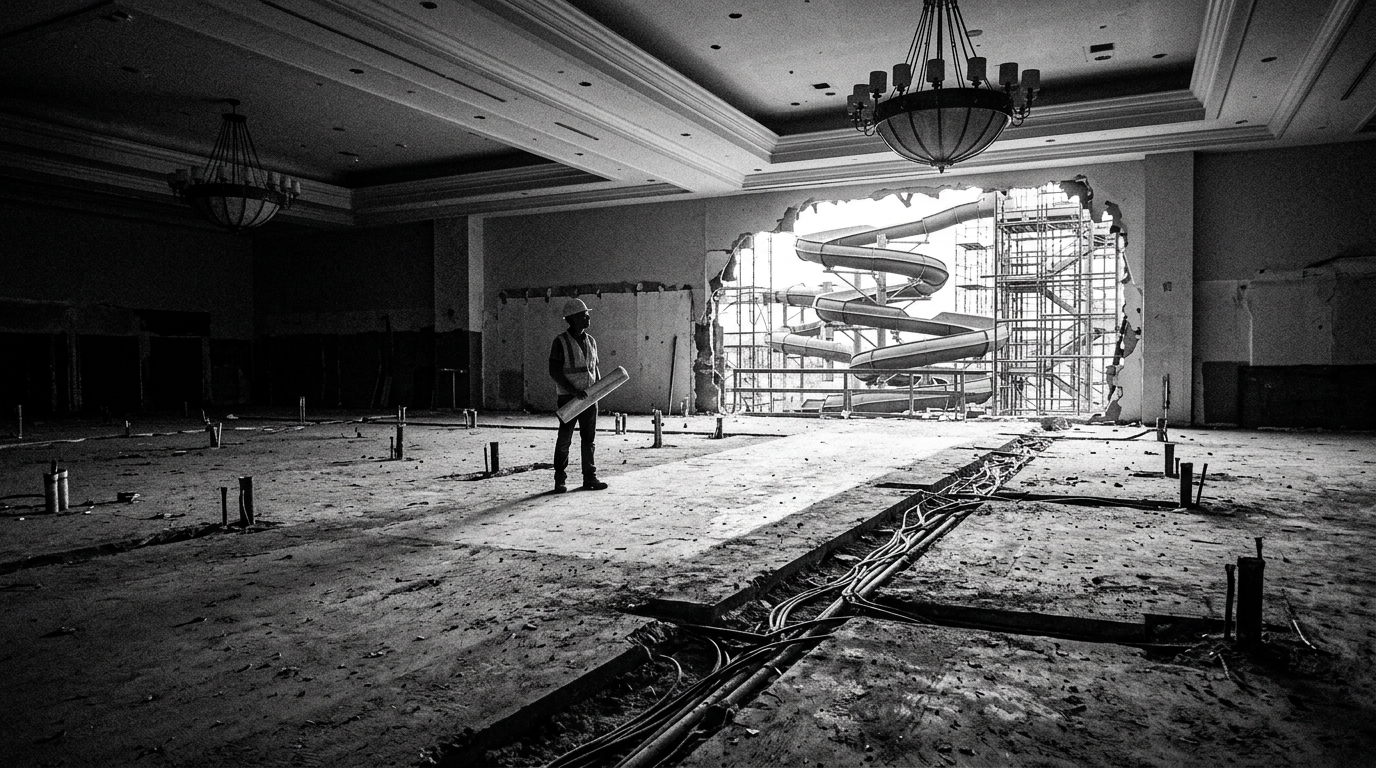
Foxwoods is in the middle of exactly that cycle right now. They've shuttered retail (some of it due to national bankruptcies, some of it just the market talking), permanently closed a nightclub that ran for nearly 20 years, and they're backfilling with Martha Stewart, Sally's Apizza, a Japanese nightlife concept, and a renovated tower. Meanwhile, a $300M Great Wolf Lodge water park is going up on 13 acres next door. The stated strategy is the one every aging casino resort reaches for eventually... "we're becoming a destination resort." I've heard that phrase so many times in 40 years that it should come with its own drinking game. The problem isn't the vision. The vision is usually right. The problem is the math underneath it.
Here's what the math looks like. Slot revenue in January 2026 was $28.6M. That's down from $30.7M last June. Q3 2025 total revenue dropped 2.3% year-over-year while operating expenses climbed 1.9%... payroll expansion, inflation, and the cost of all those new non-gaming amenities. Revenue declining and expenses rising is the definition of margin compression. And that's before two multi-billion-dollar casinos open near New York City, which is where a huge chunk of Foxwoods' drive-in market lives. Foxwoods' post-pandemic revenue is reportedly still running about 15% below 2019 levels. You don't diversify your way out of a structural demand problem... you have to actually replace the revenue you're losing, not just redecorate around the hole.
The celebrity chef strategy is interesting but it's not free. Gordon Ramsay, Martha Stewart, Masaharu Morimoto... these aren't licensing deals where you slap a name on the door and move on. These are complex operating agreements with real costs, real staffing requirements, and real brand standards. A Martha Stewart restaurant in a casino resort tower needs to deliver on the Martha Stewart promise. That means product quality, service levels, and consistency that a typical casino F&B operation isn't built for. I've seen properties bring in name-brand restaurant concepts and underestimate the operational lift by 40-50%. The concept opens beautifully. Six months later you're fighting to staff it at the level the brand requires and the food cost is eating you alive because the celebrity partner's menu wasn't designed with your market's price sensitivity in mind. The question isn't whether The Bedford is a good restaurant. The question is whether it generates enough incremental visitation and spend to justify what it costs to operate at the level Martha Stewart demands... in southeastern Connecticut, not Manhattan.
The Great Wolf Lodge partnership is the most interesting piece of this, and it's the one that could actually change the demand profile. A 91,000-square-foot indoor water park with a family entertainment center is the kind of amenity that creates NEW trips rather than just reshuffling existing ones. Families with kids aren't the traditional casino demographic, and that's exactly the point... you're adding a revenue stream that doesn't cannibalize gaming. But a $300M development on adjacent tribal land is a massive bet, and the integration between a water park resort and a casino resort is harder than it looks on the site plan. These are fundamentally different guests with fundamentally different expectations. The family checking in with three kids for the water park and the couple there for a weekend of table games and celebrity dining... those are two different hotels sharing a parking lot. Making that work operationally, from wayfinding to security to noise management to F&B routing... that's a challenge I've watched properties underestimate every single time.
If you're running a large resort or casino property and your leadership team is pitching the "destination resort" pivot, here's what I'd do before anyone signs a celebrity chef deal or breaks ground on anything. Pull your revenue by segment for the last 36 months and identify which segments are actually growing versus which ones you're just cycling through. Then stress-test every new amenity against a 15% decline in your core gaming revenue... because that's what happens when new regional competition opens. If the celebrity F&B concept doesn't pencil without the gaming spend propping up covers, you're subsidizing a brand partnership with your existing margin. Build your operating pro forma on what your market actually supports, not what the concept looks like in the rendering. And if you're adding a family-oriented amenity to a gaming property, budget 25-30% more than you think you need for the operational integration... separate check-in flows, dedicated staffing, programming that keeps two fundamentally different guest types happy in the same complex. I've seen this movie before. The resorts that survive the pivot are the ones that did the math before the ribbon cutting, not after.