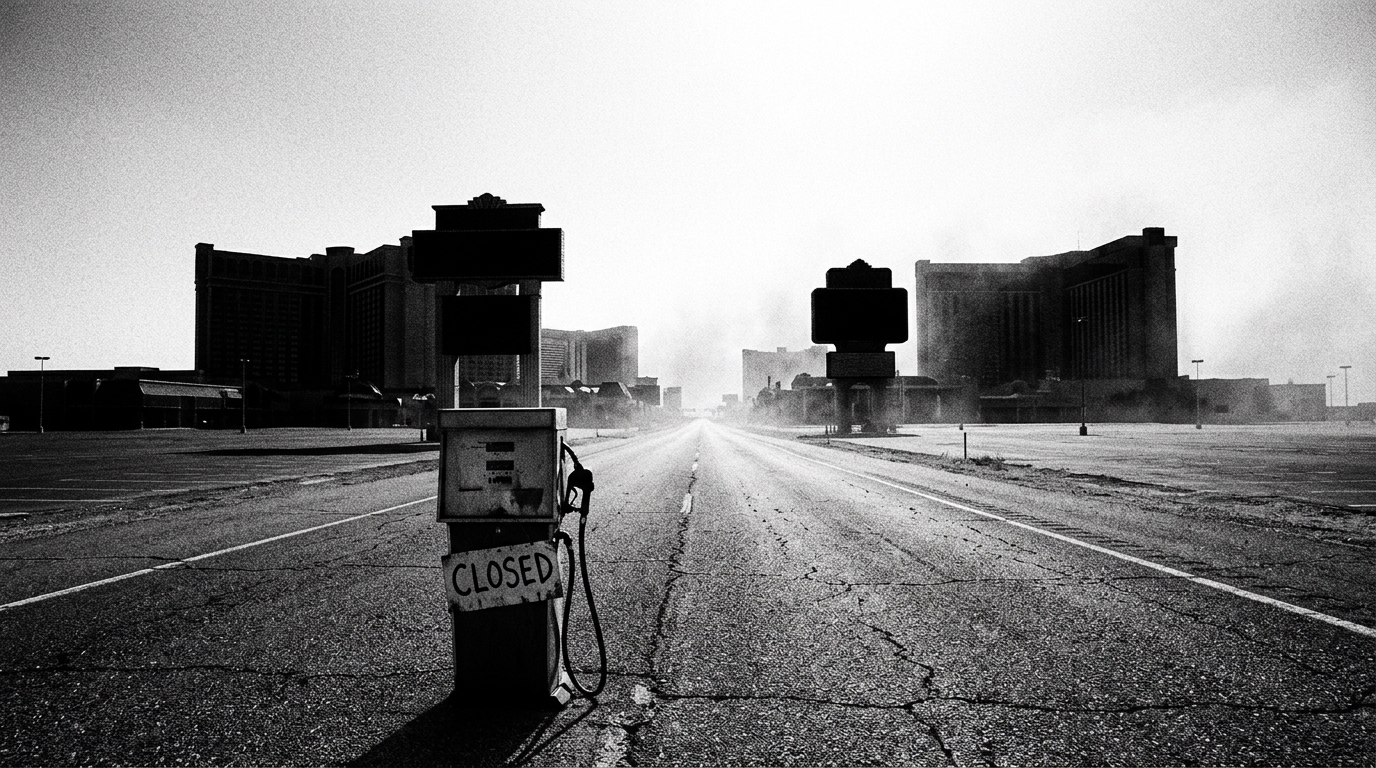
Affinity Paid $400M for Primm in 2007. Now It's Worth the Land Under It.
A $400 million casino resort complex on I-15 is shutting down entirely by July 4, including the gas stations that were supposed to be its survival strategy. The cap rate math on that original acquisition tells you everything about what happens when a thesis dies and nobody writes down the asset.
Affinity Gaming paid $400 million for Primm Valley Resorts in 2007. Three casino hotels, gas stations, a truck stop, retail, 500-plus acres straddling the California-Nevada border on I-15. By July 4, 2026, every single operating asset will be dark. Zero revenue. 344 employees terminated. The implied write-down from that 2007 basis is close to total.
Let's decompose this. A $400 million acquisition in 2007 for what was essentially a highway-dependent gaming and hospitality complex. Even at peak, Primm's economics were built on a thesis that Southern California gamblers needed a state-line stop. Tribal casinos in California killed that thesis slowly, then COVID accelerated the timeline. Affinity's own general counsel admitted post-pandemic traffic couldn't support three casinos. They closed Whiskey Pete's in 2024. Buffalo Bill's in 2025. Now the remaining resort, the gas station, and the Flying J truck stop. The strategic retreat became a full evacuation in 24 months.
The part that should make every asset manager pause: in February 2025, Affinity's CEO publicly stated the plan was to reposition Primm as a "travel resource" and expand the travel-center businesses. Fourteen months later, they're closing the travel centers. That's not a strategy revision. That's a capitulation. When leadership publicly commits to a repositioning thesis and then abandons it within a year, the financial deterioration was either faster than they modeled or the thesis was never stress-tested against a realistic downside. I've audited portfolios where the repositioning deck looked great and the trailing cash flow told a completely different story. The deck always loses to the cash flow.
50,000 cars pass Primm daily. That number sounds like it should support at least a gas station and truck stop. Clark County officials and the Primm family (who own roughly 200 of the 215 acres) are actively trying to find operators for the fuel operations. This is where it gets interesting from an investment perspective. Affinity owns approximately 15 acres. The Primm family owns the rest. The land value is real... I-15 frontage between the two largest metro areas in the region doesn't become worthless because a casino operator couldn't make the numbers work. Somebody will operate fuel and food on that corridor. The question is at what basis, under what lease structure, and who captures that value. It won't be the entity that paid $400 million in 2007.
The 344 employees, including those being evicted from company-provided housing by July 6, are absorbing the full downside of a capital allocation decision made 19 years ago by a different owner at a different price. An owner I worked with once told me the hardest part of a disposition isn't the math. It's the people who built their lives around an asset that the math says shouldn't exist anymore. He wasn't wrong. The math on Primm stopped working years ago. The people kept showing up anyway.
Here's what I want you to take from Primm if you're running or owning a highway-dependent hospitality asset. The demand thesis is the entire business. When tribal gaming killed Primm's reason to exist, no amount of repositioning, rebranding, or "travel center expansion" could manufacture a replacement thesis. If your property depends on a single demand driver... a military base, a plant, a seasonal traffic pattern, a border-crossing dynamic... stress-test what happens when that driver declines 30%. Not might decline. When it declines. Because Primm's ownership had 15 years of declining signals and still paid $400 million at the peak. Run your own version of that math before someone else runs it for you.