Today · Apr 3, 2026
Wynn Has $3.4 Billion in the Ground in a War Zone. Construction Continues.

Wynn Has $3.4 Billion in the Ground in a War Zone. Construction Continues.

Wynn evacuated part of its development team from the UAE after Iranian missile strikes, but the $5.1 billion Al Marjan Island project keeps building toward a 2027 opening. The question every casino resort operator should be asking isn't whether it opens... it's what happens to the insurance, the timeline, and the talent pipeline when your mega-project sits under an air defense umbrella.

Available Analysis

I worked with a guy years ago who was overseeing a resort renovation in a hurricane zone. Category 2 brushed the coastline mid-build. Didn't hit the property directly, but it scattered half his subcontractors back to the mainland and his insurance carrier wanted to renegotiate everything. The physical damage was minimal. The project delay and the cost escalation from that one storm added 11% to his total budget. He told me afterward: "The building was fine. The spreadsheet got destroyed."

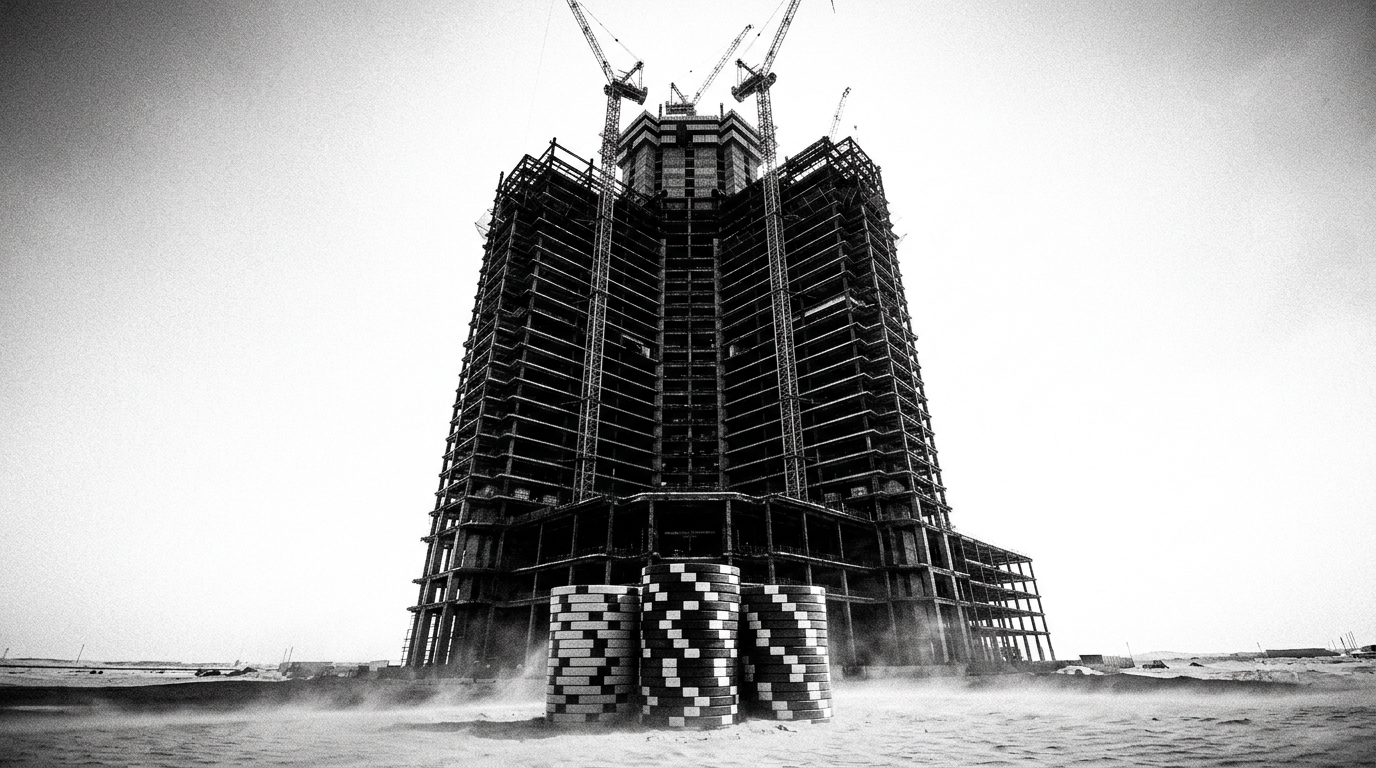
That's the lens I'm looking at this Wynn story through. Not whether the concrete's still standing on Al Marjan Island... it is. Construction hasn't stopped. The hotel tower topped out in December. Interior work is underway. Wynn's people on the ground in Ras Al Khaimah are apparently still pouring floors and hanging drywall. The company has $3.4 billion committed on a $5.1 billion project, which means they're roughly two-thirds through the spend. You don't walk away from that. You can't walk away from that. The financial gravity of a project this size makes retreat nearly impossible regardless of what's happening in the airspace above you.

But here's what I keep turning over. Since February 28th, the UAE has intercepted over 400 ballistic missiles, nearly 2,000 drones, and 15 cruise missiles. Hotels in Dubai have reportedly been hit. Wynn evacuated design and development team members... the specialized talent you need for the finish work that turns a concrete shell into a $5.1 billion luxury resort. The construction crews are still there (largely local workforce, which makes sense operationally), but the people who make decisions about finishes, FF&E installation, brand standards, the guest experience details that justify a Wynn rate... some of those people are working remotely now. From somewhere that isn't a war zone. And anyone who's ever managed a complex build knows the difference between being on-site and being on a video call. Remote oversight on a project this intricate, at this stage, with this budget... that's not the same thing and everybody in the industry knows it.

The stock tells part of the story. WYNN is down roughly 20% over 90 days. Analysts are trimming price targets but keeping buy ratings, which is Wall Street's way of saying "we believe in the thesis but we're nervous about the timeline." The projected $1.3 billion in annual gross gaming revenue assumes the UAE becomes a regulated gaming destination that attracts the kind of international high-net-worth traffic that currently flows to Macau, Singapore, and London. That thesis was compelling six months ago. It's still compelling on paper. But "on paper" and "under missile defense systems" are two very different operating environments. The question isn't whether the UAE gaming market materializes... it's whether the 2027 opening timeline holds, what the cost overruns look like when you're building through a conflict, and whether the luxury leisure traveler who's supposed to fill 1,500 rooms is going to book a trip to a destination that was in the news for intercepting Iranian cruise missiles.

This is what I call the Shockwave Response... and in this case, the shockwave is still ongoing, which makes it worse than a single event. A hurricane passes. A pandemic eventually ends. An active military conflict between a neighboring state and the country where your $5.1 billion asset sits... that doesn't have a timeline anyone can predict. Wynn's public posture is exactly what you'd expect: commitment to the project, commitment to employee safety, construction continues. And I believe them. But somewhere in a conference room in Las Vegas, someone is running scenarios on what a six-month delay costs, what happens to the lender syndicate that provided $2.4 billion in construction financing if the security situation deteriorates further, and what the insurance landscape looks like for a luxury resort that opened during or immediately after a regional war. Those are the conversations that don't make the press release.

Operator's Take

Look... most of you aren't building $5 billion casino resorts in the Middle East. But the principle here is universal and it's one I've applied at every scale. If you have any capital project underway right now, in any market with elevated risk (and that includes natural disaster zones, not just war zones), pull your insurance policy this week and read the force majeure and delay clauses. Know exactly what's covered and what isn't before something happens, not after. If you're in a management company with any international pipeline, understand who's on the ground, what the evacuation protocols are, and what "construction continues" actually means when your specialized talent is remote. And if you're an investor watching WYNN right now thinking this is a buying opportunity because the long-term UAE gaming thesis is intact... you might be right. But price in an 18-month delay, a 15-20% cost overrun, and a slower-than-projected ramp to that $1.3 billion GGR number. The thesis surviving and the timeline surviving are two different bets.

Read full analysis → ← Show less
Source: Google News: Casino Resorts
Wynn's Q4 Tells the Real Story: Revenue Up, Profits Down, and $10.5B in Debt

Wynn's Q4 Tells the Real Story: Revenue Up, Profits Down, and $10.5B in Debt

Wynn Resorts beat revenue expectations by $20 million and still missed EPS by over 20%. When top-line growth can't cover cost growth, the math is telling you something the CEO won't.

$1.87 billion in Q4 revenue, a $1.17 adjusted EPS against a $1.42 consensus. That's a 20.4% miss on the number that matters. Revenue grew 1.5% year-over-year. Operating expenses grew 8.3%. Net income dropped from $277 million to $100 million in the same quarter a year ago. Let's decompose this.

The Macau segment tells the clearest story. Operating revenue grew 4.4% to $967.7 million, but Adjusted Property EBITDAR dropped 7.5% to $270.9 million. Revenue up, profitability down. That's the treadmill. VIP hold percentages declined at both Macau properties, and management attributed the miss to "lower-than-expected hold" as if variance in hold is an unpredictable act of nature (it's not... it's a structural feature of VIP-dependent revenue, and if your earnings model can't absorb normal hold fluctuations, your earnings model is fragile). Las Vegas wasn't much better. Operating revenues down 1.6% to $688.1 million. ADR up 2.2%, but occupancy and RevPAR declined. They're getting more per room from fewer guests. That works until it doesn't.

Three things the earnings call didn't adequately quantify. First, the Encore Tower remodel starting Q2 2026 will remove approximately 80,000 available room nights from inventory. Management called it a "slight headwind." I'd want to see the RevPAR impact modeled against a comp set that isn't taking rooms offline. Second, total contributions to the UAE joint venture have reached $914.2 million for a 40% stake in a property that doesn't open until Q1 2027. That's dead capital until revenue starts flowing... and the revenue assumptions for an integrated resort in a market with no gaming track record are, generously, speculative. Third, the CFO is retiring before the Q2 earnings call. Losing your finance chief during a margin compression cycle and a major international development push is not a line item. But it should be.

The balance sheet carries $10.55 billion in debt. The company paid a $0.25 quarterly dividend. I've audited capital structures where the dividend signaled confidence. I've also audited structures where the dividend signaled "we can't cut it without triggering a sell-off." At current earnings trajectory, the interest coverage math deserves more scrutiny than the analyst calls are giving it. Wells Fargo trimmed its target to $147, UBS dropped to $146, and the stock fell 6.63% after hours. The market did the math faster than the narrative.

For REIT asset managers and institutional holders watching gaming-adjacent hospitality names, this quarter is a pattern worth flagging. Revenue growth that doesn't convert to margin improvement is a cost problem, a mix problem, or both. Wynn is dealing with both simultaneously... rising payroll and repair costs on the expense side, declining hold and occupancy on the revenue side. The UAE bet is a 2027-and-beyond story. The margin compression is a right-now story. Check again.

Operator's Take

Look... if you're an asset manager holding gaming-exposed hospitality assets, this quarter is your signal to stress-test every property in your portfolio against a scenario where revenue grows 1-2% but expenses grow 8%. Because that's not hypothetical anymore. That's what just happened to one of the best operators in the business. Run the numbers this week. If your coverage ratios get uncomfortable at those spreads, you need to be having the conversation with your lenders now, not after Q1 reports.

— Mike Storm, Founder & Editor
Read full analysis → ← Show less
Source: Google News: Wynn Resorts
Wynn's Vegas Softness Is a Warning Shot for Every Casino-Hotel Operator

Wynn's Vegas Softness Is a Warning Shot for Every Casino-Hotel Operator

Wynn Resorts is feeling the squeeze in its home market, and if a property with that level of brand equity and pricing power is losing momentum on the Strip, the operators downstream need to pay attention right now.

I've seen this movie before. When the top of the market starts showing cracks, it doesn't stay at the top for long. Wynn Resorts posting soft Las Vegas numbers isn't just a story about one company's quarterly earnings. It's a leading indicator. The Strip is the canary in the coal mine for gaming-dependent hospitality markets everywhere.

Let me be direct about what's happening. Las Vegas has been running hot since the post-COVID revenge-travel surge. Convention business came roaring back. Room rates held at levels nobody would have predicted in 2020. But the math on consumer spending is shifting. Credit card debt is at record highs. The savings buffer that fueled $400 average daily rates on the Strip is thinning out. When Wynn, a property that caters to the premium end, starts feeling drag on the profit line, that tells you the softness isn't just in the budget traveler segment. It's creeping up the ladder.

Here's what nobody's telling you: the real pressure isn't just on the gaming floor. It's in the hotel operation that supports it. Casino-hotels live and die by total revenue per available room when you factor in gaming spend, F&B, entertainment, and retail. When gaming revenues soften, the temptation is immediate: cut on the hotel side. Reduce housekeeping frequency. Trim F&B hours. Delay that carpet replacement. I worked with a casino-resort GM once who responded to a revenue dip by cutting the breakfast buffet from seven days to five. Saved about $38,000 a month. Lost three convention bookings worth $600,000 over the next two quarters because the meeting planner heard about it from attendees. Penny-wise, catastrophic.

The pattern from 2008-2009 is instructive. Vegas properties that cut their way to profitability during the downturn lost market share for three to five years afterward. The ones that held service levels and got surgical about where they trimmed, targeting vendor contracts, energy costs, management overhead rather than guest-facing labor, recovered faster. If your property has any gaming component, whether you're on the Strip or in a regional market like Biloxi or Atlantic City, the playbook is the same. Protect the guest experience. Get ruthless on the back-of-house costs that don't touch the customer. And for the love of God, do not slash your loyalty program benefits right when you need repeat visitors the most.

Your owners are going to ask about this. Here's what to tell them: one quarter of softness at the top of the market doesn't mean the sky is falling, but it does mean the cycle is turning. Now is the time to stress-test your budget assumptions for the back half of 2026. If you're projecting 3-5% RevPAR growth in a gaming market, cut that to flat and see what your P&L looks like. If flat RevPAR breaks your debt service coverage, you've got a problem that needs addressing before the next earnings cycle, not after.

Operator's Take

If you're a GM or director of operations at a casino-hotel property outside the Strip, in a regional gaming market, this is your 90-day warning. Pull your vendor contracts and find 2-3% in non-guest-facing costs this month. Lock in your best housekeeping and F&B staff with retention incentives before layoff rumors start circulating and your top performers jump to the property down the road. And run your 2026 forecast at zero RevPAR growth. If the numbers don't work at flat, you need to be in front of your ownership group with a plan now, not in Q3 when everyone's panicking.

Read full analysis → ← Show less
Source: Google News: Wynn Resorts
End of Stories