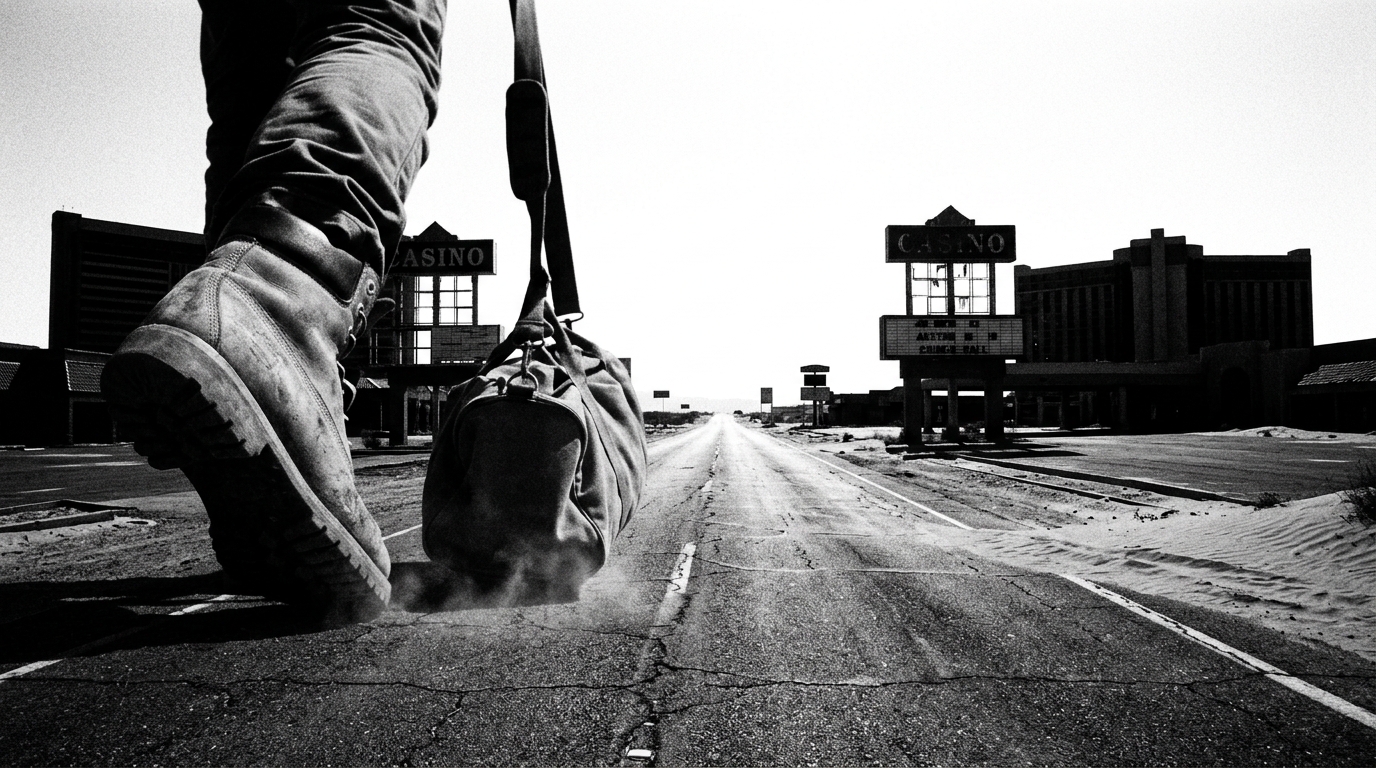
344 Workers Just Got 60 Days Notice. Primm Is a Ghost Town by July 4th.
Affinity Gaming is pulling the plug on the last Primm Valley casino properties and the Flying J truck stop by Independence Day, ending a border town gambling era that's been dying for 20 years. The $400 million question isn't why it's closing... it's what every operator sitting on a location-dependent property should be learning from the autopsy.
I worked with a GM once at a border-town property... one of those places that existed entirely because of the traffic pattern. Cars coming from one state to another, stopping because the exit was there and the signs were big. He told me something I never forgot: "We don't have guests. We have flow. The day the flow stops, we're done." He said it like a man who already knew the ending.
Primm, Nevada, is done. The last pieces of what was once a three-casino resort complex straddling I-15 between LA and Vegas will go dark on July 4, 2026. Affinity Gaming issued termination notices to 344 employees on May 5th, giving them and the people living in employee housing until July 6th to figure out what's next. Whiskey Pete's closed in December 2024. Buffalo Bill's went to events-only in July 2025. Now the remaining operations and the Flying J truck stop that served as a critical fueling point for long-haul drivers... all of it goes away. The Primm family, who developed this community and still own over 568 acres across the interstate, says they weren't given much notice. Three generations of a family watching the thing their patriarch built evaporate on someone else's timeline.
Let me give you the financial picture that tells the real story. Affinity Gaming (through its Primadonna Company subsidiary) bought these three casinos from MGM Resorts for $400 million in 2007. Four hundred million dollars. Right before the world fell apart. And what they bought was a business model with a single dependency: traffic volume at a state line crossing. Not a destination. Not a market with multiple demand generators. A gas stop with slot machines. When California tribal casinos expanded, when gas prices made the drive less casual, when COVID killed the spontaneous road trip... every one of those shifts hit the same vulnerability. Affinity's own general counsel said it plainly back in October 2024: traffic is "heavily weighted towards weekend activity and is insufficient to support three full-time casino properties." That's a lawyer's way of saying the math broke years ago and they've been managing the decline ever since.
Here's what bothers me about how this is being covered. The headlines are about a truck stop closing (and yes, that matters... if you're a CDL driver who relied on that Flying J for fuel and parking on the I-15 corridor, this is a real problem). But the operator story is bigger. Primm is a case study in what happens when your entire revenue thesis depends on a single external factor you don't control. Traffic flow. Border proximity. One highway. The Primm family built something real, but they built it on a foundation that assumed the world wouldn't change. The world always changes. California got casinos. Vegas got cheaper flights. Gas got expensive. The pandemic hit. And a property that exists purely because of geographic convenience has no defense against any of it. Zero demand diversification. Zero alternative revenue thesis. When the flow stopped, there was nothing left to manage.
The 344 people getting those termination letters... that's the part that stays with me. Some of them lived in employee housing on-site. They're losing their job AND their home with 60 days notice, in a town that essentially won't exist as an employment center after July 4th. Clark County says they're coordinating with the state's Rapid Response team, and I hope that's true and not just a press release. But let me be honest: when a property closes in a secondary market, the "assistance" rarely matches the disruption. These are real people in a town with no fallback employer. The nearest real job market is 40 minutes in either direction. That's not a career transition. That's a life upheaval.
If you're running a property where more than 60% of your revenue comes from a single demand driver... one highway, one corporate account, one event venue, one seasonal pattern... Primm is your cautionary tale. Not because you're about to close. Because you need to honestly assess what happens to your P&L if that one thing shifts by 25-30%. Run that scenario this month. Not in your head... on paper, with your actual fixed costs. Then ask yourself what you're doing to diversify. For those of you with employee housing as part of your staffing model, look at what happened here. Those 344 people got a termination notice and a 60-day eviction in the same envelope. If you're ever in that position, your people deserve better planning than that. Build separation protocols now, before you need them. And if you're an owner holding a location-dependent asset with single-source demand, the honest conversation isn't whether to sell... it's whether waiting another year makes the number better or worse. Usually worse.