Today · Jul 29, 2026
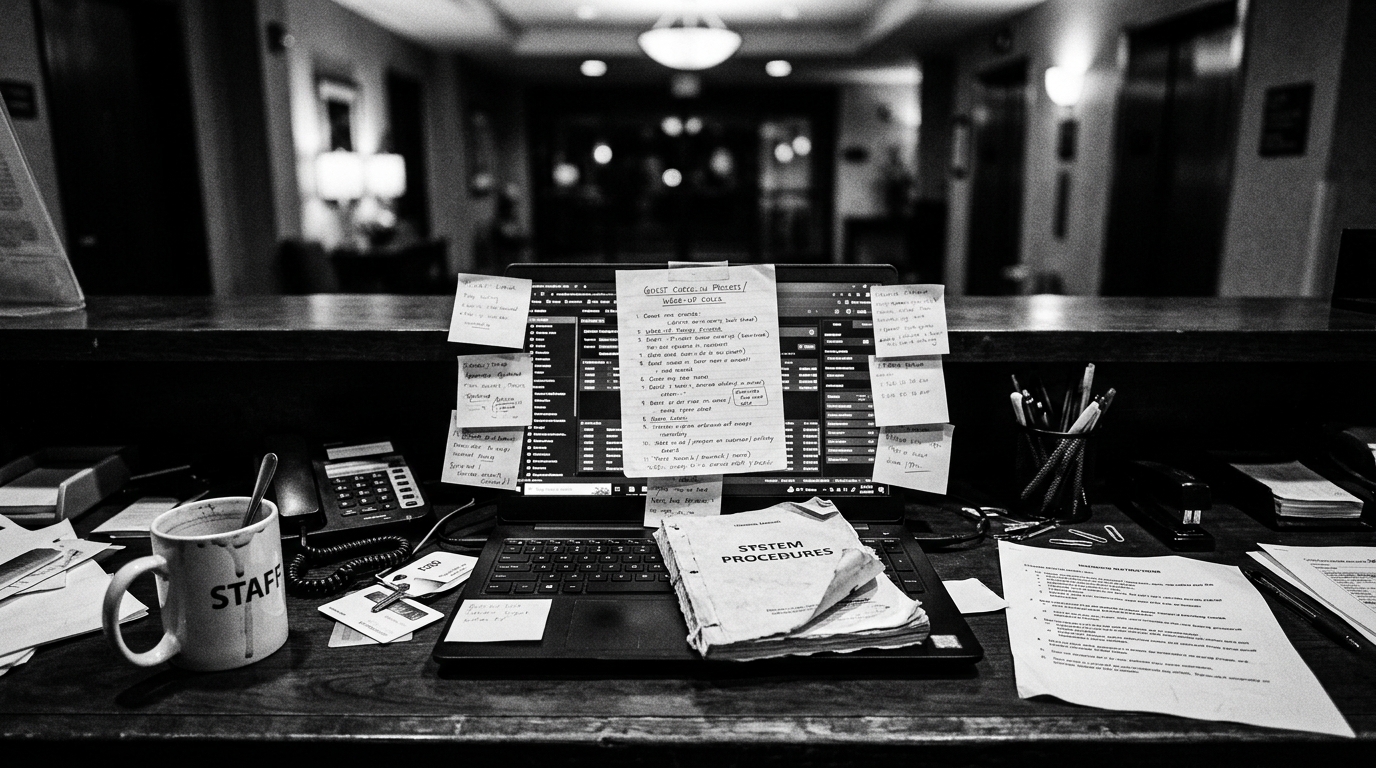
Your PMS Has More Guest Data Than Ever. Nobody's Using It at 2 AM.

Your PMS Has More Guest Data Than Ever. Nobody's Using It at 2 AM.

The hotel industry's "guest intelligence" conversation has shifted from collecting data to actually doing something with it. The problem isn't your PMS... it's that the person who needs the insight most is working the overnight shift with zero training on how to find it.

Available Analysis

So here's the conversation the industry keeps having: we need better guest intelligence. More personalization. More data-driven service. And the answer, apparently, is always the same... upgrade your PMS. The global hospitality PMS market is projected to hit nearly $10 billion by 2035, up from roughly $5.8 billion in 2024. That's a lot of money chasing the promise that if we just centralize the data, magic happens.

It doesn't. Not automatically. Not even close.

I consulted with a hotel group last year that had just migrated to a cloud-based PMS. Beautiful system. Guest profiles, preference tracking, booking history, the works. I asked the front desk supervisor how often staff actually pulled up a guest profile before check-in. She laughed. "We're supposed to?" They had 94% of the data the vendor promised during the demo. They were using maybe 15% of it. The rest just... sat there. Because nobody built the workflow that turns a data field into a human interaction. The system knew the guest preferred a high floor and extra pillows. The agent checking them in at 11 PM didn't look at the screen because she was answering two phone calls and processing a mobile key that wasn't working. That's not a data problem. That's an operations problem wearing a technology costume.

Look, I'm not anti-PMS modernization. Cloud-based systems are objectively better architecture than the on-premise dinosaurs a lot of properties are still running. Real-time data sync, API connectivity, remote management... these matter. And the stat that properties using data-driven strategies see up to 15% RevPAR improvement? I believe it. But "data-driven strategy" doesn't mean "installed a system that collects data." It means someone designed the workflow, trained the team (and then retrained them four months later when half the staff turned over, because hospitality turnover is still north of 70%), and built accountability into the process. The technology is the easy part. The human layer is where every single one of these implementations either works or becomes a very expensive database nobody opens.

The real question nobody in the PMS vendor conversation wants to answer: what does guest intelligence look like at a 150-key select-service property running two people on the desk during peak check-in and one person overnight? Because 61% of consumers might say they'll spend more for a personalized experience, but personalization requires someone with the time, training, and motivation to deliver it. The system can surface the insight. If the person seeing it has six other things competing for their attention, the insight dies on the screen. That's not a technology failure. That's a deployment failure. And it's the one vendors never demo because it doesn't look good on a laptop in a conference room.

What actually works is brutally unsexy. It's picking three... maybe four... data points that your team can realistically act on during a guest interaction. Not the full profile. Not the 47-field preference record. Three things. Guest name, stay count, and one preference. Build a 10-second ritual around those three things. Train it until it's muscle memory. Then... and only then... add a fourth data point. I've seen this approach outperform full-blown "guest intelligence platforms" at properties where the team actually executes it. Because a system that surfaces 50 insights nobody reads is worth less than a sticky note that says "returning guest, likes quiet room, said thanks last time we remembered."

Operator's Take

Here's what to do before you spend another dollar on PMS upgrades or guest intelligence add-ons. Walk to your front desk during the busiest hour of your day. Watch how many times your agents actually open a guest profile before check-in. Count it. That number is your real technology utilization rate... and I promise it's lower than whatever your vendor dashboard says. If your team isn't using what you already have, a better system won't fix it. Pick three actionable data points. Build the 10-second workflow. Train it this week. This is what I call the Vendor ROI Sentence... if your PMS vendor can't tell you exactly which workflow change will hit your P&L, they're selling you a platform, not a solution. The intelligence isn't in the system. It's in whether your 11 PM front desk agent knows what to do with it.

— Mike Storm, Founder & Editor
Read full analysis → ← Show less
Source: Google News: Hospitality Technology
Vancouver's World Cup Occupancy Is Lower Than Last Year. There Was No World Cup Last Year.

Vancouver's World Cup Occupancy Is Lower Than Last Year. There Was No World Cup Last Year.

Vancouver hotels are pacing 15% behind last year's occupancy for World Cup match days... and last year had no mega-event at all. The government is calling it a "once-in-a-generation opportunity," which should tell you everything about who's holding the risk and who's holding the microphone.

Available Analysis

I worked with a GM once who got talked into blocking 40 rooms for a regional soccer tournament. The organizer promised 200 room nights over the weekend. The GM held those rooms off the market for six weeks. Tournament weekend came, they picked up 61 rooms total. The organizer said "but think of the exposure." The GM said something back that I won't repeat here, but it involved the word "exposure" and a suggestion about where to put it.

That's what I think about every time a government official tells a hotel market to focus on the long-term benefits of a mega-event.

Here's what's happening in Vancouver right now. The FIFA World Cup kicks off tomorrow. Vancouver is hosting seven matches. And hotel occupancy for the first match day is sitting at 57.4%... down from 71.6% on the same date last year. The Canada-Qatar match on June 18th? 50.3% occupancy versus 73.8% last year. Five of seven match days are pacing below 50% occupancy. Let me say that differently so it lands. A city hosting the biggest sporting event on the planet has LOWER hotel demand than a random Wednesday in June 2025 when nothing was happening.

How does this happen? Start with FIFA canceling 70-80% of its reserved room block in March, dumping roughly 15,000 room nights back onto the market after hotels had been holding that inventory. Then add early messaging that told potential visitors Vancouver was "sold out" (it wasn't... it was never close). Then factor in short-term rental listings jumping 11.3% in the ten months before the tournament because every Airbnb host in British Columbia smelled opportunity. Then recognize that a 48-team tournament spread across three countries and 16 cities means the demand is diluted to a degree nobody modeled honestly. And here's the part that really stings... average booked rates for game days are up 49% year over year. Hotels priced for a windfall that isn't walking through the door. They're running aggressive rates into a market that's booking at half the pace they expected. The math on that is brutal. You're not just missing volume, you're missing volume at rates that are pushing away whatever demand remains. This is what I call the Rate Recovery Trap, except Vancouver is living the inverted version... they ran rate UP based on projected demand that never materialized, and now they're going to spend weeks (maybe months) retraining the market on what a Vancouver hotel room actually costs.

The B.C. government's response is instructive. The Jobs Minister says bookings are increasing "week over week" and that Vancouver leads all host cities in CoStar's survey. The Tourism Minister calls it a "once-in-a-generation opportunity" that will generate a billion dollars in GDP over five years. Here's what neither of them mentions: the hosting cost is $578 million. The hotels that held inventory and priced aggressively based on projections don't get a five-year payback horizon. They get a June P&L. And that June P&L is going to show lower occupancy, potentially lower RevPAR (because those rates are going to come down fast when reality sets in), and all the incremental costs of operating during a mega-event... extended hours, additional security, event-night staffing, the wear and tear that comes with it. The government gets the press conference. The hotels get the bill.

Look, there's still time for a late-booking surge. Some of these numbers will improve. But the structural lesson here isn't about Vancouver specifically. It's about what happens every single time a market prices to the projection instead of the demand. Every Olympics, every Super Bowl, every World Cup... somebody in a conference room shows a PowerPoint with occupancy estimates north of 90% and ADR premiums that would make Manhattan blush. And every time, a meaningful percentage of hotel operators discover that mega-event math is built for the entity selling the hosting rights, not the people holding the real estate.

Operator's Take

If you're a GM in any of the remaining World Cup host cities watching Vancouver right now, do three things this week. First, check your actual pace against your budgeted pace for match days... not against your dream scenario, against what you told your owner in January. If you're short, present the gap now with a plan, not after the event with an excuse. Second, build your rate-drop triggers in advance. Know exactly when you shift from holding rate to filling rooms, and set those dates now so you're not making panicked decisions at 10 PM the night before a match. Third, look at your non-event demand. Vancouver's conventional business travelers and leisure tourists got scared away by "sold out" messaging and inflated rates. Your regular guests are watching your pricing too. The World Cup is a few weeks. Your repeat guests are forever. Don't sacrifice the relationship for a rate that isn't converting.

Read full analysis → ← Show less
Source: Google News: Hotel Occupancy
Hilton Is Now Selling Your Elite Members the Upgrade They Used to Get Free

Hilton Is Now Selling Your Elite Members the Upgrade They Used to Get Free

Hilton's new "Upgrade at Digital Check-In" feature lets Gold and Diamond members see paid upgrade options alongside complimentary ones. If you're a franchisee celebrating the "incremental revenue," you might want to think about what happens when your best repeat guests start feeling nickel-and-dimed.

Available Analysis

So here's what Hilton just did. They rolled out a feature on June 8th that shows elite members... Gold, Diamond, the new Diamond Reserve tier... both free and paid upgrade options during digital check-in. On the surface, this sounds like "transparency" and "choice." Those are the words Hilton is using. What this actually is? It's the airline playbook. And if you've flown Delta recently, you know exactly how that playbook feels as a customer.

Let me be specific about what's happening at property level, because this is where it gets interesting. Hilton's own internal documents told owners that 57% of incremental upsell revenue at participating full-service hotels came from elite members. Read that again. Fifty-seven percent of the paid upgrade revenue is coming from the people who are supposed to be getting upgrades as a loyalty benefit. That's not a bug in the system. That's the system. The brand is monetizing the gap between what members expect (a comp upgrade for their loyalty) and what the app now presents (a menu of options with prices attached). If you've ever built a checkout flow (and I have, more than once), you know that the moment you put a price next to a "free" option, you've changed the psychology entirely. The free option suddenly feels like the lesser option. The paid option feels like the "real" upgrade. That's not an accident. That's UX design doing exactly what it's supposed to do.

Look, I get why ownership groups are excited about this. Ancillary revenue is real revenue. A 300-key full-service property that converts even 10% of elite check-ins into paid upgrades at $40-$75 a pop is looking at meaningful dollars over a year. But here's the question nobody at Hilton's brand team is being forced to answer: what's the lifetime value delta when a Diamond member who stayed 60 nights to earn that status starts feeling like the program is a tollbooth? Airlines got away with this because switching costs are high (hub captivity, credit card ecosystems, route monopolies). Hotels don't have that lock-in. A Diamond member who feels squeezed can book a Hyatt Globalist stay tonight. The friction is almost zero.

It's also worth looking at the timing here. Hilton simultaneously lowered qualification thresholds... Gold is now 25 nights instead of 40, Diamond is 50 instead of 60. More members in the elite tiers means more people expecting upgrades. More people expecting upgrades at the same inventory means fewer comp upgrades to go around. Fewer comp upgrades means more "well, you could purchase one." This isn't a coincidence. This is architecture. They widened the funnel at the top and monetized the bottleneck at the bottom. From a systems design perspective, it's actually elegant (and by elegant I mean it's going to make a lot of loyal guests quietly furious).

The real technology question here... the one I keep coming back to... is about the check-in flow itself. What does the front desk team see when a Diamond member walks up after declining the paid upgrade in the app? Does the system flag that they were offered and declined? Does the front desk agent know whether to comp-upgrade them anyway? Or does the automated system now control the inventory allocation in a way that the desk agent can't override without manager approval? Because if the technology has effectively removed the front desk's ability to make a guest-saving call on upgrades... if the human discretion has been engineered out of the process... then you've lost something that no app can replace. I talked to a front desk manager last month at an industry event who told me her team's override authority on room assignments had been reduced three times in two years. "They keep taking away the tools I use to save a stay," she said. That's the trajectory here. More automation, less human judgment, and the guest feels the difference even if they can't articulate exactly what changed.

Operator's Take

Here's what I'd do if I'm a GM at a Hilton-flagged full-service property right now. First, pull your comp upgrade data from the last 90 days and compare it to what the new system delivers in the next 90. You need a baseline before you can measure whether the "incremental revenue" is actually incremental or just converting what would have been comp upgrades into paid ones. Second, talk to your front desk leads about their override authority. If the system is restricting their ability to comp-upgrade a frustrated Diamond member at the desk, you need to know that now... not when it shows up in a guest satisfaction score. Third, watch your repeat booking patterns for elite members over the next two quarters. The revenue bump from paid upgrades is immediate and visible. The loyalty erosion is slow and invisible until it isn't. Track both. One shows up on this month's P&L. The other shows up in next year's.

— Mike Storm, Founder & Editor
Read full analysis → ← Show less
Source: Google News: Hilton
75 Million Passengers. 750,000 Flights. Your Front Desk Is the Last Stop When It All Falls Apart.

75 Million Passengers. 750,000 Flights. Your Front Desk Is the Last Stop When It All Falls Apart.

Airlines are bracing for the most chaotic summer in a decade, and when flights collapse at 11 PM, stranded passengers don't call their congressman. They walk into your lobby. The question is whether you've set your team up to turn that anger into revenue... or just absorb it.

Available Analysis

I worked with a front desk manager years ago at an airport hotel who kept a laminated card taped to the inside of the desk drawer. It said: "They are not mad at you. They are mad near you." She made every new hire read it on their first day. That property had the highest guest recovery scores in the region, and it wasn't because of the PMS or the loyalty program or the breakfast buffet. It was because someone had bothered to prepare the team for the moment when 40 people walk through the door at midnight, nobody has a reservation, half of them have been sitting on a runway for four hours, and the airline's 800 number has been ringing busy since 9 PM.

That moment is about to happen a lot this summer. American alone is projecting 75 million passengers on 750,000 flights through September. On-time arrivals last year were the worst since 2014... one out of every twelve flights showing up at least an hour late, over 100,000 cancellations across the industry. The FAA is capping flights at congested hubs. Airlines have committed to providing hotel rooms for overnight controllable delays (nine of the ten majors, all but Frontier), and those placements run through third-party systems like Travelliance's StormX portal and API's platform. If your property is within 10 miles of a major hub and you're not enrolled in at least one distressed passenger program... or worse, you're enrolled but nobody's checked that the rates are loaded correctly since last fall... you're watching revenue walk past your building to the Courtyard down the street.

But here's the part most operators aren't thinking about. Distressed passenger programs pay contracted rates. They're volume business, they fill rooms that might otherwise sit empty on a Tuesday, and they're fine. The real money this summer is the second-order effect. A family in Destin whose return flight gets cancelled doesn't call the airline's hotel desk. They walk to the front desk of the resort they're already staying at and ask to extend. That incremental night, booked at the counter with no advance purchase and no OTA discount, is close to rack rate. It's high-margin, zero-acquisition-cost revenue that shows up only if your team knows how to handle it and your system isn't blocking it with rigid length-of-stay restrictions or sold-out inventory you could have opened.

The operational piece matters more than the revenue management piece, and I say that as someone who's spent 40 years obsessing over both. Your front desk agent at 11:30 PM on a Friday in July is going to be the first human being a stranded traveler has talked to face-to-face since their gate agent disappeared. That interaction... the first 90 seconds of it... is going to determine your review score for that stay. Not the room. Not the amenities. Not the thread count. The human moment. I've seen properties turn distressed walk-ins into loyalty program enrollments and five-star reviews. I've also seen properties treat them like an inconvenience and eat a one-star hit that dragged their score for months. The difference was never the property. It was always whether someone had taken 15 minutes to brief the team before the chaos started.

This isn't complicated. It's preparation. And the GMs who do it this week, before the Fourth of July surge, are going to outperform the ones who wait until they're standing in the lobby at midnight trying to figure it out in real time.

Operator's Take

If you're running an airport-adjacent property, pull up your distressed passenger program enrollment today. Not tomorrow. Today. Verify the rates are loaded, the room types are correct, and your front desk knows the process for airline-referred walk-ins. If you're not enrolled, call Travelliance or API before the weekend. For resort and leisure GMs... check your length-of-stay restrictions and make sure your system allows same-day extensions at a rate that makes sense. Then do the thing that actually moves the needle: brief your front desk team this week. Ten minutes. Role-play the angry walk-in. Give them the language. "I'm sorry that happened to you. Let's get you taken care of." This is what I call the Price-to-Promise Moment... the single interaction where a guest decides whether your property was worth it. For a stranded traveler, that moment is the check-in, and you get exactly one shot at it. The properties that nail this will bank revenue and reviews all summer. The ones that don't will wonder why their scores dipped in Q3.

Read full analysis → ← Show less
Source: CNN
Booking and Airbnb Are Spending Hundreds of Millions to Replace the Search Box. Hotels Aren't in the Room.

Booking and Airbnb Are Spending Hundreds of Millions to Replace the Search Box. Hotels Aren't in the Room.

Booking Holdings and Airbnb are funding separate AI ventures designed to book travel autonomously, without the guest ever scrolling a results page. The question for hotel owners isn't whether agentic AI changes distribution costs... it's whether your property exists at all in a system that never shows a list.

Available Analysis

Booking Holdings pushed 338 million room nights in Q1 2026, a 6% year-over-year increase, while simultaneously building AI systems designed to eliminate the interface that generated those room nights. Airbnb spent $200 million acquiring an AI company in late 2023 and is now reportedly spinning up a separate AI lab. Both companies are constructing autonomous booking agents... systems that plan, select, and transact without presenting the guest a ranked list of options. The economics of this aren't subtle. If 30% of travel bookings are executed by AI agents by 2030 (IDC's current projection), the guest never sees your property listing. The agent sees your data feed. Those are fundamentally different distribution problems.

Let's decompose what "agentic" means for the hotel P&L. Today, an OTA commission runs 15-25% because the OTA delivers a guest who browsed, compared, and chose your property from a visible set. An AI agent that autonomously selects and books removes the browsing step entirely. The guest delegates the decision. The agent executes based on structured data... rate, availability, reviews, location, amenity tags, cancellation policy. If your inventory isn't machine-readable, properly tagged, and exposed through open protocols, you don't get rejected. You get skipped. You never existed in the consideration set. That's not a commission problem. That's an invisibility problem.

The financial structure of this shift matters. Booking Holdings repurchased $3.6 billion of its own stock in Q1 2026 while investing in AI that could eventually shrink its own storefront revenue. Airbnb is building what Chesky calls an "interaction layer" to keep the guest relationship in-house rather than ceding it to third-party chatbots. Both companies are running the same hedge: fund the thing that might kill your current model before someone else does. I audited a management company once that kept two sets of revenue projections... one assuming OTA contribution stayed flat, one assuming it grew 2 points per year. Nobody ever modeled the scenario where the OTA interface itself became irrelevant. That's the scenario now.

Priceline's "Penny" launched last week as a fully agentic system. It creates complete, bookable itineraries without the guest manually searching. Agoda (Booking Holdings) already cut customer service costs per booking by double digits through AI automation. These aren't pilot programs. They're production systems processing real transactions. The 133% monthly growth rate in agentic AI use across travel in the first half of 2025 suggests adoption is compounding, not linear. For hotel owners, the cost question isn't what commission rate the AI agent charges. It's what data infrastructure investment is required to be selectable by an agent that has no user interface, no scroll behavior, and no brand loyalty... only structured inputs and optimization criteria.

The distribution cost line on your P&L is about to bifurcate. Properties with clean, structured, machine-readable inventory exposed through standardized protocols will remain in the autonomous booking pool. Properties without it won't lose ranking. They'll lose existence. That's not a gradual erosion. It's a binary outcome. And neither Booking nor Airbnb has any incentive to tell you which side of that binary your property falls on... because both of them are still collecting commissions on the old model while building the new one.

Operator's Take

Here's what I need you to hear. This isn't a technology story. This is a distribution cost story with a cliff in it. If you're an independent or a small-portfolio owner, call your channel manager this week and ask one question: is my inventory available through open, machine-readable protocols that an AI booking agent can query directly? If the answer is no, or if the answer is a sales pitch for a new product, you have a problem that's getting more expensive every quarter you wait. For branded operators... your franchisor should be building this connectivity into the tech stack you're already paying for. If they're not, that's a conversation worth having at your next brand conference, because you're funding someone else's AI strategy through your loyalty assessments while your own property data sits in a format no agent can read. Don't wait for the OTAs to explain this to you. They're on the other side of this trade.

— Mike Storm, Founder & Editor
Read full analysis → ← Show less
Source: Google News: Airbnb
Meliá Just Walked Away From 15 Cuban Hotels. The Dominos Aren't Done Falling.

Meliá Just Walked Away From 15 Cuban Hotels. The Dominos Aren't Done Falling.

Meliá's pullback from nearly half its Cuban portfolio isn't really about Cuba. It's about what happens when geopolitics, energy collapse, and sanctions converge on properties where occupancy already cratered to 34%... and what that playbook looks like when it shows up closer to home.

Available Analysis

I've been in rooms where the decision to exit a market gets made. It's never one thing. It's never the headline reason. It's the accumulation... the slow bleed that everybody watches and nobody wants to name until somebody finally says it out loud. Meliá just said it out loud about Cuba, pulling management, branding, and commercial services from 15 of their 34 hotels on the island. Effective immediately. And if you read between the lines of their corporate language about "responsible business conduct" and "orderly operational frameworks," what you're really hearing is a company that did the math and realized the math stopped working a long time ago.

Here's what that math looks like. First quarter 2026, Meliá's Cuban properties ran 34% occupancy. Down 6.5 points from the year before, which was already terrible. Historical average for these properties was around 60%. The island pulled in 328,000 international tourists between January and April... less than half of the prior year. Airlines are canceling routes. Visa and MasterCard just suspended operations on the island. The energy grid is so unreliable that Meliá themselves acknowledged most of the 15 properties they're exiting were already non-operational. They weren't running hotels. They were maintaining the fiction of running hotels while the lights flickered on and off and the guests stopped coming. That's an important distinction. When a management company tells you "the financial impact is limited because most of these were already non-operational," what they're really telling you is they've been carrying dead weight on the books and they finally cut the rope.

The trigger here was the U.S. sanctions deadline... June 5, companies had to sever ties with GAESA, the Cuban military-linked conglomerate that controls much of the island's tourism infrastructure through its subsidiary Gaviota. Meliá routed operations through a Portuguese subsidiary, but the writing was on the wall. Iberostar pulled back. Blue Diamond pulled back. Airlines pulled routes. When your distribution channels, your payment processors, and your airlift all disappear in the same quarter, you don't have a hotel operation anymore. You have a building with beds in it. I watched something similar happen once at a resort property caught between a government dispute and a brand that kept hoping the situation would resolve itself. It didn't resolve itself. It never does. The operators on the ground knew it was over months before anyone at headquarters would admit it. The people who work in those buildings always know first.

What makes this worth paying attention to... even if you're running a 180-key Hilton Garden Inn in Omaha and Cuba feels like another planet... is the pattern. Geopolitical risk isn't theoretical anymore. Sanctions regimes are expanding. Energy reliability is a variable in markets that never used to worry about it. Airlift decisions are being made on political grounds as much as commercial ones. And management companies are demonstrating, very publicly, that when the operating environment deteriorates past a certain point, they will protect their brand and their balance sheet before they protect the property or the people in it. That's not a criticism. That's the business model working exactly as designed. The management company's risk is reputational and contractual. The owner's risk is the building, the debt, and the employees. Those are very different exposures, and Cuba just showed you what the gap looks like when it cracks open. Thousands of Cuban hospitality workers are about to find out what "orderly transition" means for them. I've seen orderly transitions. They're orderly for headquarters. They're chaos at property level.

The question nobody at the conferences wants to ask is whether this pattern stays contained. Right now it's Cuba. But the underlying mechanics... sanctions pressure, energy instability, currency risk, collapsing demand, airlines pulling capacity... those aren't uniquely Cuban problems. They're stress-test scenarios that asset managers run on paper and hope never materialize. Meliá just lived through the materialization. If you're an operator or an owner with international exposure, or even domestic exposure in markets where one or two of these variables could shift, this isn't a story about the Caribbean. This is a preview.

Operator's Take

This one's for anyone managing or owning properties with international brand affiliations, or properties in markets dependent on specific airlift, a single demand generator, or government-adjacent economics. Pull out your management agreement this week and find the force majeure and termination clauses. Know exactly what triggers an exit for your management company and what your exposure looks like if they exercise it. This is what I call the Shockwave Response... you need to know your floor and your breakeven before the shock hits, not after. If you're in a market where energy reliability, political risk, or airlift concentration is even a moderate concern, stress-test your P&L against a 30% demand drop with simultaneous cost inflation. Don't wait for your version of Cuba to show up in your inbox. The operators who survive external shocks are the ones who already ran the scenario and had a plan in the drawer. Be that operator.

Read full analysis → ← Show less
Source: Google News: Hotel Industry
Airbnb Just Told Hotels Exactly What Guests Want This Summer. Most Hotels Aren't Listening.

Airbnb Just Told Hotels Exactly What Guests Want This Summer. Most Hotels Aren't Listening.

Airbnb's summer travel data shows one-third of travelers choosing rural, activity-driven trips over traditional destinations. If you're a hotel operator wondering why your summer leisure pace is soft, the answer might be that your property is selling a bed when the guest is buying an experience.

Available Analysis

So Airbnb dropped their 2026 summer travel trends report, and buried inside the marketing language about "playcations" is something hotel operators should actually pay attention to. One-third of summer travelers are staying closer to home, booking rural properties near golf courses, surf breaks, and lakeside recreation areas. Searches for activity-driven listings more than doubled. That's not a trend piece for a lifestyle magazine. That's demand data telling you where the leisure dollar is going... and it's not going to your lobby.

Look, I get it. "Playcations" sounds like something a PR team invented during a brainstorm with too many kombucha seltzers. But strip away the branding and what Airbnb is actually reporting is a fundamental shift in how leisure travelers define value. They're not searching for "hotel near downtown." They're searching for "place near the thing I want to do." The accommodation is secondary to the activity. And here's what that means for hotels: if your property's value proposition starts and ends with "clean room, good location, free breakfast," you're competing on a dimension the guest has stopped prioritizing. You're selling inputs. They're buying outcomes.

I talked to an independent operator last month who runs a 140-key property about 20 minutes from a popular lake recreation area. She told me she started listing kayak and paddleboard rentals on her website... not as a separate booking, just information about where to get them nearby, with driving directions and a suggested itinerary. No technology investment. No app. Just a page on her existing site. Her direct bookings from organic search jumped 18% in the first quarter she did it. Why? Because Google started surfacing her property for activity-related searches instead of just "[city name] hotel." She didn't build a platform. She just answered the question the guest was actually asking.

Here's what bugs me about the hotel industry's response to this kind of data. When Airbnb publishes that activity-driven travel is surging, the brand response is usually some version of "we're launching an experience-curated partnership ecosystem" (I think I just threw up in my mouth a little). The technology response is "here's an AI-powered concierge chatbot." Neither of those actually solves the problem. The problem is discoverability. Guests searching for "best places to surf near [destination]" are finding Airbnb listings because those listings describe the activity, not the property. Most hotel websites describe the property. The amenities. The room types. The brand loyalty points. All stuff the guest already assumes exists. Nobody's searching for "hotel with a fitness center." They're searching for "weekend golf trip under $200 a night." The technology gap here isn't AI or chatbots... it's basic content strategy and SEO that most hotel websites haven't updated since 2019.

The deeper structural issue is that Airbnb's 17% active listing growth means supply keeps expanding in exactly the markets where this demand is heading... rural, recreation-adjacent, experience-driven. Hotels in secondary and tertiary markets near outdoor recreation are going to feel this compression first. Your comp set isn't just the Hampton Inn down the road anymore. It's the three-bedroom cabin on the lake that sleeps eight, has a full kitchen, and costs $175 a night. That's a per-person value proposition most select-service hotels can't touch on paper. What you CAN compete on is reliability, consistency, service, and the fact that nobody has ever shown up at a hotel and found the "amenities" were a broken hot tub and a host who doesn't respond to texts. But you have to actually articulate that value in the language the guest is using to search. And right now, most hotels aren't even in the conversation.

Operator's Take

If you're running a property anywhere near outdoor recreation... lake, coast, trails, golf... pull up your website right now and ask yourself: does this site answer the question "what can I DO here?" or just "what does the room look like?" If it's the second one, you're invisible to the fastest-growing leisure segment this summer. This week, build a simple "things to do" page with specific activities, distances, and local recommendations. Cost you nothing. Takes a couple hours. Then check your Google Search Console in 60 days and tell me your organic traffic didn't move. For branded properties, talk to your DOS about updating your OTA listing descriptions to include activity-specific keywords... "near [lake/trail/course name]" isn't brand dilution, it's revenue capture. The guests Airbnb is winning right now aren't lost to you. They just can't find you because you're not speaking their language.

— Mike Storm, Founder & Editor
Read full analysis → ← Show less
Source: Google News: Airbnb
Fertitta's $17.6B Caesars Bet Runs Through Every State Gaming Board. Pennsylvania Just Raised Its Hand.

Fertitta's $17.6B Caesars Bet Runs Through Every State Gaming Board. Pennsylvania Just Raised Its Hand.

Tilman Fertitta's all-cash acquisition of Caesars looks like a hospitality mega-merger on paper. But the real bottleneck isn't the deal structure... it's the state-by-state regulatory gauntlet that could drag this into 2027 and beyond, and the technology integration nobody's talking about yet.

So here's what's actually happening beneath the headline. Fertitta Entertainment is buying Caesars for roughly $17.6 billion in enterprise value... $31 per share in cash, plus the assumption of over $11 billion in existing Caesars debt. That $31 represents a 49% premium to where the stock sat on February 25th before the buyout rumors started circulating. The financing reportedly stacks $2 to $3 billion in equity against $4 to $5 billion in new borrowing against combined assets. And Pennsylvania's gaming control board just publicly confirmed that Caesars hasn't even submitted the required petition for change of control yet. For a deal announced May 28th, that's... not great optics on the regulatory front.

Look, I get the excitement. Fertitta combining Golden Nugget casinos, Landry's restaurants, and Caesars' 65-million-member loyalty database sounds like a tech integrator's dream. On paper. But I've been through enough system mergers to know what this actually looks like at property level. You've got Caesars running one loyalty platform, one PMS ecosystem, one sportsbook infrastructure. Golden Nugget runs its own. Landry's has restaurant tech that was never designed to talk to hotel systems. Someone is going to sit in a room and say "we'll unify everything on a single platform" and show a beautiful architecture diagram with arrows pointing in all the right directions. I've built those diagrams. I've also watched them fall apart when they hit production environments with legacy systems that haven't been updated since 2019. The "seamless integration" of a 65-million-member database with Fertitta's existing restaurant and casino loyalty infrastructure is a multi-year, multi-hundred-million-dollar technology project that nobody in this deal announcement is quantifying. Because quantifying it would make the synergy projections look a lot less impressive.

Here's the piece that matters for operators. Every state where Caesars holds a gaming license requires its own regulatory approval for this change of control. Pennsylvania is just the first to make noise about it publicly. Caesars operates Harrah's Philadelphia plus multiple online casino and sportsbook licenses in the state. Each approval process has its own timeline, its own investigation requirements, and its own political dynamics. The deal isn't expected to close until 2027, and honestly, that timeline feels optimistic given the number of jurisdictions involved. Meanwhile, there's a go-shop period running until July 11th where Caesars can entertain competing offers (Carl Icahn reportedly floated something around $33 per share previously). So for the next month-plus, this deal isn't even locked.

What nobody's asking is what happens to the technology teams and operational staff during this regulatory limbo. I consulted with a casino resort group a few years back that went through a similar multi-state approval process for a much smaller acquisition. The uncertainty period lasted 14 months. During that time, they lost 30% of their IT staff to competitors who could actually promise job stability. The people who build and maintain the systems... the ones who know where the legacy code bodies are buried... they don't wait around for regulators to make up their minds. They update their LinkedIn profiles and take calls from recruiters. And when the deal finally closes and someone says "okay, now integrate everything," the institutional knowledge that would have made that integration survivable is already gone. That's the invisible cost of a regulatory gauntlet this long.

The Deutsche Bank downgrade to Hold tells you what the financial markets actually think about this. The analysts aren't betting on a competing bid. They're aligning their price targets to $31 and essentially saying "this is the ceiling, take the money." Fertitta's dual role as U.S. Ambassador to Italy adds another layer of complexity... he's limited in direct business involvement, which means the operational vision for combining these entities is being managed by proxy during the most critical planning phase. For the 50-plus Caesars properties and however many Golden Nugget locations that will eventually need to operate as one company... the technology decisions being made (or not made) right now during this limbo period will determine whether this merger creates actual value or just consolidates debt under a bigger tent.

Operator's Take

If you're running a property inside the Caesars ecosystem right now, the single most important thing you can do is document everything about your current tech stack, vendor contracts, and integration dependencies. Don't wait for the new ownership to ask... build that inventory now. In every acquisition I've seen, the operators who walked into the transition meeting with a complete picture of their systems, their costs, and their pain points were the ones who kept their seats at the table. The ones who waited to be told what to do got told to leave. If you're at a competing casino resort watching this play out... this is your hiring window. Caesars' best technology people are nervous right now, and nervous people take phone calls. Reach out before July.

— Mike Storm, Founder & Editor
Read full analysis → ← Show less
Source: Google News: Caesars Entertainment
Marriott Is Betting on Kathmandu With 300 Luxury Keys. The Existing One Already Lost Occupancy.

Marriott Is Betting on Kathmandu With 300 Luxury Keys. The Existing One Already Lost Occupancy.

Marriott just announced a Ritz-Carlton and a Westin for Kathmandu, adding 300 rooms to a market where its current property saw occupancy drop from 67% to 61% last year. The brand math gets very interesting when you do the delivery test on a 2031 opening in an emerging luxury market that doesn't exist yet.

Available Analysis

I grew up watching my dad take calls from brand development teams pitching the next big thing. The energy was always the same... breathless, full of renderings, heavy on the words "tremendous opportunity" and "untapped potential." He'd listen politely, hang up, and say something like, "They're selling me the view from the top of the mountain. Nobody's talking about the road to get there." I think about that every time I see a luxury brand announcement in an emerging market. Which brings us to Kathmandu.

Marriott just signed a multi-unit deal with CG Hospitality Global to open a 150-key Ritz-Carlton and a 150-key Westin in Nepal's capital, both targeted for 2031. The investment on the Ritz-Carlton alone is estimated at roughly Rs 15 billion (somewhere north of $100 million USD depending on the conversion). Five restaurants and bars. Over 1,100 square meters of conference space. Spa. The full luxury playbook. And this isn't happening in isolation... Marriott already has a cluster GM managing the existing Kathmandu Marriott, a Fairfield, and a Moxy in the market, and a Luxury Collection property from another developer is supposed to open this October. By 2031, Marriott could have eight branded properties in a single Nepali city. Eight. Let that number sit with you for a second, because I want to talk about what happens between the signing ceremony and the first guest checking in.

Here's the part the press release left out. The Kathmandu Marriott (the existing one, the proof-of-concept property that should be demonstrating the demand thesis for everything that comes next) saw revenue decline 10.7% and occupancy drop from 67% to 61% in fiscal year 2025. That's not a catastrophe. But it's a trend line moving in the wrong direction at exactly the moment you're announcing 300 additional luxury and premium keys. Nepal's tourism numbers are recovering (over a million visitors in 2023, with the government targeting two million), and the luxury lodge sector is genuinely underdeveloped. I believe the long-term opportunity is real. But "long-term opportunity" and "can a Ritz-Carlton sustain a rate that justifies Rs 15 billion in development cost" are two very different conversations. The brand promise of Ritz-Carlton is specific, expensive to deliver, and assumes a guest base that currently doesn't exist in volume in Kathmandu. You're not just building a hotel. You're building a market. And building a market takes longer, costs more, and breaks more projections than anyone puts in the pitch deck.

Marriott's strategic logic is sound on paper. Gateway city first, then expand. Use Bonvoy's 280 million members (75 million in Asia Pacific alone) to pipe demand into a new destination. Position Nepal as experiential luxury before competitors do. I've seen this playbook work. I've also seen it fail spectacularly when the demand generation machine... the loyalty program, the global sales engine, the corporate accounts... can't deliver enough heads-in-beds to a market that's still emerging. The Deliverable Test here isn't about the lobby design or the spa concept. It's about whether you can staff a Ritz-Carlton service standard in Kathmandu with people who've never worked in a luxury hotel at that tier, whether you can maintain the physical plant in a city with infrastructure challenges, and whether the airlift and tourism infrastructure can deliver enough guests willing to pay Ritz-Carlton rates to make the numbers work. Those are real questions. The fact that CG Hospitality is co-developing with multiple Nepali business groups suggests the capital side is handled. The operational delivery side is where this gets fascinating... and where I'd be asking very hard questions if I were an owner looking at a similar emerging-market brand pitch.

The filing cabinet in my head (yes, I keep one) says the same thing about every emerging-market luxury play: the variance between projected performance and actual performance in years one through three is where family wealth goes to get tested. The brand will be fine either way... Marriott collects fees whether the hotel runs at 45% occupancy or 75%. The developer is the one whose sleep depends on the gap between the rendering and the reality. If you're an owner being pitched a luxury flag in a market where the demand thesis is still aspirational, pull the performance data from the closest comparable. Not the projection. The actual. And if there is no comparable (which in Kathmandu's case for Ritz-Carlton, there really isn't), that should make you think harder, not less.

Operator's Take

Here's the takeaway if you're an owner or developer being pitched a luxury brand in an emerging or frontier market right now. This is what I call the Brand Reality Gap... brands sell promises at scale, and properties deliver them shift by shift. Before you sign, demand actual performance data from the closest comparable market, not projections from corporate development. If they can't give you actuals, that tells you something. Build your pro forma on a 15-20% haircut from whatever the brand projects for loyalty contribution in years one through three... I've seen the variance in markets like this, and it's almost always optimistic. And stress-test your staffing model against the real labor pool in that market, not against what a Four Seasons in Singapore can recruit. The building is the easy part. The service culture that justifies a $400+ rate in a market that's never seen one... that's the five-year project nobody puts on the timeline.

— Mike Storm, Founder & Editor
Read full analysis → ← Show less
Source: Google News: Marriott
Huntsville Is Adding 154 More Keys. The Occupancy Dip Already Started.

Huntsville Is Adding 154 More Keys. The Occupancy Dip Already Started.

A New York developer just broke ground on a 154-key AC Hotel in Huntsville's Research Park corridor, betting $32M that defense spending and aerospace jobs will fill the rooms. The market's occupancy already dropped 5% last year from new supply alone... and six more hotels are under construction.

Available Analysis

I watched a developer present to an ownership group once about a secondary market that was "unlike anything else in the Sun Belt." Defense jobs. Government contracts. A research park with 100,000 employees. Population growth that wouldn't quit. The slides were gorgeous. The demand narrative was bulletproof. And the comp set analysis conveniently stopped right before the three other hotels under construction showed up in the numbers.

That's what I think about when I read that Spandrel Development Partners, a New York-based firm with zero hospitality track record, just broke ground on a 154-key AC Hotel in Huntsville, Alabama. Peachtree Group is backing it with $32.36 million in construction financing. The location is Bridge Street Town Centre, right next to Cummings Research Park... home to 300-plus companies and the kind of demand generators that make franchise sales teams salivate. Redstone Arsenal. NASA's Marshall Space Flight Center. The incoming U.S. Space Command headquarters. And now Eli Lilly's planned $6 billion manufacturing campus. On paper, this is a layup.

But here's what the press release doesn't mention. Huntsville's hotel market saw a 5% occupancy decline last year, driven entirely by a 5% increase in room supply. ADR is still climbing (it usually does in the early stages of oversupply... rate is the last thing to crack), but the absorption math is already showing strain. And there are six hotels currently under construction adding 743 rooms to the market. This AC Hotel won't open until 2028. By then, every one of those 743 rooms will be online and competing. Plus whatever else gets announced between now and then... including a 120-room Moxy that Huntsville already approved for downtown. So the question isn't whether Huntsville's demand fundamentals are real. They are. Defense spending isn't cyclical the way leisure or convention business is. The question is whether the supply pipeline respects the demand curve or overshoots it. And in my experience, when a market gets hot enough that developers from New York start flying in to break ground on their first-ever hotel project, the answer is almost always overshoot.

The AC Hotel brand itself is a smart pick for this submarket. The Research Park corridor is heavy on extended-stay and select-service product. There's a genuine gap at the upper-upscale, design-forward end of the spectrum for the corporate traveler who's in town for a week working on a defense contract and doesn't want to eat dinner at a breakfast buffet counter. That positioning makes sense. But positioning doesn't fill rooms when there are 900-plus new keys hitting the market in your backyard over the next 24 months. Peachtree's head of credit originations reportedly cited the "ongoing war in Iran" as a demand amplifier for Huntsville. I understand the logic... defense activity drives hotel demand in military markets. But building a hotel pro forma around geopolitical conflict staying at exactly the right temperature for exactly the right duration is not underwriting. That's speculation with a construction loan attached.

What concerns me most is the timeline. Breaking ground in mid-2026 for a 2028 opening means this hotel enters the market right when all the current construction delivers, right when the occupancy pressure is most acute, and right when Spandrel (a firm with no hospitality operating history) will be learning the hotel business in real time. First-time hotel developers in oversupplied markets with two-year construction timelines... I've seen this movie before. Sometimes it works out. But the ones who survive are the ones who underwrote for the downside scenario, not the upside narrative.

Operator's Take

If you're running an existing hotel in the Huntsville Research Park corridor right now, stop admiring your ADR trend line and start stress-testing your budget against 10-15% more competitive rooms by 2028. Pull your STR data and look at where your demand is actually coming from... transient corporate, government per diem, extended stay. Know which segments are growing and which ones the new supply is going to cannibalize first (hint: it's always the transient corporate traveler who has the most choices). If you're a select-service operator in this market, your play is locking in your corporate accounts NOW, before the AC and the Moxy start courting them with shiny lobbies and Marriott Bonvoy points. This is what I call the Three-Mile Radius... your revenue ceiling isn't set by Huntsville's macro story. It's set by what's happening within three miles of your front door. And within three miles of your front door, the math is about to change.

Read full analysis → ← Show less
Source: Google News: Hotel Development
IHG Built a ChatGPT App. The Question Is What Happens When It Breaks at 2 AM.

IHG Built a ChatGPT App. The Question Is What Happens When It Breaks at 2 AM.

IHG just launched a ChatGPT app that lets travelers search 7,000 hotels through conversational AI, and the demo probably looks incredible. What nobody's asking is who picks up the pieces when the system serves wrong rates, phantom availability, or a recommendation that contradicts your revenue strategy.

Available Analysis

So IHG launched an app inside ChatGPT on June 3rd. You talk to it like a person, it recommends hotels from IHG's portfolio of 7,000-plus properties across 100 countries, shows you real-time pricing and availability, and then sends you to IHG's direct booking channels to finish the reservation. On paper, this is exactly what a major brand should be building. Over half of U.S. travelers are already using AI for trip planning. Meet them where they are. I get it.

But let's talk about what this actually does... and more importantly, what it doesn't do. This is a discovery and recommendation layer sitting on top of IHG's existing booking infrastructure. The guest asks ChatGPT something like "I need a hotel near downtown Nashville for a family of four under $200" and the app returns options. That's genuinely useful. It's also, architecturally, not that different from what a well-built search filter does today. The conversational interface is smoother, sure. More intuitive for certain travelers. But the magic here isn't the AI. The magic is the data feed underneath it... real-time availability, accurate pricing, correct property descriptions. And that's where things get interesting. Because I've worked with hotel content systems. I've seen what happens when property-level data is stale, inconsistent, or flat-out wrong. A traditional search engine returns bad results and nobody blames the search engine. A conversational AI returns bad results and the guest feels lied to... because they asked a "person" and the "person" answered confidently. That's a fundamentally different failure mode.

Wyndham launched basically the same thing a month earlier. IHG's been building toward this since at least April 2024 when they partnered with Google Cloud on a generative AI travel planner, and in February they announced an AI-compatible content platform specifically designed to structure hotel data for AI agents. So this isn't a knee-jerk move... there's infrastructure behind it. That's encouraging. But here's my question: who at the property level has visibility into what this system is telling potential guests about their hotel? If ChatGPT recommends your 180-key select-service in Memphis and describes the "fitness center" that's actually a treadmill and two dumbbells in a converted storage room, that's a brand promise being made without the property's input. And the guest shows up expecting what the AI told them. This is the content accuracy problem that has plagued OTAs for years, except now it's wrapped in a conversational interface that feels authoritative.

Look, I'm not here to trash this. The direction is right. Conversational AI as a discovery channel makes sense, and IHG is smart to build it as a funnel to direct booking rather than letting third parties own that layer. The question I'd be asking if I were consulting with an IHG-flagged ownership group is: what's the feedback loop? When the AI gets something wrong about your property... wrong amenity description, outdated renovation status, rate that doesn't match your revenue strategy... how fast can you fix it? And can you fix it yourself, or does it go through three layers of brand content management? Because I talked to a GM at a branded property last month who told me it took eleven weeks to get an incorrect room-type description corrected on the brand's own website. Eleven weeks. Now imagine that same bad data being served conversationally to thousands of potential guests through ChatGPT. The velocity of misinformation just changed.

The other thing nobody's discussing: this is a distribution channel. A new one. Which means it needs to be part of your channel mix analysis, your rate parity monitoring, and your attribution modeling. If a guest discovers your hotel through ChatGPT, clicks through to IHG.com, and books... who gets credit? How does that affect your loyalty contribution metrics? Does it count as direct? These aren't theoretical questions. They're the questions that determine whether this technology helps properties or just gives the brand another data point to justify its fees. IHG reported 4.4% RevPAR growth and 5% net system growth in Q1. The brand is performing. But performance at portfolio level and performance at property level are two different conversations, and the owner paying franchise fees deserves to know exactly how this new channel affects their specific economics.

Operator's Take

Here's what you do this week. Pull every piece of content feeding into your brand's digital ecosystem. Room descriptions. Amenity lists. Photos. Renovation status. Audit it yourself, right now, not because someone asked you to... because this ChatGPT app is about to describe your hotel to guests in conversational language and you won't be in the room when it happens. That treadmill-and-two-dumbbells "fitness center" you never got around to updating? The AI will call it a fitness center. Confidently. To thousands of people. Second: start logging. Guest says "I found you through ChatGPT" or "the AI recommended this place"... write it down. Same discipline you'd apply to tracking OTA source. You need the volume data before the brand starts taking credit for it. Third: ask the question nobody's asking at your next franchise review. "How does this app improve my property's NOI?" Not the portfolio's. Mine. If they can't answer that in one sentence, you have your answer. This is a brand story until proven otherwise. Treat it like one.

— Mike Storm, Founder & Editor
Read full analysis → ← Show less
Source: Google News: Hotel AI Technology
Philly Killed the Hotel Tax Hike. Here's Why That Almost Didn't Happen.

Philly Killed the Hotel Tax Hike. Here's Why That Almost Didn't Happen.

Philadelphia's City Council just rejected a proposed hotel tax increase that would have pushed the city's total hospitality tax burden to 17.5%, the highest on the East Coast. The fact that it got as far as it did should worry every operator in a major metro.

Available Analysis

So let me walk you through what almost happened in Philadelphia. The mayor proposed bumping the hotel tax by 2 full percentage points... from 15.5% to 17.5%... to fund homelessness services and school district gaps. When the industry pushed back (hard), the number got revised down to a 0.6% increase. And then City Council killed even that.

Good news, right? Sure. For now.

But here's what actually matters about this story. The School District of Philadelphia has a $300 million structural deficit. The federal COVID relief money is gone. The city needs $48 million a year just to keep school-based positions from getting cut. And the mayor's instinct... her first instinct... was to look at hotels, rideshare, and short-term rentals as the ATM. A $1-per-ride tax on Uber and Lyft. A 6% bump on Airbnb-style rentals. And the hotel tax hike. The combined short-term rental and hotel increases were supposed to generate $75 million over five years. That's not a one-time ask. That's a revenue structure designed to be permanent.

Look, I get why City Council rejected it. They cited cost of living concerns, the impact on businesses, and the fact that the hotel tax change would have needed state enabling legislation that wasn't going to happen in Harrisburg anyway. But the political instinct is the thing I'm watching. When a city has a budget hole, hospitality is always the first pocket they reach into because tourists don't vote. The industry groups... the hotel association, the convention bureau, the restaurant and lodging association... had to mobilize hard to stop this. Uber said over 90,000 letters were submitted opposing the rideshare tax alone. That's a massive defensive effort just to maintain the status quo.

And here's the part that should keep you up at night if you operate in any major city. Council approved a one-time $48 million allocation from existing funds for the school district. One-time. The deficit is structural. Which means next budget cycle, or the one after that, someone's going to propose this again. Maybe not in Philly. Maybe in your city. The playbook is identical everywhere... municipality has a funding gap, hotels and short-term rentals are "luxury" services that can absorb a tax increase, and the political cost of taxing visitors is zero compared to taxing residents. I talked to an owner last year who operates in three different metros and told me he now budgets a line item for "tax defense"... not the taxes themselves, but the lobbying cost to prevent new ones from passing. That's where we are.

The FIFA World Cup and MLB All-Star Game are coming to Philly. At 17.5%, the city would have been pricing itself above New York, Boston, DC, Baltimore, and Atlanta on total hotel tax burden. Council understood that. But the pressure to find revenue somewhere isn't going away just because they said no this time. If you're running hotels in any top-25 metro, the question isn't whether your city will try this. It's when.

Operator's Take

Here's what I'd be doing right now if I operated in any major metro market. First... know your total tax burden as a percentage of room revenue, not just the rate. Your guests don't see "city tax" and "state tax" and "tourism assessment" separately. They see the total on the folio. If you're already north of 15%, you're in the zone where every additional point starts showing up in booking hesitation and OTA comparison shopping. Second... get involved with your local hotel association's government affairs committee before the next budget cycle, not during it. The Philadelphia industry won because they were organized. Not every market has that infrastructure. If yours doesn't, build it now. And third... watch what happens with that $300 million school deficit. One-time money doesn't fix structural problems. This fight is coming back, in Philly and in a city near you. The operators who see it coming are the ones who won't be scrambling when the next proposal drops.

— Mike Storm, Founder & Editor
Read full analysis → ← Show less
Source: Google News: Airbnb
IHG Built a ChatGPT Booking App. Your Night Auditor Still Can't Fix the WiFi.

IHG Built a ChatGPT Booking App. Your Night Auditor Still Can't Fix the WiFi.

IHG just launched a ChatGPT integration that lets guests search and compare 7,000 hotels through conversational AI. The question nobody at headquarters is asking is what happens when the technology that finds the guest a room can't help the person who actually has to check them in.

Available Analysis

So IHG launched a dedicated app inside ChatGPT on June 3rd. You can search hotels, compare rates, see real-time availability, pull up amenities, look at maps... the whole discovery experience, powered by conversational AI. Then when you're ready to book, it kicks you over to IHG's direct channels to complete the reservation. They're planning to bring the same conversational search to IHG.com and the One Rewards app next. This is the shiny version. Let's talk about the actual version.

Here's what this actually does: it's a distribution play dressed up as an innovation story. IHG is spending money to make sure that when someone asks ChatGPT "find me a hotel near the convention center in Nashville," IHG properties show up with real-time pricing and a direct booking link. That's not nothing. With 56% of U.S. travelers reportedly using AI for trip planning, being absent from that channel is a real risk. Wyndham launched a similar ChatGPT app in May. Accor did it in January. Marriott and Hilton are building their own conversational search tools. This is an arms race, and if you're not in it, you're ceding discovery to whoever is. I get it.

But here's where I lose patience. IHG has 160 million loyalty members and over 7,000 hotels. They appointed a Senior VP of AI and Architecture in January. They partnered with Google Cloud back in 2024 for a generative AI travel planner. They're migrating data infrastructure to the cloud, embedding machine learning into revenue management and marketing. That's a real technology roadmap... for headquarters. Now go walk into a 140-key Holiday Inn Express in a secondary market and ask the front desk agent what any of that means for their Tuesday night. Ask the GM how their PMS integration is running. Ask whether the WiFi infrastructure (probably wired sometime during the Obama administration) can handle the guest-facing tech the brand keeps layering on. I consulted with a hotel group last year that was running three different brand-mandated platforms, none of which talked to each other, and the front desk team had developed a workaround using a shared Google Sheet. A Google Sheet. That's the gap between the press release and the property.

Look, I'm not anti-AI. I'm an engineer. I've built booking systems. The architecture IHG is describing... separating discovery from transaction, using conversational AI for the search layer while routing the actual booking through owned channels... that's smart. It protects rate integrity, keeps the guest data in IHG's ecosystem, and avoids the OTA intermediary problem. Technically sound. But the Dale Test question here is: what happens when this AI-driven guest arrives at the property expecting the experience the chatbot described, and the property is running a skeleton crew with a PMS that crashed during the night audit? The technology that FINDS the guest the room is getting billions in investment. The technology that helps the person DELIVER the stay is still running on hope and a prayer at most properties. IHG reported $1.2 billion in operating profit last year. They returned $1.17 billion to shareholders through buybacks and dividends. The money exists. The question is where it flows.

Would this work at my family's hotel? The ChatGPT discovery piece... sure, if we were flagged. More eyeballs, more direct bookings, fewer OTA commissions. That math makes sense. But my dad would ask the same question he always asks: "What happens at 2 AM when nobody's here?" And right now, the answer is the same as it's been for years. The guest-facing AI gets smarter. The property-level technology stays stuck. And the person working the overnight shift is still solving problems with a three-ring binder and a phone call to a maintenance guy who may or may not pick up.

Operator's Take

Here's what I'd actually do if I'm a GM at an IHG property right now. First, understand what this ChatGPT integration means for your inbound mix... if conversational AI starts driving discovery, your listing content (photos, amenity descriptions, rate accuracy) becomes even more critical because that's what the AI is pulling from. Audit your brand profile data this week. Make sure it's current, accurate, and reflects what a guest will actually experience when they walk in. Second, don't wait for the brand to solve your property-level technology gaps. If your PMS is crashing, your WiFi is dropping, or your team is running workarounds because the systems don't integrate... document it, cost it out, and bring it to your owner with a number attached. This is what I call the Vendor ROI Sentence... if you can't tie the investment to your P&L in one sentence, it's a story, not a solution. But it works both ways. If the brand can't tie their AI investment to your property's performance in one sentence, you deserve to ask why you're paying for it.

— Mike Storm, Founder & Editor
Read full analysis → ← Show less
Source: Google News: Hotel AI Technology
New 10% Tariffs Hit Your FF&E Supply Chain. The PIP You Budgeted Last Quarter Just Got Repriced.

New 10% Tariffs Hit Your FF&E Supply Chain. The PIP You Budgeted Last Quarter Just Got Repriced.

Proposed 10%–12.5% tariffs on imports from 60 economies, including Canada, the EU, and Mexico, land directly on the materials hotels use for renovations, linens, and amenities. The comment period closes July 6, and the owners who aren't modeling the cost impact right now are the ones who'll absorb it later.

Available Analysis

A 10% tariff on Canadian imports, stacked on top of a 6.8% year-over-year increase in nonresidential construction costs through Q1 2026, is not a trade policy story. It's a per-key renovation cost story. And the per-key number just moved.

Let's decompose this. The USTR's proposed Section 301 tariffs cover 60 economies at either 10% or 12.5%. Canada, Mexico, the EU, the UK, and Taiwan fall in the 10% tier. China, India, Vietnam, Japan, South Korea, and 40 others get 12.5%. The stated rationale is forced labor enforcement failures, but the mechanism is simple: imported goods cost more. For hotels, "imported goods" means Canadian lumber and millwork in your case goods, European textiles in your linens and bath amenities, Mexican-manufactured furniture, and Vietnamese soft goods. That's not a corner of your procurement. That's the center of it.

There's a CUSMA exemption for goods compliant with the U.S.-Canada-Mexico trade agreement, which matters. But compliance is product-specific and documentation-heavy. An FF&E vendor sourcing partially from Mexico doesn't automatically qualify. The exemption requires proof of origin at the line-item level, and most hotel procurement contracts don't specify origin with that precision. If your vendor can't certify CUSMA compliance by item, you're paying the tariff. The burden of proof isn't on customs. It's on the importer... which, depending on your contract structure, might be you.

Here's the timing problem. The comment period closes July 6. The public hearing is July 7. AHLA has stated that easing tariffs on hotel construction and renovation materials is a 2026 priority, and they're right to push it. But "priority" and "outcome" are different words. If these tariffs finalize as proposed, any PIP or renovation budgeted before June 2026 is working from a stale cost basis. I've seen portfolios where a 10% FF&E cost increase on a $4M renovation pushes the payback period from 7 years to 9. On a 10-year franchise agreement, that's the difference between a project that builds equity and one that barely breaks even (and that's before you account for the disruption cost that never makes it into the pro forma).

AHLA reported in Q1 2026 that GOPPAR is still running at roughly 90% of 2019 levels, with rising operating expenses as the primary drag. These tariffs don't help. They stack. Earlier Section 232 duties already inflated steel, aluminum, and copper pricing. This round adds another layer on a different set of inputs. For owners carrying renovation debt or approaching a PIP deadline, the math is getting harder in a specific, quantifiable way. The question isn't whether costs go up. It's whether the revenue premium from the renovation still justifies the capital at the new cost basis. For some properties, it won't.

Operator's Take

Here's what I'd do this week if I had a renovation or PIP anywhere in my pipeline for the next 18 months. First... call your FF&E vendor and ask two questions: what percentage of your materials originate from the 60 named economies, and can you certify CUSMA compliance at the line-item level? If they can't answer both clearly, you don't have a locked cost... you have an estimate that's about to move. Second... rerun your renovation pro forma with a 10% increase on imported FF&E components and see what it does to your payback period. If the project was already marginal, this is the moment to have that conversation with your owner... not after the tariffs finalize. Third... the comment period closes July 6. That's not decoration. AHLA and AAHOA are filing comments, and if your property has significant import exposure on a current project, adding your voice to the record is 30 minutes of work that might matter. Operators who bring this to their owners first, with the updated math already done, are the ones who look like they're running the business. The ones who wait get surprised.

— Mike Storm, Founder & Editor
Read full analysis → ← Show less
Source: Whitecase
75 Million Summer Passengers. But Your Nonstop From Dallas Just Disappeared.

75 Million Summer Passengers. But Your Nonstop From Dallas Just Disappeared.

Airlines are projecting record-breaking summer travel while simultaneously cutting routes because jet fuel hit $15 a gallon at LAX. If your hotel's feeder market depends on a route that just got suspended, the macro headline is worse than useless... it's a distraction.

Available Analysis

I worked with a revenue manager once who had the best wall in any hotel I've ever seen. Not awards. Not thank-you letters. A map. Pushpins for every city that fed her property more than 50 room nights a year, with colored string connecting them to the airlines that served those routes. When I asked her why she didn't just use the data in the RMS, she said something I've never forgotten: "The system tells me where guests came from. The map tells me how they got here. When the how changes, the where follows about 90 days later."

That map is what every revenue manager at an airport-adjacent or air-travel-dependent hotel needs to be building right now... metaphorically or literally. American Airlines is projecting 75 million passengers this summer across 750,000 flights. That's a record. That's genuinely strong demand. And it is also almost completely irrelevant to you if your property depends on a route that just got axed. American suspended six domestic routes effective August 5 through October 5. Four of them out of LAX... to Cleveland, Columbus, Pittsburgh, and Washington Dulles. Two from Charlotte to Ontario and Sacramento. The reason is $15-a-gallon jet fuel at LAX (up 50% since the Iran situation escalated in March) and a system-wide fuel bill that's climbing by over $4 billion this year. They're not the only ones. Norse Atlantic killed all LAX-to-Europe summer service back in April. Allegiant rerouted LAX operations to Burbank in January. Spirit is gone entirely. JetBlue just raised its Q2 fuel cost guidance to over $4.30 a gallon. United's CEO is projecting 15-20% ticket price increases. This is not one airline having a bad quarter. This is a structural reshuffling of where passengers fly, how much they pay, and which markets win or lose seats.

Here's what this means at property level, and it's different depending on where you sit. If you're running a hotel near LAX, you're about to see a net reduction in connecting passengers and potentially in overnight stays. Four fewer American routes means fewer passengers with layovers, fewer missed connections, fewer "I'll just grab a hotel tonight and fly out in the morning" bookings. If you're in Cleveland, Columbus, Pittsburgh, or Dulles and your transient mix includes guests who flew nonstop from LA... that's gone until at least October. United still operates on all four of those routes, so the demand doesn't vanish entirely, but it concentrates onto fewer flights with higher fares. Higher fares mean fewer leisure travelers. Fewer leisure travelers mean your weekend pace is about to soften. If you're in a secondary leisure market that depended on one or two carriers for nonstop service from a major hub... you already know this feeling, because we lived through it during COVID recovery when routes came back unevenly. Some markets got their airlift back in months. Some waited years. Some are still waiting.

What bothers me about the 75 million number is how easy it is to hide behind. It's this massive, reassuring headline that makes everyone feel good about summer. And system-wide, demand IS strong. But system-wide demand is a national weather report. You don't staff your pool deck based on the national forecast. You look out your window. This is what I call the National Number Trap... the macro data tells a story that's true at 30,000 feet and potentially dead wrong at your property. Your revenue management decisions need to be made at the route level right now, not the system level. Pull your forward booking pace by feeder market. Cross-reference it against every published route suspension you can find (not just American... check JetBlue, check Spirit's old routes that nobody backfilled, check whether your regional carrier has quietly reduced frequency). The information is out there. The airlines publish schedule changes. Your GDS data shows booking pace by origin. If you're not connecting those two data sets right now, you're flying blind. Pun intended.

One more thing worth watching. The FAA has capped operations at O'Hare at 2,708 daily through October and extended caps at Newark through the same period. Construction, gate constraints, controller staffing... the usual alphabet soup of reasons. But the effect is real. Fewer operations means more delays, more misconnects, more passengers who end up needing a room they didn't plan on. If you're an airport hotel near a capped hub, that's actually a demand driver... but only if you're positioned to capture it. Walk-in rates. Mobile booking. Making sure your front desk knows to quote the rack rate with a smile when a tired passenger walks in at 10 PM because their connection evaporated. That revenue opportunity exists. But it's a Tuesday-at-10-PM opportunity, not a strategy-deck opportunity. It happens at the desk or it doesn't happen at all.

Operator's Take

If you're running a hotel that depends on air travel for more than 30% of your transient mix, stop what you're doing this week and pull your forward booking data by origin city. Match it against current airline schedules for August through October. If you see a route that's been suspended or reduced in frequency, adjust your forecast now... not in three weeks when the pace report confirms what you already could have known. For airport-adjacent properties near capped hubs like O'Hare and Newark, train your front desk team on walk-in conversion. Misconnects and delays are going to spike this summer, and every one of those stranded passengers is a potential $189 room night if your team handles it right. For properties in secondary markets that just lost nonstop service, start building your drive-to marketing now. The guest who used to fly nonstop from LAX to your market didn't stop wanting to visit. They just need a different reason to make a four-hour drive instead.

Read full analysis → ← Show less
Source: News
A 30-Basis-Point Rate Tick Just Vaporized $850K in Asset Value. Most Owners Haven't Recalculated.

A 30-Basis-Point Rate Tick Just Vaporized $850K in Asset Value. Most Owners Haven't Recalculated.

The Fed held at 3.75%, futures are pricing higher by year-end, and that $20M floating-rate loan you underwrote in 2023 is quietly eating your NOI from the inside. The owners who haven't stress-tested their debt stack against a flat-to-rising rate environment are about to learn what "recalibration" actually costs.

Available Analysis

SOFR closed at 3.62% on June 4. A $20M hotel loan at SOFR + 250 bps is running $1.224M annually in interest. Futures are pricing the policy rate near 3.8% by December. That's not a cut cycle. That's a drift higher... and the math on floating-rate hotel debt just shifted from "manageable" to "actively corrosive."

Let's decompose what a 30-basis-point move actually does. On that same $20M loan, annual debt service increases by $60,000. Sounds modest. Apply a 7% cap rate and you've lost $857,142 in asset value. At 8%, it's $750,000. Neither number is modest. Neither number shows up in a press release about the Fed holding steady. But both numbers show up in a disposition model, a refinancing appraisal, and an owner's equity position. The headline says "no change." The balance sheet says otherwise.

The refinancing wall makes this worse. There's roughly $48 billion in CMBS hotel loan maturities hitting between 2025 and 2026. Owners who locked in at legacy rates near 4.5% are now facing refi environments at 6.25-7%. That's a 40% jump in servicing costs. Debt service coverage ratios across the sector have compressed by 217 basis points since Q1 2024. I've seen this compression pattern before at a REIT I worked at... properties that looked healthy on a trailing-twelve NOI basis suddenly couldn't cover debt service under the new rate, and the conversation shifted from "refinance" to "extend and pray" to "sell." The sequence happens faster than most owners expect.

The construction side confirms the thesis. Hotel rooms under construction hit their lowest level since August 2022 as of late 2024. Q1 2026 completions were the lowest quarterly total CBRE has ever tracked. CBRE's forecast of $562 billion in commercial real estate investment this year is almost entirely capital chasing existing assets, not new builds, because new construction pro formas don't pencil at current rates. That's good news if you own a stabilized asset with fixed-rate debt (less future supply competition). It's irrelevant if your floating-rate loan is repricing upward while your NOI stays flat.

The owners who assumed 2026 would bring rate relief are out of runway. Friday's jobs report pushed Fed Fund futures to their highest level since February 2025... a rate hike is now priced in by year-end, not a cut. Every month an owner waits to address a floating-rate exposure is a month where the refi economics get worse, not better. The spread between "I should have locked in" and "I can still lock in" is widening. At some point it becomes "I can't lock in at a rate that covers my debt service." That's the point where refinancing becomes recapitalization... or disposition.

Operator's Take

Here's what I need you to do if you're a GM or operator at a property carrying floating-rate debt from the 2021-2023 wave. Pull your loan docs. Find your SOFR spread. Calculate your annual interest at today's 3.62% SOFR, then run it again at 3.92% (current rate plus 30 bps). Take the difference in debt service and divide by your cap rate... that's what just evaporated from your asset value. Now bring that number to your owner or asset manager before they stumble across it in a quarterly report. This is what I call the Shockwave Response... know your floor and your breakeven before the shock hits, because panic is not a strategy. If there's a loan maturing in the next 18 months, the conversation with your lender about extension options needs to happen this month, not next quarter. The owners who move first get flexibility. The ones who wait get terms dictated to them.

— Mike Storm, Founder & Editor
Read full analysis → ← Show less
Source: Streetstats
Chesky Just Sold $128M in Airbnb Stock. His Remaining Stake Still Controls the Board.

Chesky Just Sold $128M in Airbnb Stock. His Remaining Stake Still Controls the Board.

Airbnb's CEO dumped nearly a million shares over nine days while simultaneously announcing an AI lab and new service verticals. The sale is pre-planned and legal, but the number underneath it tells you exactly how the company's leadership is pricing its own growth story.

$128.5 million in Class A share dispositions across nine trading days, May 27 through June 4. Approximately 961,510 shares at a weighted-average price between $132 and $138. Chesky still holds north of 10.85 million shares directly, plus indirect stakes through trusts. The filing says Rule 10b5-1 plan, adopted February 26, 2026. Pre-arranged. Automatic. Nothing to see here.

Let's decompose this. Chesky sold roughly 8.9% of his direct holdings in a single week. The 10b5-1 plan was adopted three months before these sales executed, which means in late February, someone (or someone's wealth advisor) looked at Airbnb's trajectory and decided that $132-$138 per share was an acceptable exit price for nearly a billion-dollar chunk of personal net worth. That's not a panic sale. It's a price target. And it was set while the stock was trading within 10% of its 52-week high of $147.25. The CFO sold the same week... 7,433 shares under her own 10b5-1 plan adopted a full year earlier. Two C-suite insiders, two separate plans, same execution window.

The timing is worth noting not because of the plan (plans are plans), but because of what Airbnb announced around the same dates. Q1 revenue came in at $2.68 billion, beating consensus by $60 million. EPS missed at $0.26 versus $0.31 expected. Then came the Summer Release on May 20... car rentals, grocery delivery, boutique hotels, the full platform expansion playbook. Then the AI lab announcement on June 4. Revenue beat, earnings miss, aggressive diversification, and the CEO is selling. The read isn't complicated: top-line growth is real, bottom-line conversion is getting harder, and the people closest to the numbers are taking chips off the table at current valuations.

For hotel investors and asset managers watching Airbnb's competitive positioning, the product expansion matters more than the stock sale. Boutique hotels on the Airbnb platform is a direct channel play against independent properties that currently rely on OTA distribution. Car rentals and grocery delivery are stickiness features... they keep the traveler inside the Airbnb ecosystem for the full trip, not just the accommodation. Every dollar Airbnb captures in adjacent services is a dollar that doesn't flow through your lobby, your F&B outlet, or your concierge recommendations. The AI lab is the infrastructure bet underneath all of it... better matching, better pricing, better host tools, all of which compress the quality gap between a well-run Airbnb and a mediocre hotel.

ABNB dropped 2.6% to $134.26 after the filings hit. Analyst consensus remains "Moderate Buy" with price targets from $162 to $168. That's a 20-25% implied upside from current levels, which means Wall Street is pricing in the platform expansion thesis even while insiders are selling at today's price. One of those positions will be wrong. If you own or operate hotels competing against Airbnb supply in leisure markets, the safer assumption is that the analysts are right and the platform gets stronger... because the downside of being wrong about that assumption is a lot more expensive than the upside.

Operator's Take

Here's what this actually means if you're running an independent or soft-branded property in a leisure market. Airbnb isn't just your competitor for the overnight stay anymore... they're building a full-trip platform. Car rentals, groceries, experiences, all inside one app. Every service they add is one more reason a guest books there instead of with you. If your direct booking strategy still starts and ends with a "Book Direct" button on your website, you're losing ground. Call your revenue manager this week and audit what percentage of your comp set's demand is going to short-term rental platforms. Then look at your ancillary revenue per guest... F&B, parking, experiences... and ask whether you're capturing enough wallet share to justify your rate premium over an Airbnb down the street. That's where the real fight is now. Not room night versus room night. Dollar versus dollar across the full trip.

— Mike Storm, Founder & Editor
Read full analysis → ← Show less
Source: Google News: Airbnb
People Inc. Offers $48.30 Per Share to Take MGM Private. The Market Already Says It's Not Enough.

People Inc. Offers $48.30 Per Share to Take MGM Private. The Market Already Says It's Not Enough.

Barry Diller's People Inc. wants to buy the rest of MGM Resorts at a $18.8 billion valuation, but the stock closed above the offer price on day one, which tells you everything about where this negotiation is actually headed.

MGM Resorts closed at $50.69 on June 1, the day People Inc. confirmed its $48.30 per share go-private offer. The stock is trading above the bid. That's not enthusiasm for the deal as structured. That's the market pricing in a bump.

Let's decompose this. People Inc. already owns 26.1% of MGM's common stock. The offer values the full enterprise at roughly $18.8 billion including debt. MGM reported $4.5 billion in net revenue for Q1 2026 alone. Annualize that (conservatively, since Q1 included strong Macau GGR and Strip performance), and you're looking at a company generating north of $17 billion in revenue being taken out at roughly 1.1x trailing revenue. JPMorgan pegs fair value closer to $55 per share. Stifel agrees the bid is low, particularly when you compare the implied multiple against the Fertitta-Caesars deal announced days earlier at $17.6 billion. Two major casino operators going private in the same week isn't coincidence. It's a thesis... that public market valuations are structurally discounting physical gaming assets and digital optionality (BetMGM contributed 6% of revenue mix but is the fastest-growing segment).

The risk allocation here is worth examining. Diller and former IAC CEO Joey Levin both sit on MGM's board. Diller initiated this position six years ago at materially lower prices. A 26.1% holder making a go-private bid while occupying a board seat creates a governance dynamic that MGM's independent directors will need to navigate carefully. The 24% premium over May 29 pricing sounds generous until you note that the 90-day VWAP premium exceeds 30%, which means the stock was depressed relative to intrinsic value for months. Buying at a "premium" to a trough is a different proposition than buying at a premium to fair value.

For the owner side of the hotel equation, the interesting question is what happens to MGM's $42.2 billion asset base under private ownership. Public companies face quarterly earnings pressure that distorts capital allocation. A private MGM could accelerate the Osaka integrated resort timeline, restructure the VICI Properties lease arrangements without market scrutiny, or consolidate BetMGM's economics more aggressively. It could also strip costs in ways that a public board wouldn't approve. Private ownership removes the reporting discipline. Whether that's liberation or risk depends entirely on which side of the capital stack you're sitting on.

The consensus analyst target before this bid was $47.02. The offer is $1.28 above consensus. That's not a premium for control... that's rounding error. I've audited enough take-private transactions to know that a bid trading underwater on day one typically moves 10-15% before close (if it closes at all). The 22 analysts rating this a "Hold" are collectively saying: this company is worth more than what's on the table. The question is whether Diller agrees, or whether he's anchoring low and waiting for the board to negotiate against itself.

Operator's Take

Here's who should be paying attention: if you're an operator at any MGM-managed or MGM-branded property, the ownership structure above you may be about to change, and that changes the capital plan, the renovation timeline, and the management philosophy. Private owners optimize differently than public ones. I've seen this movie at three different casino companies. The first 18 months after a take-private, discretionary CapEx gets reviewed line by line, staffing models get pressure-tested, and anything that doesn't produce measurable returns gets cut or deferred. Don't wait for the memo. Pull your property's capital plan now, identify which projects are approved but not yet started, and build your case for why each one is essential... because someone new is about to ask that question, and you want the answer ready before they do.

— Mike Storm, Founder & Editor
Read full analysis → ← Show less
Source: Google News: MGM Resorts
Hotel AI Spent $750 Billion Learning to Fire People. It Still Can't Sell a Room Upgrade.

Hotel AI Spent $750 Billion Learning to Fire People. It Still Can't Sell a Room Upgrade.

98% of hotel owners say they've adopted AI, but only 7% have a strategy for it... and the gap between those two numbers explains why the technology keeps cutting labor instead of growing revenue.

Available Analysis

So here's the problem with hotel AI in one sentence: the industry figured out how to automate the easy stuff and then called it a strategy.

I consulted with a hotel group last year that had deployed AI across three properties. Chatbot for the front desk. Predictive scheduling for housekeeping. An energy management system that genuinely worked well (15-18% utility savings, which is real money). The COO was thrilled. "We've reduced operating costs by 25%," he told me. Great. Then I asked what their AI was doing on the revenue side. Long pause. "We're exploring dynamic pricing options." Exploring. They'd been live with cost-cutting AI for 14 months and they were still "exploring" the revenue piece. That's not a technology problem. That's an architecture problem. And it's everywhere.

Look, the numbers tell the story pretty clearly. Hotels are spending aggressively on AI... Marriott alone dropped $1.2 billion on it in 2024. The global hospitality industry is projected to invest $750 billion in AI-driven technology over the next decade. But here's what that money is actually buying: call volume reduction (one property cut front desk calls by 75%), faster room cleaning (20% speed increase), food waste reduction (50% at one resort property over eight months). All valuable. All cost-side. The revenue generation numbers exist too... up to 15% RevPAR gains from AI-powered pricing, 30% increases in direct bookings from personalized campaigns. But those wins are concentrated at major brands with massive data infrastructure. The other 60-70% of the industry? Still exploring.

The reason is painfully simple if you've ever tried to integrate hotel systems. Your PMS doesn't talk to your RMS. Your RMS doesn't talk to your CRM. Your CRM doesn't talk to your distribution platform. AI needs connected data to generate revenue... it needs to know that the guest in room 412 always books a suite when traveling for leisure, prefers late checkout, and spends $80 at the bar. That requires a unified data layer. What most hotels actually have is four separate databases with four separate logins and a "unified platform" that's really just a single sign-on page sitting on top of duct tape (and I know what duct-taped integrations look like because I've built them). Cost-cutting AI doesn't need that connected data. It just needs a scheduling algorithm or a thermostat sensor. Revenue-generating AI needs the whole picture. And the whole picture doesn't exist at most properties.

Here's what actually concerns me though. The cost-cutting gets commoditized fast. If every hotel deploys the same scheduling AI, the same energy management system, the same chatbot... nobody has an advantage. You've all just lowered your cost basis together. Meanwhile, the properties that figure out the revenue side... real dynamic pricing, real personalization, real upsell intelligence... they build something proprietary. Something competitors can't copy by buying the same vendor product. The hotels that treat AI as a cost-cutting tool are running a race where everyone crosses the finish line at the same time. The hotels that crack the revenue problem are running a different race entirely. And right now, that second race has about seven participants out of every hundred.

The tokenomics issue makes this worse, by the way. AI agents are generating massive search volume on hotel booking platforms... way more queries than human browsers... but they're not converting at the same rate. So your backend costs go up (more server load, more API calls, more bandwidth) while your booking revenue stays flat. That's a new cost that didn't exist two years ago, created by the same technology that's supposed to be saving you money. Hilton's CIO flagged this publicly. It's real. And nobody's talking about who pays for it at the property level. The math on this is interesting (and by interesting I mean it doesn't work for most independents).

Operator's Take

Here's what I'd tell any GM or owner who just got a pitch from an AI vendor this week. Ask one question: "Show me where this connects to my revenue, not my labor cost." If they can't answer that... if the entire value proposition is about reducing headcount or automating tasks... you're buying a commodity. It'll save you money today and give you zero competitive advantage tomorrow. That's what I call the Vendor ROI Sentence... if a vendor can't tie their value to your P&L in one sentence that includes a revenue number, it's a story, not a solution. Before you sign anything, audit your data architecture. Can your PMS export guest history to your pricing engine in real time? If the answer is no, that's your actual problem... not which AI chatbot to buy. Fix the plumbing before you install the fancy faucet.

— Mike Storm, Founder & Editor
Read full analysis → ← Show less
Source: Google News: Hotel AI Technology
Your Summer Staffing Plan Is Already Broken. June Is Going to Prove It.

Your Summer Staffing Plan Is Already Broken. June Is Going to Prove It.

An 18% labor shortfall sounds like a policy paper until you're staring at next week's schedule with four housekeeping slots you can't fill and overtime costs that are about to eat your flow-through alive.

Available Analysis

I worked with a GM once... sharp operator, mid-size select-service in a drive-to leisure market... who kept a whiteboard in her back office. Not the schedule board. A separate one. She called it the "truth board." Every Monday she'd write down how many room attendants she actually needed versus how many she actually had. Not budgeted. Not what HR promised. What she had, that day, bodies in the building. For the entire summer of 2023 she never once hit the number she needed. Not once. She ran the whole season 15-20% short and held it together with overtime, cross-training, and the kind of personal favors from long-tenured staff that you can only call in so many times before people stop answering the phone.

That was three years ago. It's worse now.

The 18% shortfall number that's been floating around isn't news to anyone who's been building a summer schedule in the last month. You already know you're short. What the number does is put a frame around the problem so you can stop pretending this is a bad recruiting quarter and start treating it like the structural reality it is. Sixty-five percent of hotel operators say rising labor costs are their top financial pressure. Over half report they're understaffed right now... not projected, not modeled, right now. And the positions you can't fill are the ones that keep the building running: housekeeping, front desk, kitchen, maintenance. The roles where there's no "AI solution" that checks a guest in at 11 PM with a smile and handles the noise complaint in 412 on the way back from the supply closet.

Here's the part that should keep you up tonight. It's not just that you're short-staffed. It's that the cost of covering for it has gone up simultaneously. Nineteen states raised their minimum wage this year, with at least three markets now above $17 an hour. That's your new base. And when you're running overtime on top of that base... 1.5x for every hour over 40... you're paying $25.50 an hour or more for the same room attendant who was costing you $19 in overtime two years ago. On a 20-person housekeeping team running even moderate overtime to cover gaps, you're looking at $8,000 to $15,000 a month in unbudgeted labor cost. That's not a rounding error. That's your entire GOP improvement for the quarter, gone. Labor cost per occupied room jumped nearly 13% year-over-year from 2024 to 2025, and Q4 spiked over 21%. The trajectory hasn't reversed. It's accelerated into your peak season.

And this is where I see operators make the mistake that costs them twice. They try to absorb the shortfall by cutting room turns, skipping deep cleans, running the front desk with one fewer person per shift. It feels like discipline. It feels like managing through it. But what you're actually doing is building a quality deficit that shows up in your reviews 60-90 days later, which pressures your rate integrity heading into fall, which means you spend Q4 trying to recover the ADR you quietly surrendered in July. This is what I call the Labor Window... temporary staffing relief that trades short-term cost savings for long-term damage to your rate position and your reputation. The window is small. Make the wrong call inside it and you're not saving money. You're borrowing from September to pay for June.

The operators who are going to come out of this summer in decent shape are doing two things right now. First, they're being honest about the math. Not the budget math. The actual math... what does my schedule look like against real occupied rooms for the next 8 weeks, and what is the true cost of every gap? Second, they're looking outside the traditional hospitality labor pool. Retail and restaurant workers displaced by restructuring and automation... there are people available right now who know customer service, who understand shift work, who can be trained on your systems in two weeks if you have a decent onboarding process. The ones who are sitting around waiting for their usual applicant pipeline to magically refill are the ones who are going to be running skeleton crews in August wondering what happened.

Operator's Take

If you're a GM at a select-service or limited-service property heading into peak season, stop reading industry surveys and start counting bodies. Pull your actual staffing-to-occupied-room ratio for June right now... today, this weekend... and compare it to your 2024 summer baseline. If you're more than 10% below, you already have an overtime problem that's going to show up on your July P&L like a freight train. Call your staffing agency or PEO contact Monday morning and find out what their pipeline looks like through Labor Day. Don't ask for promises. Ask for numbers. Then bring your owner a one-page showing three things: your actual headcount gap, the monthly overtime cost of covering it, and what it costs to bring in two or three contract workers to close the gap before it compounds. Be the one who brings the problem AND the solution. That's the GM who keeps the trust.

Read full analysis → ← Show less
Source: Xclusiveservices
End of Stories