Your Generator Won't Run the AC. That's a Problem at 105 Degrees.
Southern grid operators are issuing emergency alerts this week as heat demand pushes past capacity, and most hotel generators are sized for life-safety systems, not guest comfort. The gap between what your backup power covers and what your guests expect is about to become very visible.
I worked with a chief engineer once... quiet guy, 20-something years in the business... who kept a laminated card taped to the inside of the generator room door. It listed exactly what ran on backup power and exactly what didn't. He made every new GM read it on day one. "Because when the lights go out," he told me, "nobody remembers what the generator covers until they're standing in a 95-degree lobby full of guests asking why the air conditioning just died." Most of them were shocked at how short that list was.
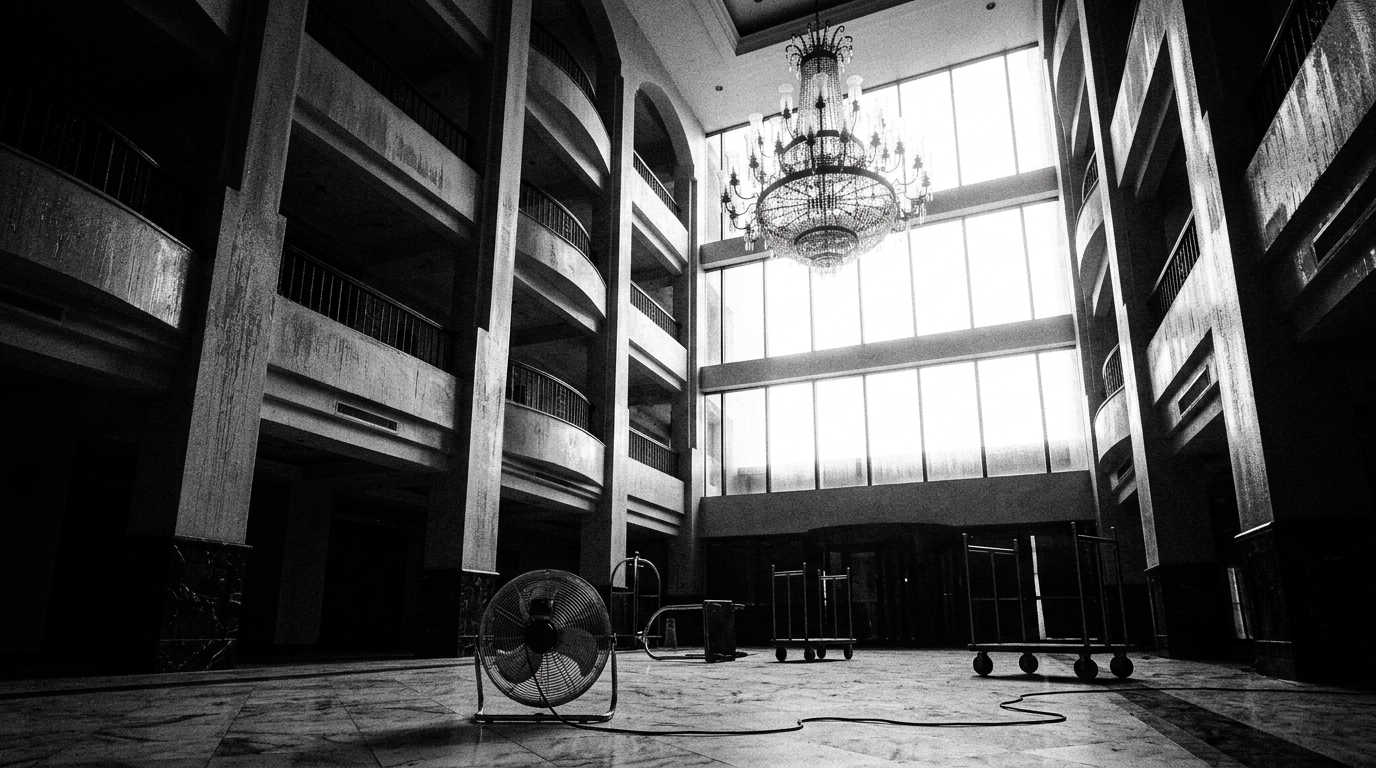
That card is what I keep thinking about this week. Duke Energy just got a federal emergency order allowing them to run power plants past their emissions limits to keep up with demand. ERCOT in Texas is forecasting peak demand above 92 gigawatts... a record. Heat index values across a corridor from Texas to the Carolinas are pushing 106 degrees. This is not a forecast problem. This is a right-now problem. And the thing that should keep every GM in the Southern half of the country up tonight is this: your generator almost certainly cannot run your HVAC. It runs your emergency lighting, your fire suppression, your elevators, maybe your PMS server. It does not run the system that accounts for 50-60% of your total electrical load. So when that rolling blackout hits at 3 PM during your check-in rush... you have a building full of people, a lobby that's climbing past 90 degrees, electronic door locks that may or may not have recovered cleanly, and a front desk team that has never drilled for this scenario. That's not an inconvenience. That's a safety liability and a reputation event rolled into one afternoon.
Here's what makes this different from the generic "be prepared for summer" advice you've heard a hundred times. The grid is structurally more fragile than it was five years ago. Population growth, data centers, crypto mining facilities... they've all piled onto infrastructure that was already aging. The 2003 Northeast blackout data is instructive and terrifying: 98% of affected hotels lost air conditioning, 89% lost computers and cooking systems, 88% lost elevators. Eighty-five percent of hotels with generators maintained power to their critical systems. But "critical systems" and "guest comfort systems" are two very different lists, and nobody in that lobby cares about the distinction. They care that it's 100 degrees in their room and the ice machine is dead.
The financial angle here is real and it's hiding in plain sight. Hotels spend an average of $2,196 per available room per year on energy. HVAC is more than half of that. Demand response programs... where your utility pays you to reduce load during peak events... can cut 10-15% off your summer energy costs. Marriott ran a program across 264 properties with projected savings of $9.9 million over five years. Some utilities offer $50 per kilowatt of demand reduction. That's not pocket change for a 200-key property. But enrollment requires advance setup, and if you haven't signed up yet, you're leaving real money on the table while also carrying the full risk of a grid event you have no buffer against.
And then there's the labor piece that nobody wants to talk about until somebody gets hurt. Your valet staff, your pool attendants, your maintenance crew working the loading dock or the roof... OSHA heat illness standards require water, rest, and shade, and enforcement is tightening. One heat-related incident involving a hotel employee this summer in Texas or Florida or Georgia, and you're looking at a workers' comp claim, an OSHA investigation, and a local news story that will do more damage to your employer brand than anything your competitors could cook up. The cost of shade structures and hydration stations and adjusted break schedules is trivial compared to the cost of getting this wrong. This is one of those things where the Invisible P&L is working against you... the expense of prevention never shows up as a line item, but the cost of failure will eat you alive in ways that don't hit the P&L until it's too late to do anything about them.
If you're running a property anywhere from Texas to the Carolinas, here's what you do this week... not next month, this week. First, pull your generator load sheet and know exactly what it covers. If you don't have a laminated list on the generator room door, make one today and make sure your MOD, your front desk leads, and your chief engineer can recite it from memory. Second, call your utility company Monday morning and ask about demand response enrollment. Even if you can't get into a program this week, you need to know what's available for the rest of the summer. Third, run a power failure drill with your front desk team. Not a tabletop exercise... an actual walkthrough of what happens when the PMS goes down, the key system reboots, and you've got 40 arrivals standing in a lobby with no air conditioning. Who does what, in what order, with what tools. Fourth, audit your outdoor staff exposure right now. Water stations, shade, mandatory break schedules, a thermometer someone actually checks. An OSHA heat citation starts at $16,131 per violation. A hospitalization makes that look cheap.