Today · Aug 2, 2026
Barry Diller Wants MGM at $48.30. The Market Already Said No.

Barry Diller Wants MGM at $48.30. The Market Already Said No.

People Inc.'s $18 billion bid for MGM Resorts prices the company at a 24% premium to its 30-day average, but shares immediately traded above the offer, and now a wave of shareholder investigations is asking the question the board should have anticipated from day one.

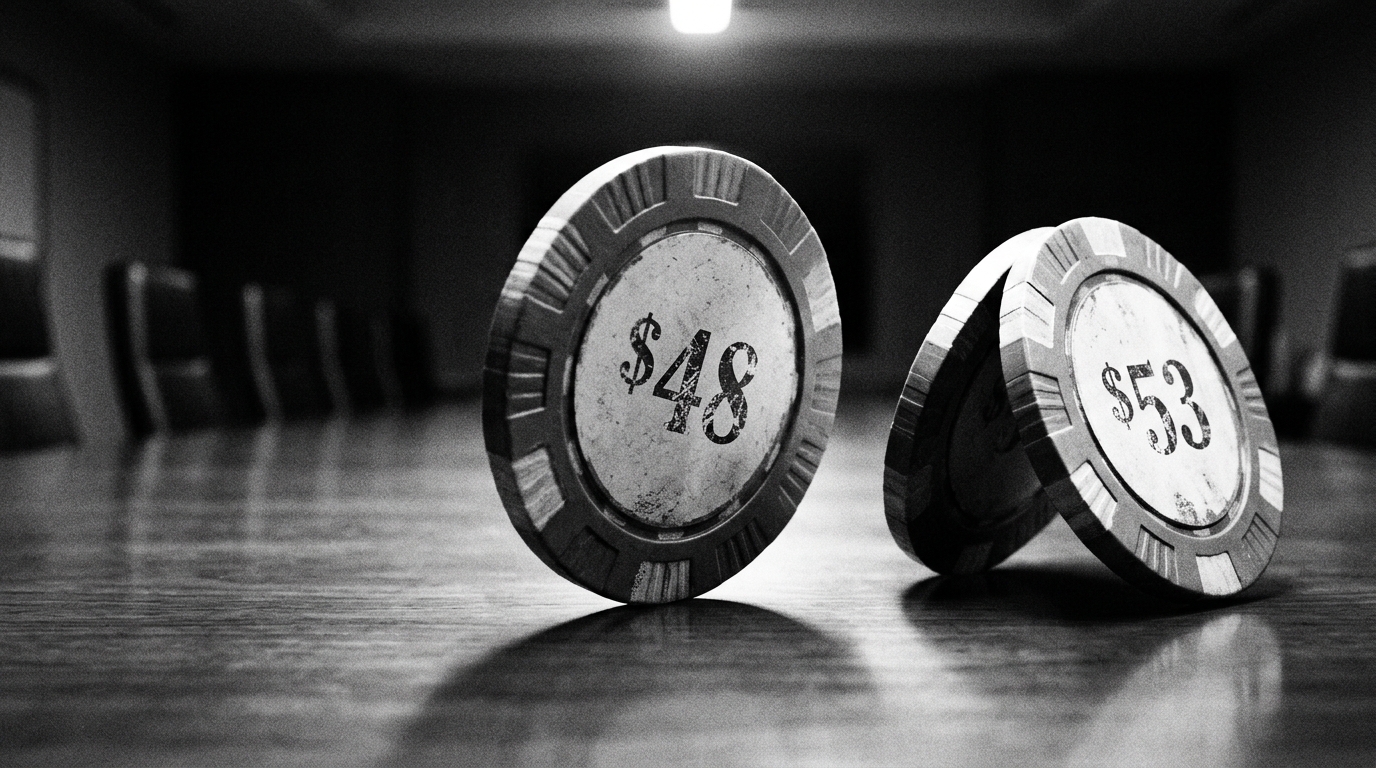
MGM shares closed at $50.69 the day after People Inc. dropped its $48.30-per-share bid. The market priced the offer as a floor, not a ceiling. That's a 5% gap between what Diller is offering and what public investors think the company is worth. When the market trades through your premium on day one, your "premium" isn't one.

Let's decompose this. The $18 billion enterprise value implies a valuation on MGM's $42.2 billion asset base that looks modest before you even factor in BetMGM's digital growth trajectory or the Osaka integrated resort. JPMorgan moved its target to $53. Stifel downgraded to Hold not because they think the deal is bad, but because they think $48.30 undervalues the company and the uncertainty isn't worth the position. Two different conclusions, same underlying finding: the bid is light.

The legal investigations are procedurally predictable but structurally significant. Barry Diller sits on MGM's board. People Inc. owns 26.1% of MGM. The buyer's chairman is a director of the target. Under Delaware law, that conflict requires a level of process rigor that most boards find uncomfortable... independent committees, fairness opinions, and a standard of review that assumes the transaction is unfair until proven otherwise. Diller has said he'll recuse himself from board deliberations. Recusal is necessary. It is not sufficient. The shareholder plaintiffs' bar knows this, which is why multiple firms filed investigations within weeks.

The real question for anyone watching this from the investment side: what does Diller actually need to pay? MGM's trailing EBITDA, its development pipeline, and its digital optionality all argue for a number north of $53. An owner I spoke with last year during a different gaming deal put it simply: "When the acquirer is also on the board, the first offer is never the real offer. It's the opening bid dressed up as a final number." People Inc. has the balance sheet capacity to go higher. The question is whether the board has the independence to demand it.

For hotel-focused investors and asset managers tracking gaming-adjacent hospitality, this deal's outcome sets valuation benchmarks across the sector. If MGM trades at $48.30, that reprices every integrated resort asset in the market. If it trades at $55-plus, the Fertitta-Caesars deal at $17.6 billion starts looking like a different conversation. The per-key math on MGM's Strip portfolio alone suggests the current bid leaves substantial value on the table. The legal investigations aren't just shareholder theater. They're the mechanism that forces the real number into the open.

Operator's Take

Look... if you're in gaming-adjacent hospitality or you've got ownership groups that also hold gaming exposure, this one matters. The MGM bid sets the pricing floor for integrated resort assets across the Strip and beyond. If you're an asset manager benchmarking hotel valuations against gaming comps, don't use $48.30. The market has already told you that number is wrong. Use $53 as your starting point and stress-test from there. And if your ownership group holds any MGM shares directly, make sure they know about the shareholder investigations before they read about it in the Journal. Be the person who brings the context, not the one who gets asked about it later.

— Mike Storm, Founder & Editor
Read full analysis → ← Show less
Source: Google News: MGM Resorts
Fertitta's $31 a Share for Caesars. Four Law Firms Think You're Getting Shortchanged.

Fertitta's $31 a Share for Caesars. Four Law Firms Think You're Getting Shortchanged.

Caesars shareholders are being offered $31 per share while multiple analysts had the stock pegged at $35, and now a growing pile of law firm investigations is asking the question nobody on the board apparently wanted to answer: is Tilman Fertitta getting a $17.6 billion empire at a discount?

So here's what's actually happening. Fertitta Entertainment is buying Caesars Entertainment for $31 a share in an all-cash deal valued at roughly $17.6 billion (that includes about $11.9 billion in Caesars' existing debt, which... yeah, that's a number). The board approved it. The press release called it a "compelling premium." And now at least four different law firms have launched investigations into whether the board did its job.

Let's talk about why. Before this deal leaked, multiple Wall Street analysts had CZR price targets at $35 a share. Deutsche Bank, J.P. Morgan, Stifel, TD Cowen... all at $35. The offer is $31. That's an 11% gap between what the analysts thought the stock was worth and what the board agreed to accept. The board is pointing to a 49% premium over the "unaffected" share price from February 25, which sounds impressive until you remember that CZR had been beaten down significantly before that date. A 49% premium on a depressed stock can still land you below fair value. That's not complicated math. That's the kind of thing my family would catch on the back of a napkin.

Now, law firm investigations around M&A deals are not unusual. Happens all the time. Ambulance-chasing? Sometimes. But the underlying question here is legitimate: did the Caesars board adequately explore alternatives, or did they take the first credible offer that gave them a headline premium? There's a go-shop period running through July 11, which means other buyers can theoretically step in. But go-shop provisions are notoriously ineffective... they exist to provide legal cover, not to genuinely invite competition. The deal structure, the breakup fees, the information asymmetry... all of it makes a competing bid harder than the "we're open to alternatives" language suggests.

Here's the technology angle that nobody's discussing. Caesars has been pouring money into its digital infrastructure. Their iGaming segment hit $80 million in adjusted EBITDA in Q2 2025, a 100% year-over-year increase. They committed $600 million in capex for 2025 alone, including new iGaming platforms. That digital buildout represents real value that's harder to price in a traditional gaming company valuation model. When you're evaluating Caesars at $31 a share, you're pricing 52 physical properties AND a rapidly scaling digital gaming operation AND the Caesars Rewards loyalty ecosystem (one of the largest in gaming). The question isn't whether $31 is more than the stock was trading at. The question is whether $31 captures the value of assets that are still on their growth curve. I'd argue it doesn't, and I suspect the analysts at $35 were thinking the same thing.

What makes this interesting from an infrastructure standpoint is what happens post-acquisition. Fertitta has been trying to merge his Landry's restaurant and Golden Nugget casino operations with a larger gaming platform for years. That means systems integration across fundamentally different technology stacks... POS systems, loyalty platforms, property management systems, gaming management systems. I've seen what happens when acquisitions of this scale try to consolidate technology. It's never "seamless" (nothing is). The transition period creates real operational risk at property level, and the people who feel that risk first are the ones working the floor, not the ones signing the merger agreement.

Operator's Take

If you're running a property in a Caesars market... whether you're a competitor or you're inside their portfolio... pay attention to what happens between now and July 11. That's when the go-shop period closes. If no competing bid materializes, this deal closes as structured, and you need to start planning for a different competitive landscape. Fertitta's playbook is operational consolidation. He runs things lean. If you compete against Caesars properties in your market, expect a transition period where their service delivery gets uneven (it always does during ownership changes this big). That's your window. If you're inside the Caesars system, get ahead of the technology migration conversation now. Don't wait for the new ownership group to tell you what's changing. Map your current systems, document your integrations, and know exactly what breaks if they swap platforms. The operators who survive acquisitions are the ones who walk into the transition meeting with answers, not questions.

— Mike Storm, Founder & Editor
Read full analysis → ← Show less
Source: Google News: Caesars Entertainment
End of Stories