Today · Jul 30, 2026
Summer Travel Isn't Dying. It's Just Getting Cheaper at the Edges.

Summer Travel Isn't Dying. It's Just Getting Cheaper at the Edges.

Americans are still booking summer trips, but they're cutting dining, shopping, and entertainment before they cut the hotel room. If you think that's good news for your property, you're only reading half the data.

Available Analysis

I worked with a GM years ago who had a theory about recessions. He said guests never stop coming... they just stop spending once they get here. The minibar stays closed. The restaurant gets skipped for the Applebee's across the highway. The spa goes unbooked. "They're sleeping in my beds," he told me once, "but they're not living in my hotel." He tracked it by ancillary revenue per occupied room. When that number started sliding, he knew the squeeze was on... usually six weeks before occupancy caught up.

That's exactly what this new AHLA data is showing, and I don't think enough operators are reading it the right way. Yes, 56% of Americans are still planning a summer trip. That's the headline everyone wants to run with. But dig one layer deeper: 43% are cutting shopping, 39% are cutting dining out, and 26% are slashing entertainment spending... all before they touch the hotel line item. Only 24% say they're reducing what they spend on accommodations. On the surface that sounds like a win for hotels. Rooms are the last thing to get cut. Great. But if you're running a full-service or upper-upscale property where 30-40% of your revenue comes from F&B, spa, and ancillary... those guests just told you they're coming to sleep. Not to spend. Your occupancy might hold. Your total revenue per guest is about to get thinner.

And the averages are lying to you. Squaremouth says the average summer trip now costs $9,032... up 17% from last year. Deloitte says travelers expect to spend $4,049 on their longest trip, also up 17%. Those are big numbers that sound healthy until you realize what's underneath them. This is a K-shaped market. The affluent traveler is spending more (a lot more), pulling the average up. The middle-market traveler... the one who fills your 150-key select-service in a secondary market... is the one cutting the dining, shortening the trip, and driving instead of flying. CoStar upgraded its full-year RevPAR forecast to 2.8% growth, which is a nice rebound from the 0.3% decline in 2025. But national RevPAR is a weather report. Your comp set is the forecast that actually matters. If you're in a market that's not hosting World Cup matches or America 250 celebrations (and most of you aren't), your experience of this summer may look nothing like the national number.

Here's what I think operators are missing in all the optimistic framing: the guest behavior shift is structural, not temporary. People aren't just cutting back because gas is expensive this month. They're reprioritizing. Travel is moving from "experience economy" (where the whole trip is the spending event) to "accommodation economy" (where the room is the one thing they protect and everything else gets sacrificed). That's a fundamentally different guest than the one you built your F&B concept and your rate strategy around. The property that figures this out first... that adjusts the offering to match the guest who shows up versus the guest they wish would show up... that's the property that wins the summer. The one that keeps running the same playbook hoping the minibar starts moving again is the one that's going to wonder in September why GOP didn't track with occupancy.

Look, I'm not saying the sky is falling. Demand is real. People want to travel and they're proving it with bookings. But "they're still coming" and "they're still spending" are two very different sentences, and this data makes it clear we're living in the first one, not the second. The smart play right now isn't celebration. It's recalibration.

Operator's Take

This is what I call the National Number Trap. CoStar's 2.8% RevPAR growth and those $9,000 average trip costs are portfolio-level numbers that may have zero relationship to your Tuesday night in June. If you're a GM at a select-service or a limited F&B property, pull your ancillary revenue per occupied room for the last 90 days and compare it to the same window last year. If it's down more than 5%, your guests have already made their spending decisions and you need to adjust... whether that means repackaging F&B into grab-and-go value bundles, pushing rate on the room itself (since that's the last thing they'll cut), or renegotiating your food cost with suppliers before margin erodes further. For full-service GMs, go look at your restaurant covers per occupied room. If that ratio is sliding, don't wait for ownership to notice it on the monthly. Bring them the data, bring them your plan, and frame it as "here's what's changed and here's what we're doing about it." That's how you run the building.
Read full analysis → ← Show less
Source: Google News: AHLA
The World Cup Demand Spike Isn't a Spike. It's a Reshuffling.

The World Cup Demand Spike Isn't a Spike. It's a Reshuffling.

Sojern's data shows flight bookings to World Cup host cities are surging while hotel searches are dropping 16%, which means guests are coming but waiting to book rooms. If you're in a host city banking on sustained demand beyond match days, the numbers have a different story to tell.

Available Analysis

I worked with a GM once during a Super Bowl host rotation who told his ownership group six months out that they were going to crush it. Room nights, F&B, banquets... the whole thing. By the time the game actually happened, he'd sold 80% of his inventory at a premium, felt great about it, and then watched the city go dead for three weeks after the confetti got swept up. He pulled forward demand that would have come anyway, spiked his costs with temporary labor and security, and when he ran the full quarter numbers, his NOI was almost flat. "I made a fortune on Thursday through Sunday," he told me. "And I paid for it Monday through March."

That's what I see happening right now across 16 World Cup host cities, except it's messier because the demand isn't even distributed. Houston is up 10.4% on flight bookings. Dallas up 8.7%. New York up 8.8%. Great. But Seattle is down 20.6%. The Mexican host cities are getting hammered... Mexico City down nearly 25%, Guadalajara about the same. So this isn't a rising tide lifting all boats. It's a wave moving sideways, and if you're not in its direct path, you might actually be worse off than a normal summer because the World Cup is pulling attention (and travelers) toward the cities that have games and away from everywhere else.

Here's the number that should keep you up tonight if you're a revenue manager in a host city: hotel searches are down 16% year-over-year even though flight bookings are up 13%. Let that disconnect sit for a second. People are buying plane tickets and NOT booking hotel rooms. A third of summer bookings haven't been made yet. That's not pent-up demand waiting to explode... that's price sensitivity. Travelers are watching rates, waiting for the market to soften, and they're going to book late at whatever number they can get. If you pushed rate aggressively in anticipation of a demand wave, you might be sitting on unsold inventory two weeks from now wondering what happened. Meanwhile, AHLA's own survey says 80% of hoteliers are reporting bookings below initial forecasts. Eighty percent. The gap between what we all expected and what's actually materializing is significant, and the reasons are structural... FIFA room block cancellations, visa processing delays for international visitors, rising travel costs pushing domestic travelers to wait and watch.

And here's what nobody's talking about: the composition of this demand. Nearly half of World Cup bookings are solo travelers. Solo. That means one guest per room, lower F&B spend per occupied room, and minimal ancillary revenue from the kind of group and family travel that actually drives property-level profitability. You're getting heads in beds, but the revenue per guest is thinner than what a summer family traveler or a corporate group delivers. The UK is the top international source market at 19.4% of bookings, followed by Brazil, Germany, Japan, Colombia. These are real travelers, but they're match-day travelers... they show up, they watch the game, they leave. The occupancy spike looks great on the day. The drop-off the next day is where your GOP takes the hit because your labor model, your food prep, your housekeeping schedule... all of it was built for the spike, not the valley.

This is what I call the National Number Trap. The $10.9 billion revenue figure being thrown around sounds incredible. But that's a national number across three countries, 16 cities, and an entire summer. Your hotel doesn't operate at the national level. Your hotel operates in a three-mile radius where match-day demand is either there or it isn't, where the traveler is either booking or waiting, and where your costs are fixed whether the rooms fill or not. The operators who win this summer aren't the ones chasing the spike. They're the ones who manage their cost structure for the valleys between games and capture every dollar of the peaks without overextending. If you're not in a host city, understand that some of your normal summer demand may have migrated toward one. That's not a crisis, but it's real, and your comp set data over the next 60 days is going to tell you how much.

Operator's Take

If you're a GM or revenue manager in a host city, stop waiting for the demand wave to hit and look at what's actually on the books right now versus what you projected. If you're pacing below forecast (and statistically, there's an 80% chance you are), do not panic-cut rate. That late-booking solo traveler is coming regardless... the flight's already purchased. Hold your rate discipline inside 72 hours of match days and flex your shoulder nights. Pull your F&B labor schedule back on non-match days immediately... solo travelers aren't ordering bottles of wine at dinner. If you're NOT in a host city, run your comp set numbers this week and look for displacement. Normal summer leisure may be thinner than usual in your market because those travelers went to Houston or Dallas instead. That's not a trend... it's a six-week disruption. Don't retrain your rate strategy for a temporary dip.

Read full analysis → ← Show less
Source: Google News: Hotel Industry
Gas Dropped 60 Cents. Your Summer Rates Shouldn't Still Be Stuck in May.

Gas Dropped 60 Cents. Your Summer Rates Shouldn't Still Be Stuck in May.

Consumer sentiment just bounced off a record low, gas prices are down 60 cents from their May peak, and the Iran deal is pushing oil even lower. If your drive-to property is still holding rates based on the doom scenario from six weeks ago, you're pricing for a world that doesn't exist anymore.

Available Analysis

I worked with a revenue manager years ago who had a rule she called "the parking lot test." Every Friday afternoon she'd walk outside and count cars with out-of-state plates. If the number was climbing week over week, she'd bump weekend rates before she even opened the RMS. If it was dropping, she'd hold or trim. No algorithm. Just eyes. She was right more often than the $40K system her management company eventually forced her to use.

I keep thinking about her this week, because the parking lot just changed and a lot of revenue managers haven't looked outside yet.

Here's what happened in the last 30 days. Gas peaked near $4.50 a gallon in May. The Iran peace deal opened up oil exports, Brent crude dropped over 20% in June to around $72 a barrel, and the national average is sitting at roughly $4.05. Michigan consumer sentiment crawled from a record-low 44.8 in May to 49.5 in June. Now... 49.5 is still terrible. It's almost 20% below where it was a year ago. Over half the people surveyed are still complaining about prices every time they open their mouths. This is not a boom. Let me be very clear about that. But it IS a shift in direction, and for drive-to leisure properties specifically, direction is what matters right now.

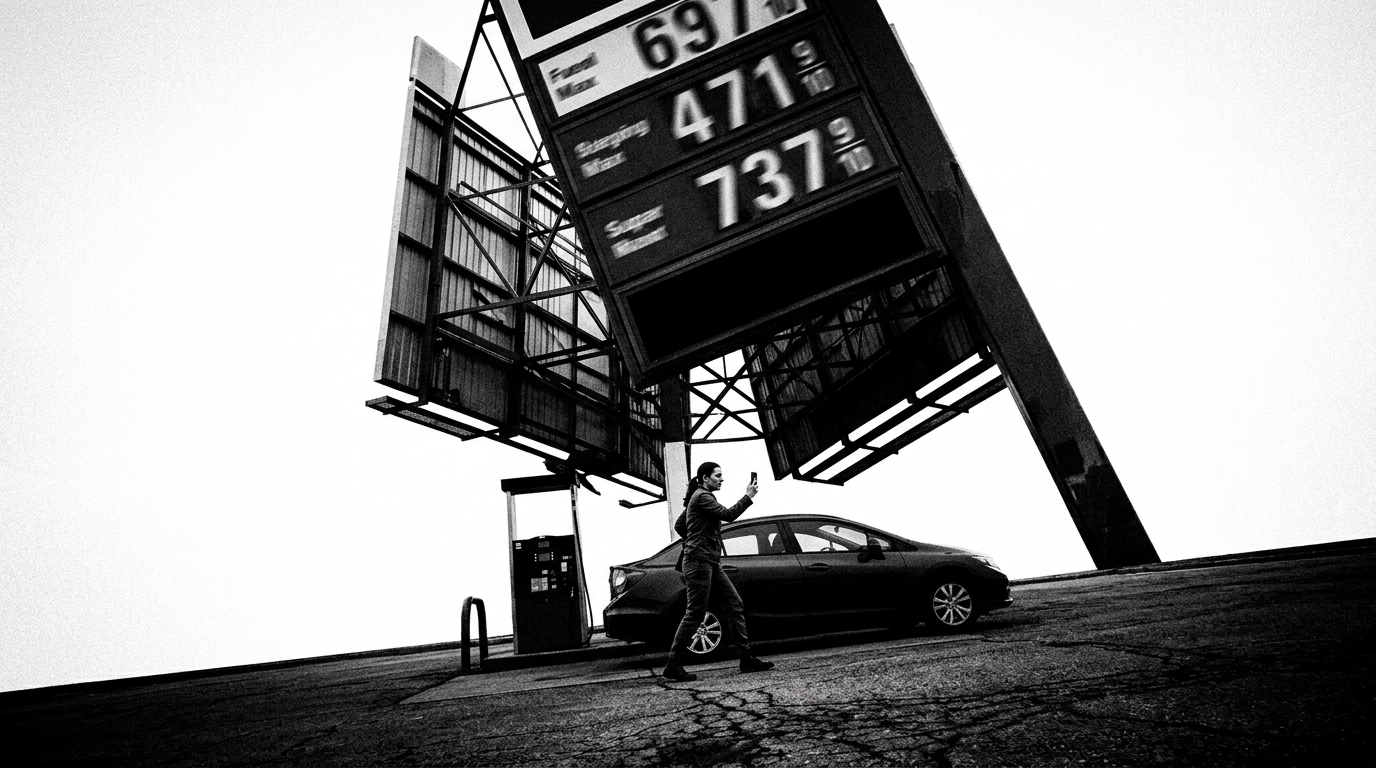
The source material does the math on the actual gas savings for a family road trip... about $6.40 on a 300-mile round trip. And they're right, that's not life-changing money. Nobody's booking a resort weekend because they saved six bucks on gas. But that completely misses how gas prices work psychologically. Gas stations post their prices on 20-foot signs visible from the highway. It's the single most visible price in the American economy. When that number drops, people FEEL like things are getting better even if their grocery bill hasn't moved. It's a permission slip. "Gas is down, let's go somewhere this weekend." I've seen this cycle play out four or five times in my career. The demand response to falling gas prices at drive-to properties is almost always faster and stronger than the underlying savings justify. And this time it's happening right before the Fourth of July, which AAA is tracking as a travel window starting today... June 27 through July 5.

Here's what concerns me. CoStar just upgraded their full-year forecast to 2.8% RevPAR growth, driven mostly by rate. Expedia is reporting last-minute bookings (made within 14 days of check-in) up 16% for the holiday window, with budget-filter searches for Fourth of July travel up over 1,200% compared to last year. That's demand looking for a deal. If you're a drive-to property still sitting on the conservative rate strategy you set when the world felt like it was ending in May, you have a mismatch. Demand is waking up and your rates are asleep. But if you read that Expedia stat and think "great, I'll spike rates $30 for the holiday weekend"... you're going to push that price-sensitive demand right into the vacation rental next door. The window here is narrow and specific: test rate elasticity on shoulder dates first. See what the pickup looks like at $10-$15 above where you're sitting. Watch your booking pace for the next 10 days. The travelers making decisions right now are making them fast and they're still value-conscious... sentiment is better, not good.

The other thing nobody's talking about is what this means for the REST of summer, not just the Fourth. The Iran deal has a 60-day sanctions waiver baked in. Oil is repricing structurally, not just on a headline. If gas stays in this range through August, you've got six to eight weekends of potential demand recovery at drive-to properties. That's not a one-weekend repricing exercise. That's a summer strategy revision. And the properties that figure this out this week... not next week, not after the holiday, THIS week... are the ones that capture the demand while everyone else is still running May's playbook.

Operator's Take

If you're running a drive-to leisure property within three to five hours of a major metro, here's what I'd do before Monday. Pull your rate strategy for every weekend through August 15. Compare it to what you set in May. If those rates haven't moved, they're wrong... the demand signals have shifted and your pricing needs to reflect that. Start with shoulder nights (Thursday, Sunday) for the Fourth of July window and test $10-$15 above current positioning. Watch your 72-hour pickup. This is what I call the Rate Recovery Trap in reverse... you held conservative rates for good reason six weeks ago, but holding them too long trains the market to expect a discount you don't need to give anymore. Don't spike aggressively (this is a relief rally, not 2019), but don't leave money on the table because you're still emotionally pricing for May. And call your OTA market manager... ask what search volume looks like for your comp set right now. That conversation costs you nothing and tells you everything about whether demand is real or I'm just an old guy reading tea leaves.

Read full analysis → ← Show less
Source: Gurufocus
Airlines Are Selling Out This Summer. If Your Pace Report Isn't Keeping Up, You Already Know Why.

Airlines Are Selling Out This Summer. If Your Pace Report Isn't Keeping Up, You Already Know Why.

Every major airline is reporting record summer bookings while quietly raising fares 15% on domestic routes. That's a demand signal and a warning in the same sentence... and the hotel operators who read it correctly this week will outperform the ones who figure it out in August.

Available Analysis

I worked with a revenue manager years ago who had a rule. Every time the airlines released forward booking data, she'd pull her own pace reports within 24 hours and put them side by side. Not because the numbers always correlated perfectly... but because when they diverged, that divergence was the most important thing happening in her market. She called it her "smoke detector." If planes are filling up and your hotel isn't, something is on fire somewhere in your pricing, your distribution, or your product. You just can't smell it yet.

Right now, the airlines are projecting 5.1 billion passengers globally in 2026. Load factors are hitting 84%. Domestic fares are up roughly 15%, international about 12%. That's not soft demand... that's a tidal wave of travelers about to hit destination markets, gateway cities, and airport corridors. But here's the part that matters for your Tuesday afternoon: IATA just cut its 2026 airline profit forecast nearly in half... from north of $40 billion down to $23 billion. Net margin for the entire global airline industry is sitting at 2%. Jet fuel jumped 70%, pushing airline fuel costs to $350 billion. The airlines are passing every dime of that to the traveler. And the traveler is going to arrive at your hotel having already spent more than they planned. That's the setup. Record demand. Compressed wallets. The guests are coming. They're just going to be pickier about what they spend once they get there.

This is the dynamic that kills full-service hotels if you're not paying attention. Your resort in a fly-to market might see strong occupancy... but your ADR ceiling just got lower. A guest who paid 15% more for the flight is not the same guest who paid last year's fare. They're cutting somewhere. They're skipping the spa. They're eating off-property. They're booking the standard king instead of the suite. You can fill rooms all summer and still watch your ancillary revenue and your flow-through underperform if you're pricing to last year's traveler instead of this year's. Meanwhile, STR data shows short-term rentals grew demand nearly 5% last year while hotel RevPAR actually declined slightly. The budget-conscious traveler who just absorbed a fare increase has more alternatives than ever, and they're using them.

Here's where it gets interesting for different operators. If you're running a select-service or extended-stay near a major airport, this is your moment. Those passengers are landing, and a meaningful percentage need a room. If your pace isn't reflecting the airline demand signal, you're either priced wrong or invisible in the channel. Fix that this week, not next month. If you're at a convention hotel, you've got a different problem... strong leisure demand is going to compete with your group blocks for the same July and August inventory. Run your displacement analysis now. A group block at $189 that seemed fine in February might be costing you $220 transient demand in a market that's about to surge. And if you're an independent in a drive-to market within three or four hours of a major metro? You might be the biggest winner in this whole scenario. When flights cost more, road trips look better. Your competition isn't the Marriott downtown... it's the cost of a round-trip ticket that just went up 15%.

The national RevPAR forecast for 2026 just got bumped to around 2.8%. That sounds fine until you realize most of that growth is concentrated in luxury ADR (up nearly 6%) while select-service is grinding out maybe 2%. I call this the National Number Trap... that 2.8% is a weather report, and you don't run your hotel based on the weather in a different city. What matters is your comp set, your pace versus the demand signal, and whether you're positioned to capture the traveler who's about to show up with less discretionary budget than they had last summer. The guests are coming. The question is whether they're coming to you... and what they're willing to pay when they get there.

Operator's Take

Here's what I'd do this week if I were back behind the desk. Pull your pace reports for July and August today... not Monday, today... and compare them against the same period last year. If airline bookings in your market are up and your pace is flat or soft, you've got a pricing or distribution problem and you need to find it before those rooms go somewhere else. If you're at a full-service or resort property, model a scenario where your ADR comes in 5-8% below what you budgeted. Not because demand is weak... because the guest already spent their upside on the plane ticket. Stress-test your ancillary revenue assumptions too. For convention and group-heavy hotels, revisit every group block you're holding for July and August and run displacement against current transient demand. You may be sitting on inventory that's worth more on the open market right now. And if you're an independent in a drive-to market, this is the week to push your digital marketing hard... you're the value play for every family that just priced out a flight and decided to drive instead. Don't wait for them to find you. Go get them.

Read full analysis → ← Show less
Source: InnBrief Analysis — National News
Gas Prices Dipped. You've Got Maybe Three Weeks Before the Window Closes.

Gas Prices Dipped. You've Got Maybe Three Weeks Before the Window Closes.

Consumer sentiment just bounced for the first time in months, and gas prices are down almost 50 cents from May's peak. If you're running a drive-to leisure property and your revenue manager isn't already watching 7-day pickup pace, you're about to miss the only clean demand signal you'll get before July 4th.

Available Analysis

A revenue manager I worked with years ago used to keep a gas station price tracker on her phone. Not the GasBuddy app... a spreadsheet she'd built herself that tracked the Exxon on the interstate exit closest to our property. She checked it every morning before she checked STR. I thought it was quirky until I realized she was outperforming her comp set by 400 basis points on summer weekends. She wasn't smarter about rate strategy. She was smarter about when demand was coming.

That's exactly the moment we're in right now. National average gas hit $4.56 on May 21st. By June 11th it was down to $4.12. Some markets are already under $4.00. The University of Michigan consumer sentiment index jumped to 48.9 in June... up 9.2% from May's all-time low of 44.8. That's still ugly (we're 19% below June of last year), but the direction matters more than the number right now. When gas drops this fast, families who mentally canceled the summer road trip start uncanceling it. The research is consistent on this... lower-income households respond to gas prices first and fastest, and those are your drive-to leisure bookings. The conversion from "maybe we should go somewhere" to an actual reservation happens inside of two to three weeks.

Here's the problem. This is a sentiment bounce, not a sentiment recovery. CPI came in at 4.2% in May. Energy costs are up 23.5% year over year. Grocery prices haven't budged. Credit card balances are stretched. Year-ahead inflation expectations are still sitting at 4.6%. People feel slightly less terrible about their finances this week. That's what we're working with. Slightly less terrible. And "slightly less terrible" books differently than "confident." It books shorter stays, shorter lead times, higher cancellation rates, and extreme price sensitivity. The guest who books a three-night weekend at your lake resort this week is the same guest who cancels it in 72 hours if gas ticks back up or the next inflation print spooks them.

This is what I call the Rate Recovery Trap, and it eats revenue managers alive in exactly this kind of window. You see occupancy softening, sentiment bounces, and the instinct is to drop rate to fill the house. Don't. This is the one moment where holding rate actually works because you're not chasing demand... demand is coming to you. Every dollar you give away on rate right now is a dollar you spend the next six months trying to get back. The drive-to leisure guest booking in a sentiment window isn't comparison shopping your rate against the Hampton down the road. They're deciding whether to go at all. If they've decided to go, your rate isn't what stops them. But once you train that guest that your Friday night is $139 instead of $169, good luck getting $169 back in September.

CoStar just bumped their 2026 RevPAR growth forecast to 2.8%, up from 0.6% earlier this year. Room demand is up over 8 million room nights year-over-year through April. There's a tailwind here. But tailwinds don't help you if you're pointed in the wrong direction. The properties that win the next three weeks are the ones already monitoring pickup pace against 2025 comps, holding rate, watching cancellation velocity like a hawk, and building flexible packages that create perceived value without discounting. The properties that lose are the ones who see a sentiment headline and start cutting rate to "capture the bounce." You don't capture a bounce by giving away margin. You capture it by being ready when it arrives.

Operator's Take

If you're running a drive-to leisure property within 150-300 miles of a major metro... resort, lake, beach, mountain, extended-stay... pull your 7-day and 14-day pickup pace today and compare it to the same week in 2025. If you're seeing acceleration, that's the sentiment bounce translating to real demand. Hold rate. Do not discount into a demand signal. Build a midweek value package if you need to move distressed inventory, but protect your weekend ADR like your Q3 depends on it, because it does. Set a cancellation alert threshold... if your cancel pace jumps more than 15% over the next two weeks, gas probably spiked or another inflation number hit, and you need to shift to a shorter booking window strategy immediately. Urban and airport properties, this one isn't your fight. But for everyone within a tank of gas of a family with two kids and a long weekend... this is your window. Three weeks. Maybe less.

Read full analysis → ← Show less
Source: Theguardian
75 Million Summer Passengers. But Your Nonstop From Dallas Just Disappeared.

75 Million Summer Passengers. But Your Nonstop From Dallas Just Disappeared.

Airlines are projecting record-breaking summer travel while simultaneously cutting routes because jet fuel hit $15 a gallon at LAX. If your hotel's feeder market depends on a route that just got suspended, the macro headline is worse than useless... it's a distraction.

Available Analysis

I worked with a revenue manager once who had the best wall in any hotel I've ever seen. Not awards. Not thank-you letters. A map. Pushpins for every city that fed her property more than 50 room nights a year, with colored string connecting them to the airlines that served those routes. When I asked her why she didn't just use the data in the RMS, she said something I've never forgotten: "The system tells me where guests came from. The map tells me how they got here. When the how changes, the where follows about 90 days later."

That map is what every revenue manager at an airport-adjacent or air-travel-dependent hotel needs to be building right now... metaphorically or literally. American Airlines is projecting 75 million passengers this summer across 750,000 flights. That's a record. That's genuinely strong demand. And it is also almost completely irrelevant to you if your property depends on a route that just got axed. American suspended six domestic routes effective August 5 through October 5. Four of them out of LAX... to Cleveland, Columbus, Pittsburgh, and Washington Dulles. Two from Charlotte to Ontario and Sacramento. The reason is $15-a-gallon jet fuel at LAX (up 50% since the Iran situation escalated in March) and a system-wide fuel bill that's climbing by over $4 billion this year. They're not the only ones. Norse Atlantic killed all LAX-to-Europe summer service back in April. Allegiant rerouted LAX operations to Burbank in January. Spirit is gone entirely. JetBlue just raised its Q2 fuel cost guidance to over $4.30 a gallon. United's CEO is projecting 15-20% ticket price increases. This is not one airline having a bad quarter. This is a structural reshuffling of where passengers fly, how much they pay, and which markets win or lose seats.

Here's what this means at property level, and it's different depending on where you sit. If you're running a hotel near LAX, you're about to see a net reduction in connecting passengers and potentially in overnight stays. Four fewer American routes means fewer passengers with layovers, fewer missed connections, fewer "I'll just grab a hotel tonight and fly out in the morning" bookings. If you're in Cleveland, Columbus, Pittsburgh, or Dulles and your transient mix includes guests who flew nonstop from LA... that's gone until at least October. United still operates on all four of those routes, so the demand doesn't vanish entirely, but it concentrates onto fewer flights with higher fares. Higher fares mean fewer leisure travelers. Fewer leisure travelers mean your weekend pace is about to soften. If you're in a secondary leisure market that depended on one or two carriers for nonstop service from a major hub... you already know this feeling, because we lived through it during COVID recovery when routes came back unevenly. Some markets got their airlift back in months. Some waited years. Some are still waiting.

What bothers me about the 75 million number is how easy it is to hide behind. It's this massive, reassuring headline that makes everyone feel good about summer. And system-wide, demand IS strong. But system-wide demand is a national weather report. You don't staff your pool deck based on the national forecast. You look out your window. This is what I call the National Number Trap... the macro data tells a story that's true at 30,000 feet and potentially dead wrong at your property. Your revenue management decisions need to be made at the route level right now, not the system level. Pull your forward booking pace by feeder market. Cross-reference it against every published route suspension you can find (not just American... check JetBlue, check Spirit's old routes that nobody backfilled, check whether your regional carrier has quietly reduced frequency). The information is out there. The airlines publish schedule changes. Your GDS data shows booking pace by origin. If you're not connecting those two data sets right now, you're flying blind. Pun intended.

One more thing worth watching. The FAA has capped operations at O'Hare at 2,708 daily through October and extended caps at Newark through the same period. Construction, gate constraints, controller staffing... the usual alphabet soup of reasons. But the effect is real. Fewer operations means more delays, more misconnects, more passengers who end up needing a room they didn't plan on. If you're an airport hotel near a capped hub, that's actually a demand driver... but only if you're positioned to capture it. Walk-in rates. Mobile booking. Making sure your front desk knows to quote the rack rate with a smile when a tired passenger walks in at 10 PM because their connection evaporated. That revenue opportunity exists. But it's a Tuesday-at-10-PM opportunity, not a strategy-deck opportunity. It happens at the desk or it doesn't happen at all.

Operator's Take

If you're running a hotel that depends on air travel for more than 30% of your transient mix, stop what you're doing this week and pull your forward booking data by origin city. Match it against current airline schedules for August through October. If you see a route that's been suspended or reduced in frequency, adjust your forecast now... not in three weeks when the pace report confirms what you already could have known. For airport-adjacent properties near capped hubs like O'Hare and Newark, train your front desk team on walk-in conversion. Misconnects and delays are going to spike this summer, and every one of those stranded passengers is a potential $189 room night if your team handles it right. For properties in secondary markets that just lost nonstop service, start building your drive-to marketing now. The guest who used to fly nonstop from LAX to your market didn't stop wanting to visit. They just need a different reason to make a four-hour drive instead.

Read full analysis → ← Show less
Source: News
End of Stories