Reynoldsburg Just Banned One-Night Airbnb Stays. Your Market Is Next.
A suburb of Columbus passed a three-night minimum, owner-occupancy requirements, and permit revocation rules for short-term rentals after party complaints and gunfire. If you're running a hotel anywhere near a residential market that's fed up with STR chaos, the competitive math in your comp set just shifted.
I worked with a GM years ago whose property sat about two miles from a cluster of Airbnb party houses in a residential neighborhood. Every weekend, his front desk got calls from people who'd booked one of those rentals, showed up to find the cops already there, and needed a room at midnight. He called them "refugee bookings." Loved the walk-in revenue. Hated that his market was being defined by chaos he had no control over.
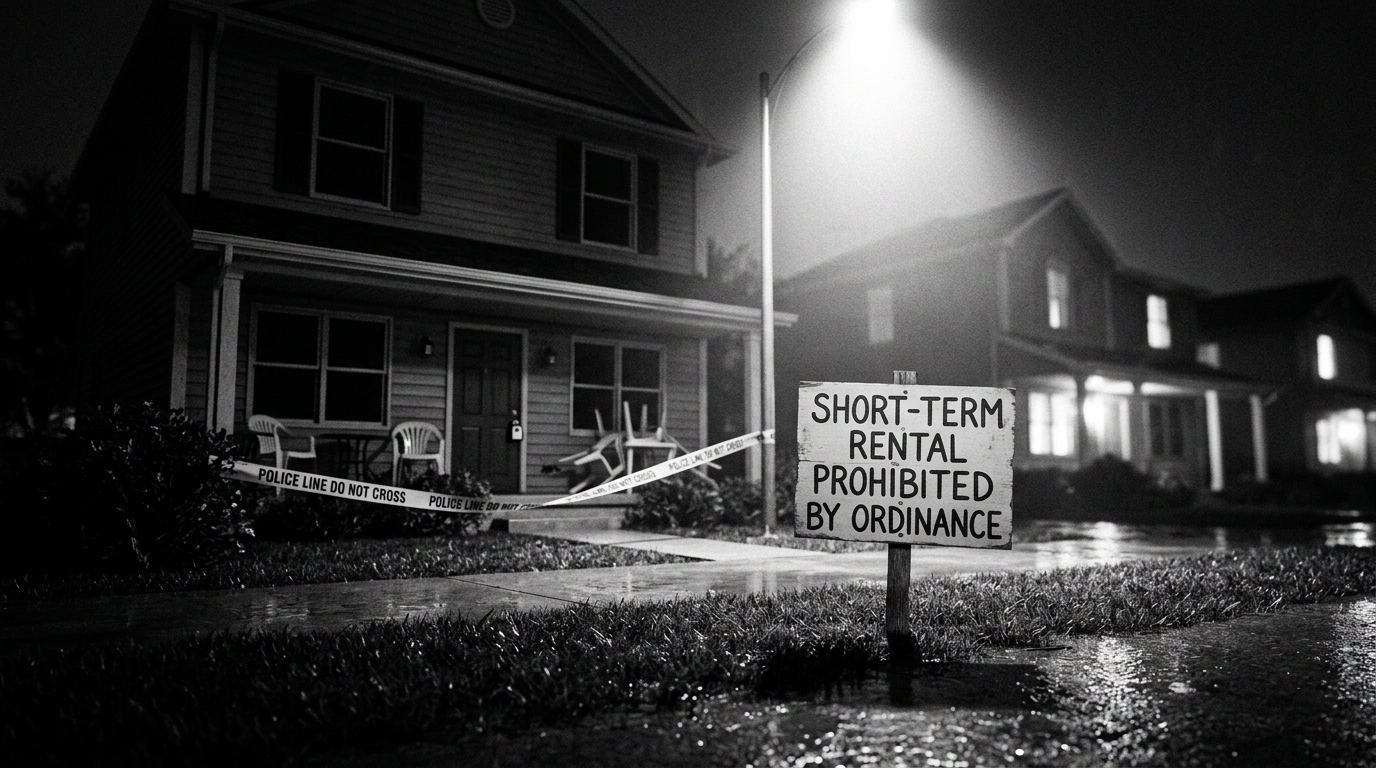
That's basically what just happened in Reynoldsburg, Ohio... except the city council decided to do something about it. On Monday they unanimously passed a short-term rental ordinance that hits hard. Three-night minimum stay. Owner must live on the property or own it as their primary residence. Two people per bedroom, max. Vehicle limits tied to garage and driveway capacity. A $225 annual permit. And here's the teeth... your permit gets revoked for noise violations, delinquent city taxes, or if your guests wander onto a neighbor's property within 500 feet uninvited. That last one is wild, but when you read that it was parties and gunfire that pushed this through, it starts making sense.
And Reynoldsburg isn't operating in a vacuum. Cleveland passed STR regulations a month ago with a $150 annual license, $500,000 liability insurance requirements, and density caps at 10% of units on a block. Bowling Green added registration requirements and hotel lodging tax for STR operators. The Ohio statehouse is debating statewide legislation right now... some of it aiming to prevent cities from banning STRs outright, some of it pushing for increased taxes on these properties. The patchwork is growing fast, and every new ordinance makes it harder to operate a short-stay rental as a pure investment play. The three-night minimum alone kills the weekend party booking model entirely.
Here's what I want you to pay attention to if you're operating in a secondary or suburban market where STRs have been eating your weekend transient demand. These ordinances don't add supply to your comp set. They remove it. Every investor-owned rental that doesn't qualify under owner-occupancy rules disappears. Every one or two-night demand generator that was going to an Airbnb now needs a hotel room. That's real, tangible compression for your Friday and Saturday nights. But don't get comfortable... this only works in your favor if your product is ready to absorb that demand at rate. If your property is the fallback option because the party house got shut down, you're not winning market share. You're catching overflow. There's a difference, and your ADR will tell you which one you are.
The bigger pattern here is something I've been watching for about three years now. The regulatory pendulum on short-term rentals has swung decisively toward restriction in markets where safety incidents made the news. A shooting at a Columbus STR on July 4th last year killed one person and injured five. That's the kind of event that turns a neighborhood association complaint into a city council vote. And once one municipality acts, the surrounding communities follow fast because nobody wants to be the last suburb without rules... the one that absorbs all the displaced party traffic. If you're in central Ohio, this is already your reality. If you're in any metro area where STRs have generated police calls, you should be watching your own city council agenda. This wave isn't slowing down.
Pull your weekend transient pickup from the last 90 days. Compare it to the same period two years ago. If Friday-Saturday is softer than it used to be and you can't explain it with rate or renovation... STR displacement might already be working against you. These new regulations could reverse that. Worth knowing before someone else figures it out first. Second thing. Go find your city council meeting minutes from the last six months. If short-term rental regulation has come up even once, you need to be in that room. Show up. Be the hotel operator who says "we support fair regulation and we're here as a resource." I've seen that kind of visibility pay off in ways a marketing budget never could. And if the demand does shift your direction... make sure your rate strategy is ready to capture it at proper ADR. Not just fill rooms because someone's Airbnb got shut down. There's a version of this where you win, and a version where you just become the overflow valve. The difference is whether you're paying attention right now.
