Expedia's Board Members Are Getting Paid in Stock Nobody's Buying on the Open Market
Expedia directors pocketed stock units worth $0 on paper as routine compensation while executives quietly sold $1.3 million in shares over the last 90 days. The divergence between who's accumulating and who's cashing out tells you more than the Q1 earnings headline ever will.
A batch of Form 4 filings hit the wire on July 1 for Expedia Group, and the financial press dutifully reported them like they meant something. Directors picking up a few dozen stock units each as part of their deferred compensation plan. Price paid: $0.00. Not because the stock is worthless... because these aren't purchases. They're grants. The kind of thing that happens every quarter at every publicly traded company in America. It's the corporate equivalent of direct deposit hitting your checking account on a Friday.
Here's why I'm writing about something this mundane. Because what's interesting isn't the filing. It's the contrast. While board members are accumulating small positions through automatic compensation (we're talking 37 units here, 34 units there... rounding errors against Expedia's market cap), executives inside the company have been net sellers to the tune of $1.3 million over the last 90 days. That's not a scandal. Executives sell stock all the time for perfectly legitimate reasons. But when the people running the company are lightening their positions while the board is only "buying" because their comp plan requires it... that's a data point. Write it down. Don't panic over it. Just write it down.
The bigger picture matters more to anyone in this industry who depends on OTA volume. Expedia just posted a 15% revenue jump in Q1 to $3.4 billion. Gross bookings up 13% to $35.5 billion. Highest first-quarter profitability in company history. They're buying CarTrawler, expanding their B2B segment (which grew 25%), and rolling out AI tools that will make their marketplace stickier for suppliers. That's you, by the way. You're the supplier. And "stickier" means harder to leave, not better for your margins. Their B2B revenue growing at 25% means more of your distribution is flowing through pipes they control, priced the way they want to price it. Every percentage point of growth on their earnings call is a percentage point of leverage at your negotiating table.
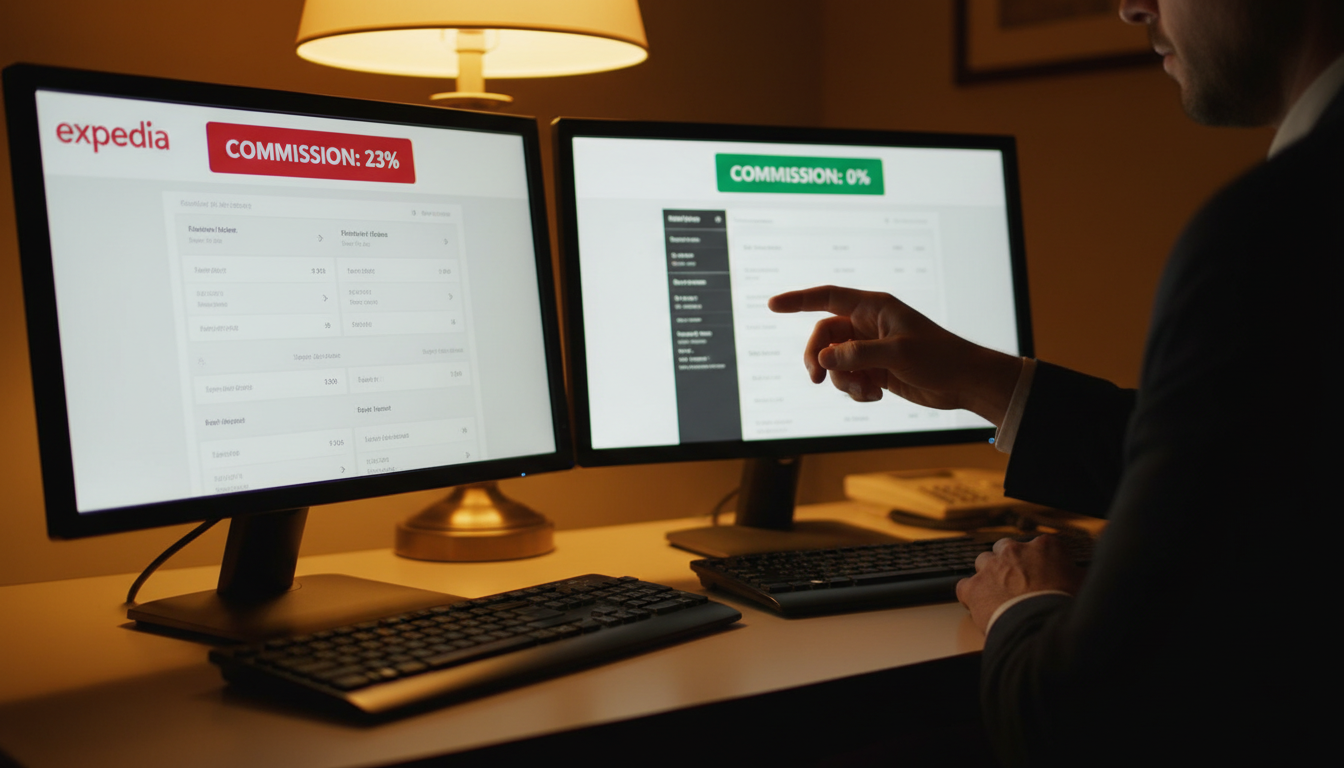
I've seen this movie before. An OTA posts record numbers, analysts upgrade the stock, and the trade press writes it up like it's good news for hotels. It is good news... for Expedia. For you, the operator paying 15-25% commission on every booking they send you, their record profitability is your cost of acquisition going in exactly the wrong direction. Their $700 million share buyback came from somewhere. Some meaningful chunk of it came from your rooms revenue. That filing cabinet of Form 4s everybody got excited about? It's a distraction from the real filing you should be reading... your own channel cost analysis.
The stock is trading around $263 with analysts split between buy and hold, and at least one valuation model suggesting it's 27% overvalued. The board members accumulating units at zero cost aren't making a bet on the company. They're collecting compensation. The executives selling $1.3 million aren't making a statement. They're managing personal portfolios. None of this changes your Monday morning. What should change your Monday morning is the 25% B2B growth number, because that's the wave coming at your direct booking strategy whether you're watching Expedia's insider trades or not.
If you're a GM or revenue manager at a branded or independent property, stop reading SEC filings and start reading your own channel mix report. Pull your OTA commission spend for the last 12 months and calculate it as a percentage of total revenue... not rooms revenue, total revenue. If it's trending up, you have a distribution problem that no amount of Expedia earnings analysis will fix. This week, sit down with your director of sales (or whoever owns your digital strategy) and identify your top 20 OTA-sourced repeat guests. Those are the ones you can convert to direct. Start there. The OTAs are getting stronger, more profitable, and more embedded in your distribution every quarter. The only hedge you have is owning more of your own demand. Build that muscle now while your top line is still healthy enough to invest in it.