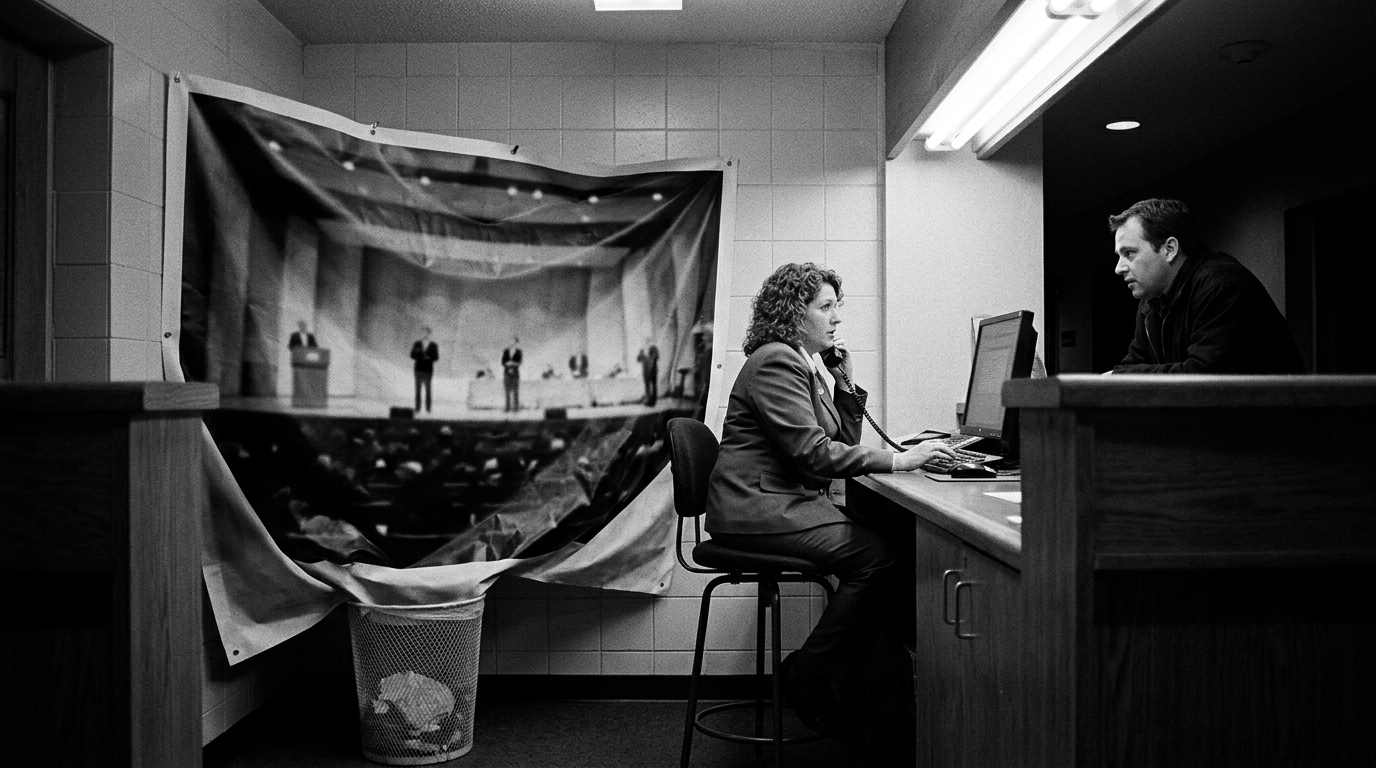
Hotel CEOs Spent Three Days Talking AI. The Night Auditor Still Can't Get It to Work.
Every major hotel CEO showed up at NYU IHIF this week promising AI will transform operations, boost RevPAR, and personalize the guest experience. The gap between what gets announced on a conference stage and what actually runs at 2 AM on a Tuesday is the only number that matters right now.
I talked to a GM last week who told me his brand just rolled out a new "AI-powered guest communication platform." Took his front desk team four hours of training. The system worked great in the demo. Then a guest texted at 11 PM asking where to find ice, and the AI responded with a paragraph about the hotel's "commitment to curated hydration experiences." His front desk agent turned it off and just... texted the guest back. Room 114, down the hall, left side. Done.
That's the backdrop I keep thinking about while reading everything that came out of NYU IHIF this week. Every CEO on that stage... Hilton, Hyatt, IHG, Marriott, Accor... talked about AI like it's already transforming operations. And look, some of the underlying technology is genuinely impressive. Marriott is launching conversational search on their website and app. Hilton rolled out a generative AI concierge back in March. IHG is working with Google on AI trip planning. Hyatt deployed ChatGPT Enterprise across multiple functions. These aren't vaporware announcements. Real engineering teams built real products. But here's my question, and it's the same question my dad asks every vendor who walks into our family's hotel: what happens at 2 AM when nobody's here?
So let's talk about what these announcements actually do at property level. CoStar bumped 2026 RevPAR growth to 2.8% from a prior estimate of 0.6%, with occupancy projected at 62.8% and ADR up 2%. That's not nothing. But 85% of hospitality IT decision-makers say they'll allocate at least 5% of their IT budget to AI tools this year. Over half plan to spend more than 10%. For a 200-key select-service property running a $300K annual IT budget, that's $15K-$30K earmarked for AI. The question nobody on stage answered is: what's the measurable return on that spend? Not the projected return. Not the "efficiency gains" slide. The actual, auditable, show-me-on-the-P&L return. I've built technology products for hotels. I know what integration actually costs once you factor in training, turnover (73% in this industry... the person you trained in January is gone by June), data migration, and the GM's time babysitting the rollout. A "$500/month" AI platform that requires 20 hours of management attention per month has a very different cost profile than the one on the sales deck.
The more interesting story that got buried underneath all the AI talk is the demand shift. Chris Nassetta described a "C-shaped economy" where mid-tier and lower-tier segments are finally catching up to luxury. That's a meaningful change from the K-shaped recovery we've been living in, where luxury boomed and economy treaded water. CoStar's data backs it up... every chain scale is projected to see RevPAR growth, including economy at 0.2%. International inbound is expected to rise 3.4% after declining 2.5% last year. The FIFA World Cup is the wildcard. If you're in a host city, you already know this. If you're not, watch for the displacement effect... travelers avoiding host cities and ending up in your market instead. That's where the real opportunity is for operators who are paying attention to their three-mile radius instead of the national headline number.
Here's what actually concerns me about the AI conversation happening at conferences like this. Every CEO talked about AI streamlining administrative tasks and personalizing guest experiences. Nobody talked about what happens when five major hotel companies all deploy similar AI systems trained on similar data sets, all optimizing for similar outcomes. Rate recommendations converge. Marketing copy starts sounding identical. "Personalized" guest communications all hit the same tone because they're all pulling from the same language models. The technology is real. The differentiation problem is also real. And the gap between what gets demonstrated on a conference stage and what survives contact with a 1978-wired building running three access points on the second floor... that gap is where the money either gets made or gets wasted. I know this because I built a product that looked perfect in every demo and failed spectacularly the first night it hit a real property. The best technology in hospitality isn't the flashiest. It's the one that still works when the WiFi drops and the only person in the building is someone who's been working the desk for 19 years and doesn't have time to troubleshoot your algorithm.
Here's the move. Don't wait for your brand to tell you what AI tools to buy. Pull your last 90 days of guest communications... texts, emails, chat logs... and find the five most common requests. If an AI tool can handle those five things reliably at 2 AM with zero staff intervention, that's worth your money. If it can't pass that test, it's a demo feature, not a production feature. On the demand side, the CoStar upgrade to 2.8% RevPAR growth is real, but it's a national number. Pull your comp set data this week and see if YOU'RE participating in that growth or watching it happen somewhere else. If your STR index is flat while the national number climbs, that's a conversation to bring to your ownership group before they read the headline and assume you're riding the wave. Don't let a conference stage set expectations your property can't deliver.