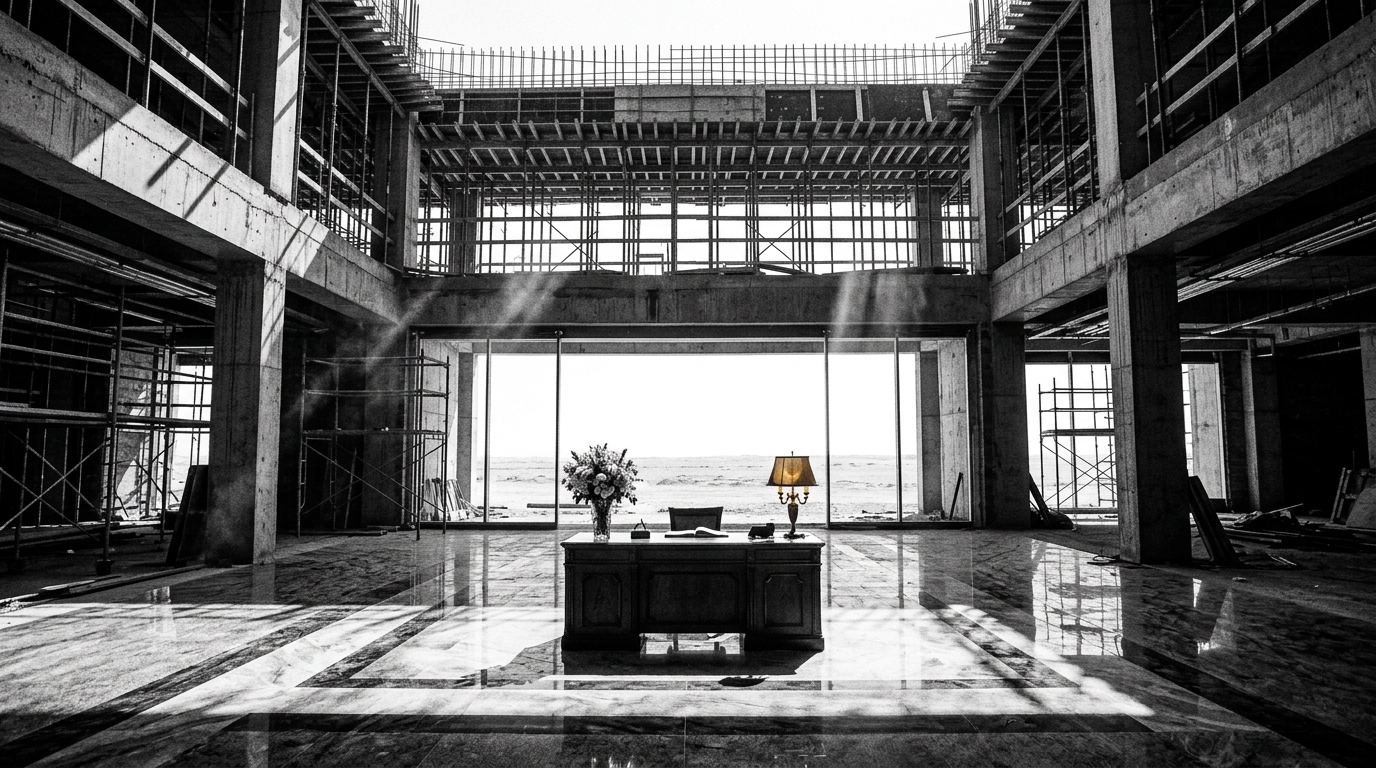
Marriott Just Opened a W in Riyadh. The RevPAR Decline They're Not Talking About Is the Real Plot.
Marriott is planting flags across Saudi Arabia at a pace that makes even the most aggressive franchise developers blink. But when your Middle East RevPAR drops 30% in a single quarter while you're signing deals for 1,300 new rooms, the question isn't whether you believe in the market... it's whether the market believes in the timeline.
I grew up watching my dad build relationships with brand teams who sold him a future. Beautiful renderings. Projected occupancies that made the investment look like a no-brainer. Loyalty contribution numbers that justified every dollar of the PIP. And then reality showed up, and reality didn't look anything like the PowerPoint. So when I see Marriott opening the W Riyadh with 210 keys in the King Abdullah Financial District, signing a 10-hotel deal with a Riyadh-based developer for 1,300 more rooms, inking another agreement for a 464-key Westin in Abha, and announcing five properties in Jeddah, Makkah, and Madinah adding 2,700 rooms... all within the span of about six months... I don't see ambition. I see a franchise machine running at full speed toward a finish line that keeps moving. And I want to know who's holding the risk when the music changes tempo.
Here's the part that should make every development partner in that region pause and do some math. On Marriott's own Q1 2026 earnings call, leadership disclosed that Middle East RevPAR declined over 30% in March. They projected a 50% reduction in Q2. The region accounts for 3% of Marriott's open rooms and 7% of its pipeline... which means the pipeline is growing more than twice as fast as the existing footprint, in a region where current performance is contracting. I've read hundreds of FDDs and sat through more franchise sales presentations than I can count, and this is a pattern I recognize instantly. The development team is selling the 2030 story. The operations team is living the 2026 reality. Those two teams are not in the same meeting, and they are definitely not looking at the same numbers.
Saudi Arabia's Vision 2030 is enormous... 150 million annual visitors, 320,000 new hotel rooms, $37.8 billion in development cost, tourism pushed to 10% of GDP. And I'm not here to say it won't work. It might. The government is spending over $550 billion on infrastructure and giga-projects, and that kind of sovereign capital can will things into existence that market forces alone never would. But "can" and "will" and "on schedule" are three very different words, and I have watched enough brand expansions into aspirational markets to know that the distance between a signed agreement and a profitable operating hotel is where families lose their shirts. The developer in Riyadh signing up for 10 hotels through 2030 with a mandate to allocate 60% of 6,000 new jobs to Saudi nationals... that's not just a hospitality play. That's a workforce development obligation baked into a hotel deal. The staffing complexity alone should give anyone pause. (And if you think brand-mandated staffing ratios are hard in the U.S., try building a luxury service culture from scratch in a market where the hospitality talent pipeline is still being constructed.)
What I keep coming back to is the Deliverable Test. Can these brands... W, Westin, St. Regis, JW Marriott, Moxy, Courtyard, Residence Inn, Autograph Collection, Four Points, Element... can they deliver their brand promises in these specific markets, at these specific price points, with this specific labor force, on this specific timeline? The W brand in particular is one of the most experience-dependent flags in Marriott's portfolio. It requires a specific energy, a specific service personality, a specific F&B concept that isn't just a restaurant with a DJ booth. Can the team in Riyadh execute that on a Wednesday at 11 PM with a front desk team that may include associates who are new to hospitality entirely? That's not skepticism. That's the question every owner should be asking before the construction loan closes. Because the brand promise and the brand delivery are two different documents, and I have a filing cabinet full of FDDs that prove it.
The opportunity is real. I'm not dismissing that. Saudi Arabia is building something unprecedented, and the operators and developers who get in early with the right capital structure and realistic expectations will do very well. But "realistic expectations" means stress-testing against a scenario where the 150 million visitors arrive in 2033 instead of 2030, where RevPAR takes three years to recover from its current dip instead of one, where the giga-projects open in phases rather than all at once. If your deal only works in the base case... the vision-on-schedule, RevPAR-recovers-quickly, loyalty-contribution-hits-projection case... then you don't have a deal. You have a hope. And I've watched hope destroy people who trusted it.
Here's what I'd say to anyone evaluating a Marriott development opportunity in the Middle East right now. The Vision 2030 story is compelling. The capital behind it is real. But you need to run your pro forma against a revenue ramp that's 18-24 months slower than whatever the franchise sales team is projecting, because Marriott's own earnings call just told you the region is down 30-50% on RevPAR this year. If your deal survives that scenario and still pencils, you might have something. If it doesn't... you're betting on a timeline you don't control, with a brand that collects fees whether you hit your NOI target or not. Ask for actual performance data from comparable openings in the region, not projections. And if they can't give it to you... that's your answer.