World Cup Hotel Guides Are Travel Porn. Here's What's Actually Coming.
Everyone's publishing where to stay for 2026. Nobody's talking about what happens inside those hotels when 400,000 fans show up at once.
I read another one of these World Cup hotel recommendation lists this morning. This one's for fans following the Latin American teams — nice little guide, tells you which cities host which groups, suggests some IHG and Marriott properties near the stadiums, gives you the vibe.
It's fine. It's also completely useless for anyone who actually runs a hotel.
Here's what nobody's telling you: the 2026 FIFA World Cup is going to hit North American hotels like a category five hurricane, and most properties in host cities are sleepwalking into it. Eleven U.S. cities. Three Mexican cities. Two Canadian cities. Forty-eight teams for the first time ever. Matches running from June 11 to July 19 — five and a half weeks of sustained, rolling demand across the continent. And travel publications are publishing curated lists of where to book a room like this is a long weekend in Napa.
I've run properties through Super Bowls, through UFC fights, through New Year's Eve on Fremont Street when 40,000 people materialized in six blocks. I've managed events at the Downtown Las Vegas Events Center with 11,000 capacity and watched what happens to the surrounding properties when the crowd spills out. None of that is comparable to what's coming. This is sustained, multi-week, multi-city, international-scale demand hitting hotels that are already running lean on staff and tight on patience.
Let me paint the picture that this travel article doesn't.
You're a GM at a 300-key full-service in Dallas or Miami or Houston. Your booking pace for June 2026 is already climbing. Revenue management is licking their chops — dynamic pricing, minimum stays, premium packages. Your ownership group sees the RevPAR projections and starts doing math on a cocktail napkin.
Nobody's asking the question that matters: Do you have the team to deliver?
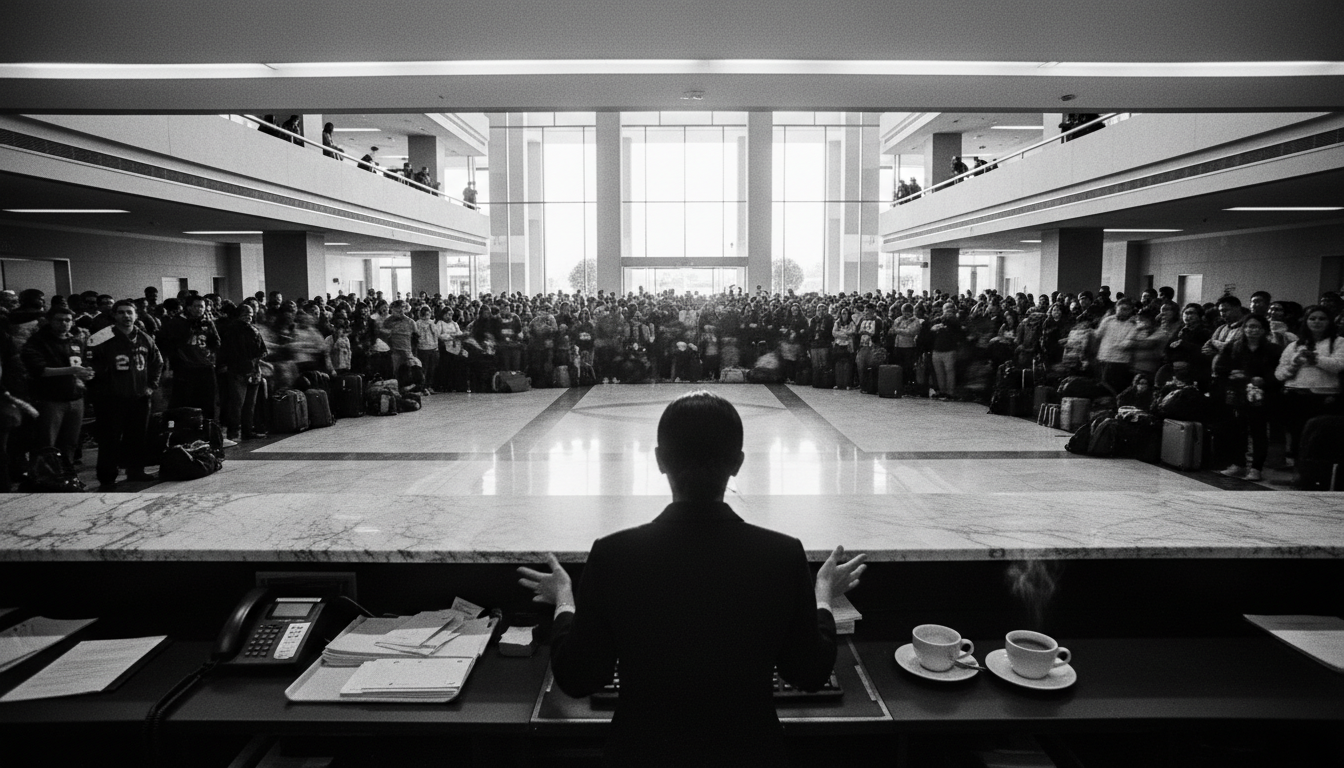
Because here's what happens. You're going to sell every room at rates you've never charged before. You're going to fill your restaurant, your bar, your lobby, your parking garage. You're going to have guests from Argentina and Brazil and Mexico and Ecuador — passionate, emotional, traveling-in-packs soccer fans who are here for the experience of a lifetime. They're not here for your loyalty points. They're here because their country is playing, and this might be the only World Cup they ever attend.
And your housekeeping team is 30% short-staffed because it's been 30% short-staffed since 2021. Your front desk is running two agents when it needs four. Your F&B operation hasn't been fully staffed in three years. Your engineering team is held together by one guy named Carlos who knows where every valve is and hasn't taken a vacation since the pandemic.
You're about to charge $400 a night and deliver a $189 experience.
I've seen this movie before. I saw it at Hooters when we were bankrupt and still selling every room on fight nights. The revenue looked great on paper. The guest experience was a disaster — because we didn't have the infrastructure to support the demand. It took a full operational turnaround before we could actually capture the revenue that was walking through our doors. Revenue without delivery isn't revenue. It's a future refund and a one-star review.
The article recommends properties near stadiums in cities like Miami, Dallas, Houston, Atlanta, and others hosting Latin American teams. Smart advice for the fan. But it doesn't mention that these host cities are about to experience something most American hotel markets have never dealt with: sustained international event demand over weeks, not days. A Super Bowl is one weekend. The World Cup is 39 days of matches across the continent, with fan zones, watch parties, and cultural activations running continuously.
What does that mean operationally?
First — staffing. You can't surge-hire quality hospitality workers for five weeks. You need to be building your bench NOW. Not in March 2026. Now. Every GM in a host city should be identifying their strongest hourly team members and cross-training them for the roles that will need surge capacity. Your best bartender should know how to run a banquet bar. Your strongest front desk agent should be able to step into concierge. This isn't about hiring — it's about developing what you already have.
Second — language. A significant portion of your guests will be Spanish-speaking, Portuguese-speaking, traveling internationally. If your front desk can't communicate with your highest-paying guests, you've already failed. I'm not talking about a translation app on an iPad. I'm talking about having actual bilingual staff scheduled during peak hours. At the Golden Gate, when we started attracting international tourists to Fremont Street, one of the first things I did was identify every bilingual team member and build schedules around them. It wasn't a program. It was common sense.
Third — F&B. Your hotel restaurant menu was designed for business travelers and tourists. You're about to host passionate fans who want to eat and drink for six hours before a match and six hours after. Your current F&B operation isn't built for that volume or that energy. If you're smart, you're planning outdoor activations NOW — temporary bars, food stations, watch party setups. Turn your dead pool deck into the hottest fan zone in the city. I did this exact thing at Hooters with 40,000 tons of sand and a DJ stage. The pool broke even. Gaming revenue jumped 21%. Because I gave people a reason to be on the property that wasn't just a bed.
Fourth — and this is the one that keeps me up at night — guest experience consistency. You're going to have fans whose team just won and fans whose team just lost staying on the same floor. You're going to have noise complaints at 3 AM. You're going to have lobby celebrations that look like a street party. You need a plan for this. Not a memo — a plan. Dedicated floors for group bookings. Security staffing that matches the energy. Clear noise policies communicated at check-in. And — here's the part most GMs won't want to hear — some grace. These people saved for years to be here. The GM who treats a jubilant crowd like a nuisance is the GM who's going to get destroyed on social media.
Fifth — partnerships. Every host city is going to have official fan zones, cultural events, and watch parties. If you're not already reaching out to your local organizing committee, your CVB, and your city's tourism office, you're going to miss the wave. The properties that win in 2026 won't be the ones closest to the stadium. They'll be the ones that become part of the experience. When I was at the Golden Gate, we had 122 rooms and the Golden Nugget had 2,400. We won by putting everything outside — by making ourselves part of the street, part of the experience, part of the energy. You can do that with a 150-key select-service if you think like a producer instead of a property manager.
Travel articles will keep publishing hotel recommendation lists. They're fine for the guest. But if you're on the other side of the front desk — if you're the one who has to deliver what that guest is expecting — you need to start thinking about this differently.
This isn't a rate opportunity. It's an operations test. And the grade is permanent — because every one of those international guests is going to post about their experience in real time, in multiple languages, to audiences your marketing team has never reached.
You either rise to the moment or you become the cautionary tale.
I know which one I'd choose. But I'd be planning it right now. Not next quarter. Not when the booking pace report gets scary. Right now.
GMs in World Cup host cities — Dallas, Miami, Houston, Atlanta, Seattle, all sixteen of them — stop looking at your June 2026 pace report like it's Christmas morning. That revenue means nothing if you can't deliver the experience behind it. Start cross-training your best people today. Identify every bilingual team member on your roster this week and build your summer '26 schedules around them. Call your CVB and ask what fan zone activations are being planned within a mile of your property. And for the love of God, start thinking about your F&B capacity now — because your 80-seat restaurant isn't going to cut it when 200 Argentine fans want to eat after a match. Build the outdoor activation. Plan the watch parties. Be the destination, not just the room. I turned a 122-room property into the loudest block on Fremont Street with flair bartenders and a snow machine. You can turn your pool deck into the best fan zone in your city with a screen, some speakers, and a beverage program that doesn't run out at halftime. The properties that win the World Cup won't be the ones that charged the most. They'll be the ones people talk about for twenty years after.